A blockchain API is the layer between your code and a public ledger. It reads chain state, indexes history, signs transactions or moves value between chains. Blockchains process about 3,400 transactions per second, per a16z’s State of Crypto 2025.
No single provider covers all of that. Production teams often combine four or five APIs. The hard part is knowing which API owns which job.
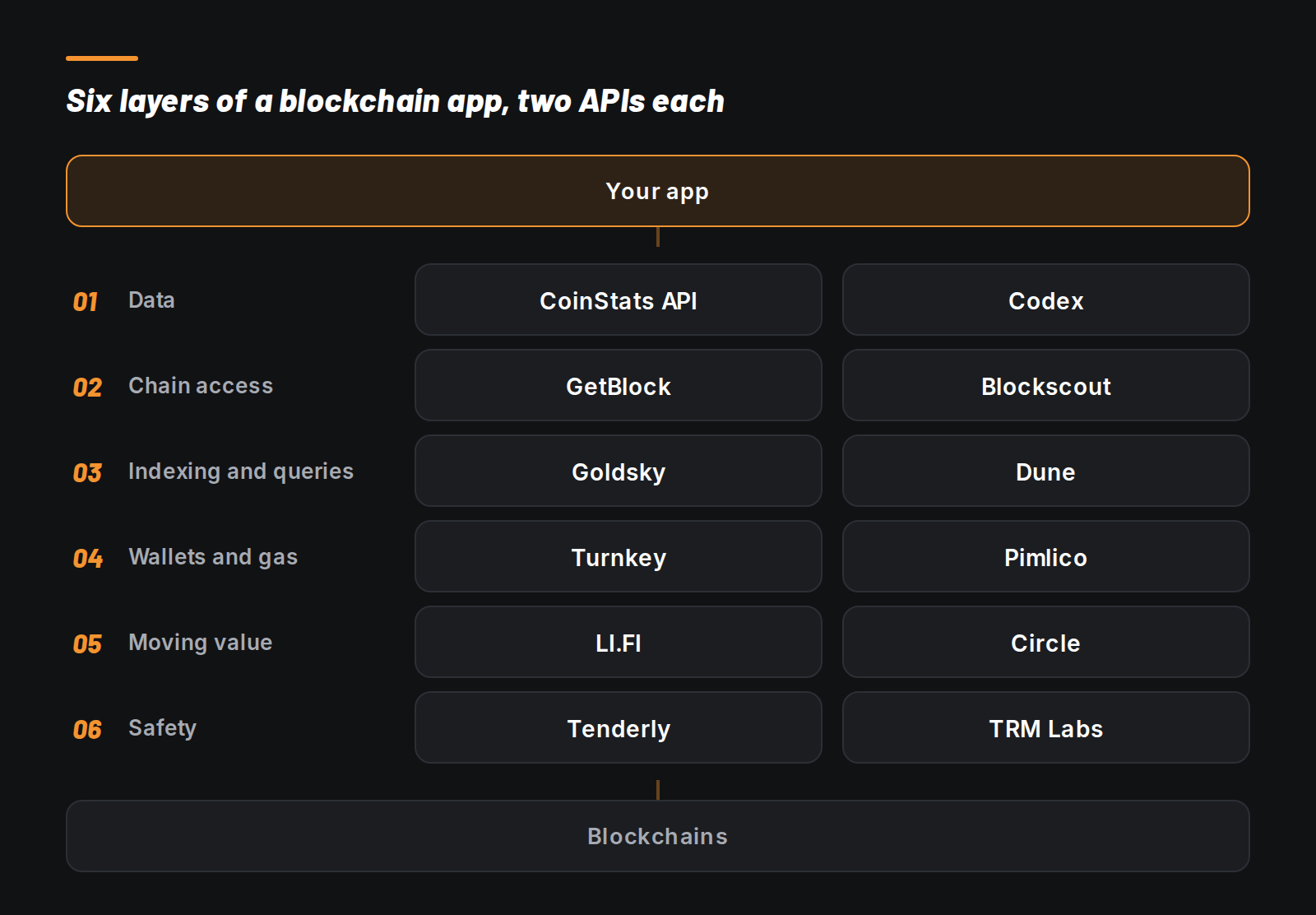
This expert review sorts the best blockchain APIs for developers into six layers. Each layer gets two picks, twelve in total. Pricing, free tiers and limits were checked in October 2026.
CoinTURK’s earlier guides ranked crypto APIs for AI agents and trading bots. They also covered the best Ethereum APIs. This one maps the full stack under a multichain app.
What Is a Blockchain API?
A blockchain API turns raw ledger data into calls an app can make. At the bottom sits RPC, the JSON-RPC interface that nodes expose to apps. Every layer above it adds interpretation, speed or a new ability.
A production app touches six layers:
- Data APIs return prices, balances and DeFi positions, already decoded and priced.
- Chain access covers RPC nodes and explorer APIs for raw or indexed ledger state.
- Indexers and query engines turn contract events into tables you can search.
- Wallet infrastructure creates keys, signs transactions and sponsors gas for users.
- Value-moving APIs route swaps and transfers between chains.
- Safety APIs simulate a transaction before it lands and screen the addresses involved.
BlockExplorer.one’s best crypto APIs guide uses three layers: chain access, data and execution. This review splits the write side further, into wallets, value movement and safety.
The demand is broad. a16z’s State of Crypto 2025 counts about 181 million monthly active addresses onchain. Every address an app touches needs a read layer, a write layer, or both.
How We Picked These 12 Blockchain APIs
Six tests decided this list. Each one catches a failure that a feature list hides.
- Coverage: the exact product works on your chains, not just a headline count.
- Billing unit: credits, compute units, requests and signatures are four different meters.
- Free path: a free tier, trial credit or testnet you can build on.
- Agent access: an MCP server, the connector standard AI agents use, or pay-per-call payments.
- Production signals: published limits, uptime commitments, audits or named customers.
- Liveness: every provider shipped product updates in 2026 and documents them publicly.
Agent access now matters as much as uptime. 24% of developers design APIs for AI agents, per Postman’s 2025 API report. 84% of developers already use or plan to use AI tools (Stack Overflow, 2025).
Fewer vendors also means fewer failure points. Supratip Banerjee makes that case in his dev.to guide to crypto APIs:
“If I had to pick one API to start with for a general crypto app, it’d be CoinStats. The main reason: you don’t have to stitch three things together to get a working product.”
Supratip Banerjee, writing on dev.to
Blockchain API Comparison at a Glance
Every API below is compared on the same six columns. Prices are list prices for monthly billing unless noted.
| # | API | Layer | Best for | Free tier | Paid from | Agent access |
|---|---|---|---|---|---|---|
| 1 | CoinStats API | Data | Wallet, DeFi and market data in one key | 20,000 credits a month | $49 a month | MCP Server, x402 |
| 2 | Codex | Data | Real-time token and prediction-market data | 10,000 requests a month, $1 activation | $350 a month | MCP server, x402, MPP |
| 3 | GetBlock | Chain access | RPC nodes on 127 chains | 50,000 compute units a day | $49 a month | Docs MCP server |
| 4 | Blockscout | Chain access | Explorer data on 100+ EVM chains | 100,000 credits a day | $49 a month | MCP server, x402 |
| 5 | Goldsky | Indexing | Subgraphs and streaming pipelines | $100 one-time credit | Pay as you go | Agent skills |
| 6 | Dune | Indexing | SQL over decoded chain data | View-only, no API | $75 a month | MCP server |
| 7 | Turnkey | Wallets | Key management and signing | 25 signatures a month | $99 a month | Docs MCP server |
| 8 | Pimlico | Wallets | Gas sponsorship for smart accounts | 10M credits a month, card needed | $1 per 100,000 credits | CLI for agents |
| 9 | LI.FI | Moving value | Cross-chain swaps and bridges | Free to integrate | Enterprise on request | MCP server |
| 10 | Circle | Moving value | USDC transfers and wallets | 1,000 active wallets a month | $0.038 per wallet | Docs MCP, Agent Stack |
| 11 | Tenderly | Safety | Simulation and debugging | Browser only, no API | Custom contract | MCP server |
| 12 | TRM Labs | Safety | Sanctions screening | 100 screens a day | Enterprise on request | Docs MCP server |
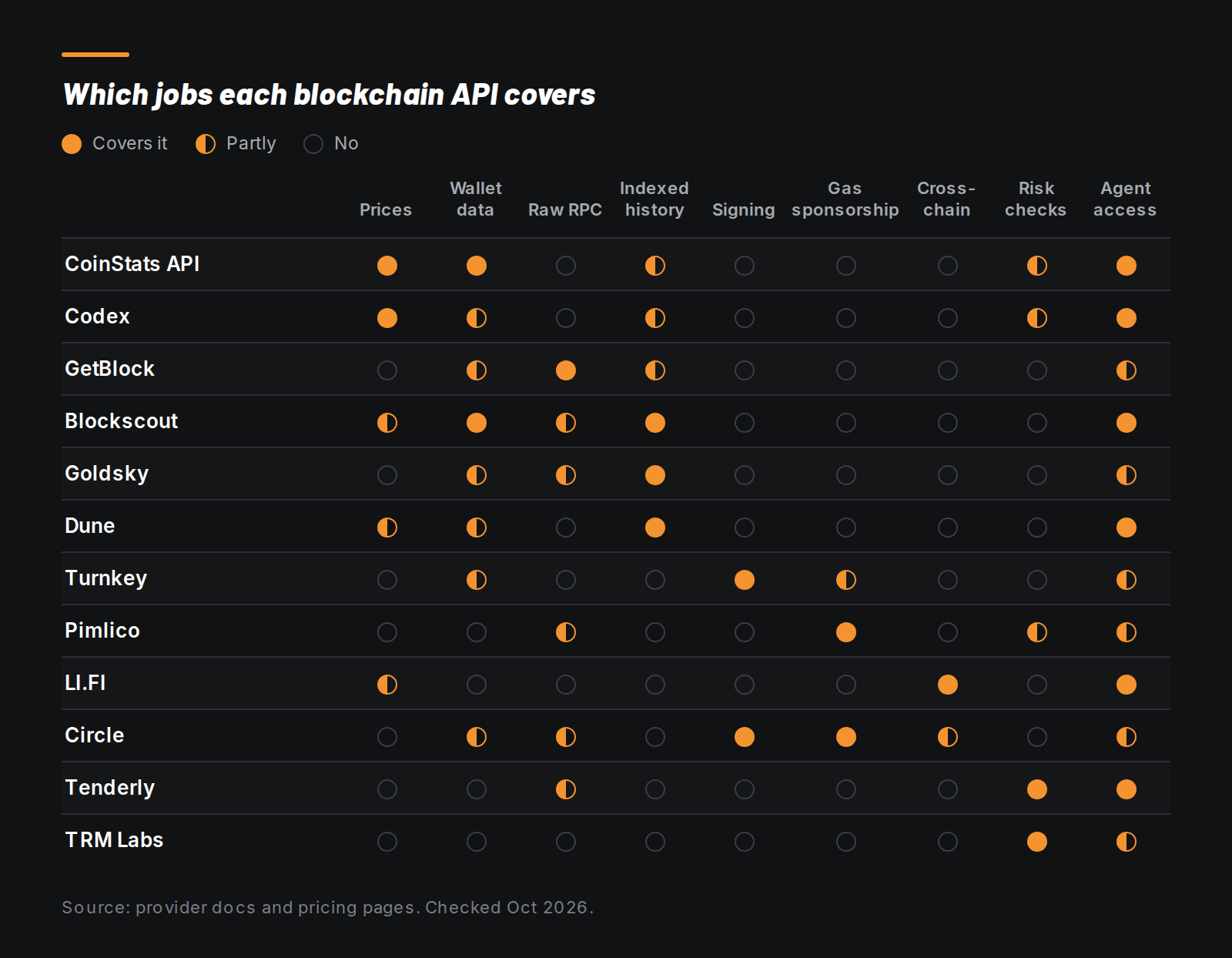
The matrix shows which jobs each API covers fully, partly or not at all.
What the Free Tiers Actually Cover
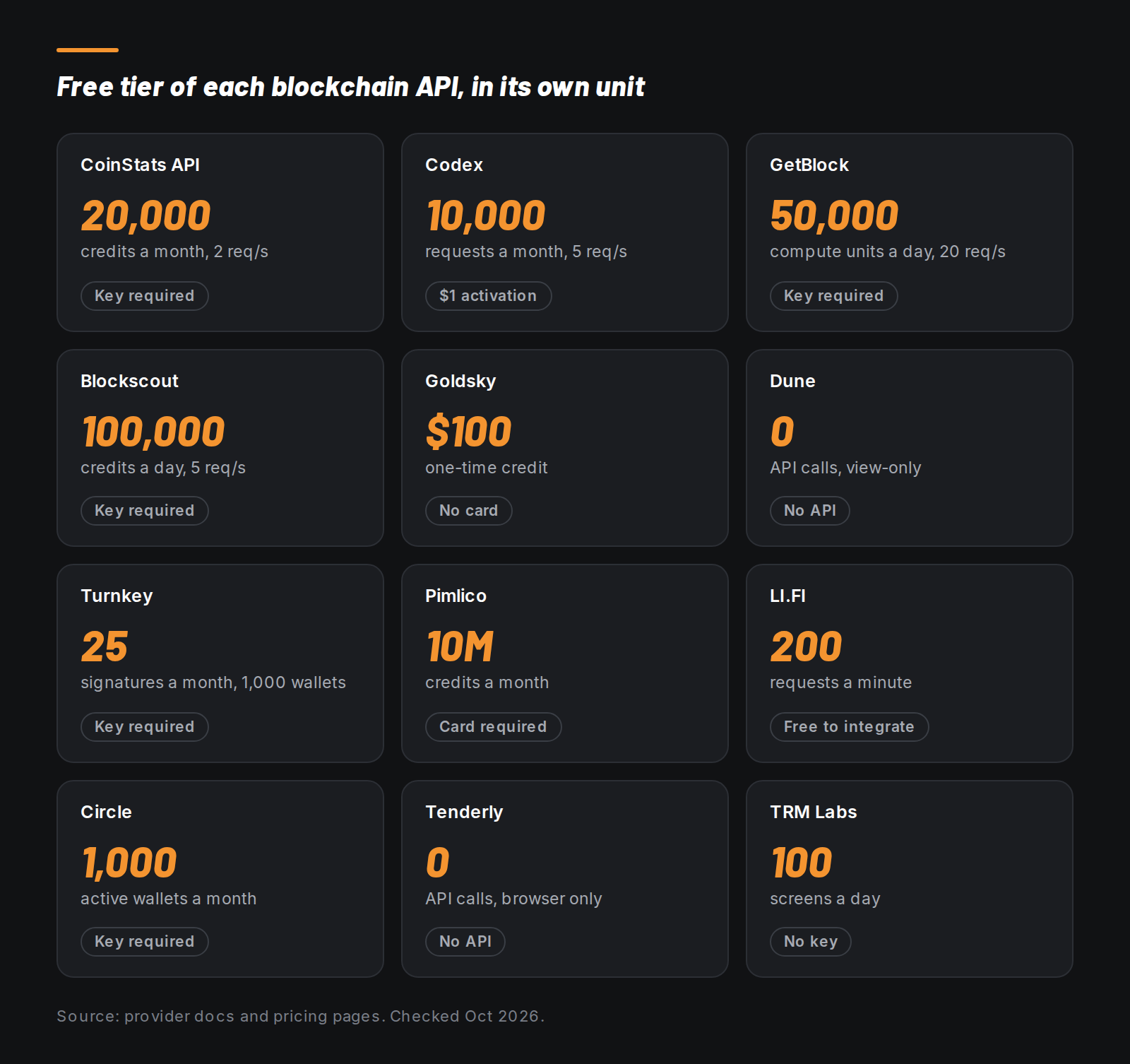
Free tiers measure different things, so headline numbers mislead. CoinStats API gives 20,000 credits a month. GetBlock gives 50,000 compute units a day.
Dune and Tenderly include no free API access. Pimlico and Circle meter by operation or active wallet instead.
What You Pay After the Free Tier
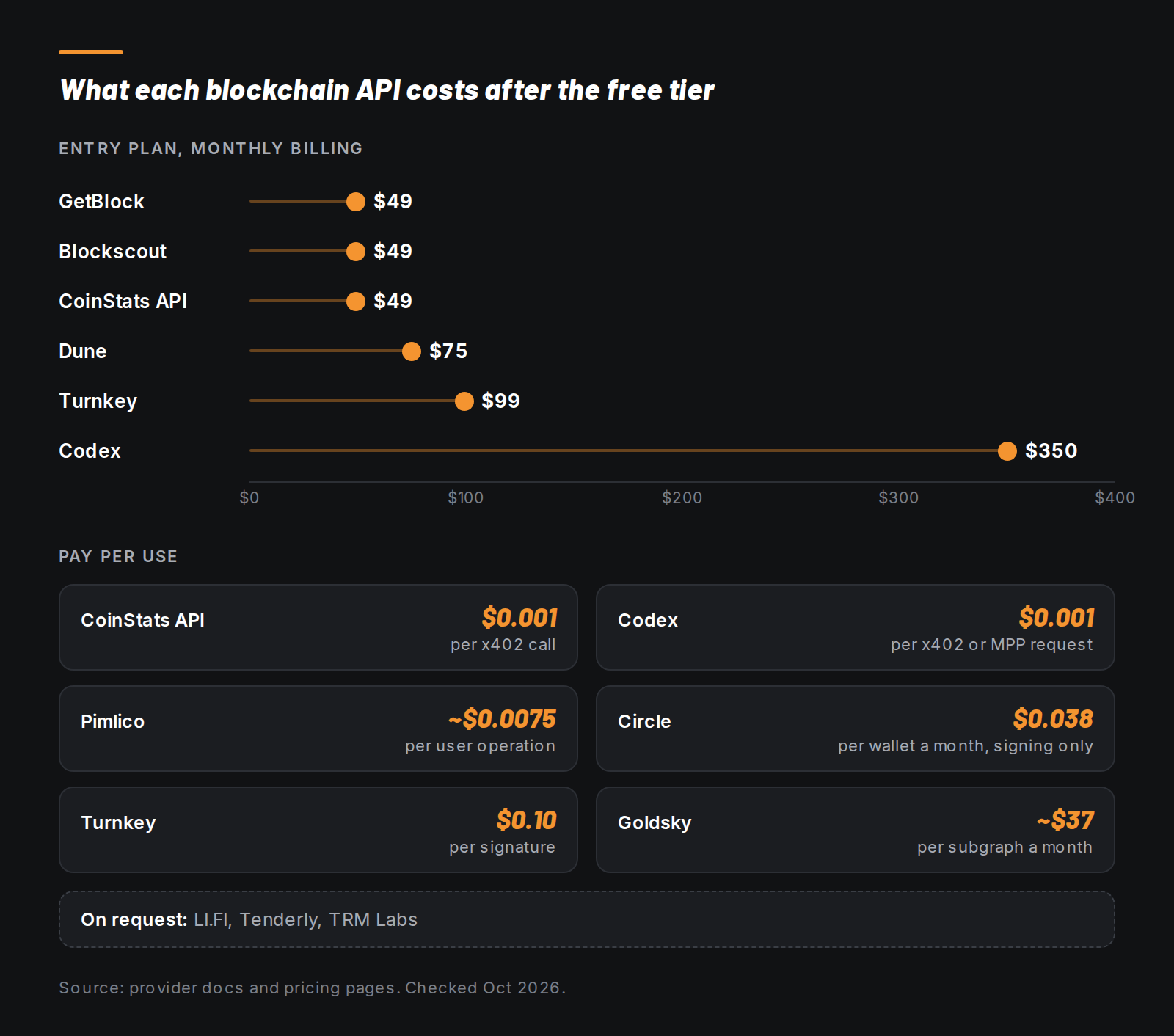
Entry plans for data and chain access cluster at $49 a month. Codex starts at $350, the highest self-serve entry here.
Turnkey, Pimlico, Circle and Goldsky also meter per use. LI.FI, Tenderly and TRM Labs quote production plans on request.
1. CoinStats API
CoinStats crypto API is the all-in-one crypto API at the data layer. One key returns market data, wallets, DeFi positions, portfolio analytics and token security. That makes it the best fit for most crypto use cases on this list.
Coverage and Portfolio Data
Market data spans 100,000+ coins and 200+ exchanges, Binance, Coinbase and Hyperliquid included. Wallet reads cover 120+ blockchains, including Ethereum, Solana and Bitcoin.
Bitcoin support takes xpub, ypub and zpub keys. One extended key resolves a whole HD wallet.
DeFi positions resolve per wallet across 10,000+ protocols, with no protocol-by-protocol setup. Staking, lending, LP shares and borrowing come back priced in USD. Of the 12 APIs here, only CoinStats API resolves DeFi protocols to per-wallet positions.
Portfolio endpoints return cost basis, realized and unrealized profit and loss, and allocation. Cash-flow-adjusted P&L history landed in September 2026. Real-world asset endpoints for tokenized stocks, commodities and ETFs arrived in October.
The Token Risks endpoint scores EVM token contracts from 0 to 100. It flags honeypots, hidden fees, mint authority and upgradeable proxies. Connected exchange accounts, such as Binance and Coinbase, sync balances and P&L too.
MCP Server and AI Agents
CoinStats MCP Server exposes 20+ tools to Claude, ChatGPT, Cursor and n8n. An agent can read a user’s balances, positions and P&L, not just prices.
Agents can also pay per request through the x402 payments standard. Calls start at $0.001, paid in USDC on Base.
Pricing and Access
The free tier gives 20,000 credits a month at 2 requests per second. Commercial use is included, and no card is needed. Starter costs $49 for 1,000,000 credits at 30 requests per second.
Pro is $199 for 5,000,000 credits, and Business is $999 for 80,000,000. Credits are weighted: a price call costs 1 to 2, a wallet balance 40. DeFi positions cost 400 credits on paid plans, and Token Risks costs 5,000.
CoinStats’ own app runs on the same infrastructure, with 1M+ users every month. For a deeper breakdown, see this best crypto API guide.
In a simple way: CoinStats API = market data + wallets + DeFi + portfolio analytics + token security.
Best for: Any crypto product requiring market data, wallet balances, DeFi positions, portfolio analytics, and token security.
Watch out for: There is no WebSocket or webhook feed, so live views poll. It reads data and does not broadcast transactions. Pair it with an RPC provider.
2. Codex
Codex.io is an enriched blockchain data API built on two pillars: tokens and prediction markets. One API returns real-time token prices, OHLCV charts, holder analytics and wallet balances. Coverage spans 106M+ tokens, 2B+ wallets and 80+ networks, EVM and Solana included.
Codex reports sub-second data freshness and a 99.9% uptime SLA. The prediction-market side covers Polymarket, Kalshi and more. It returns odds, volume, trending events and trader analytics in the same schema.
Delivery runs over GraphQL, with WebSocket subscriptions and webhooks for live feeds. Agents use a TypeScript SDK, an MCP server and $0.001 x402 or MPP payments. TradingView, MoonPay, Uniswap and Pump.fun build on it.
The “Almost free” plan gives 10,000 requests a month after a one-time $1 activation. It covers token prices, charts, pair stats, search and trending tokens.
Growth starts at $350 a month for 1M requests. It adds WebSockets, webhooks and wallet data.
Best for: Terminals, screeners and bots that need tick-level DEX and prediction-market data.
Watch out for: Codex skips Bitcoin and does not decode DeFi positions. Pair it with a portfolio layer like CoinStats API for those.
3. GetBlock
GetBlock.io sells node access, the layer under everything else. It was founded in 2019 and is headquartered in Singapore. Its catalog lists 127 chains: 97 on shared endpoints and 124 as dedicated nodes.
Access runs over JSON-RPC, REST, WebSocket, GraphQL and, on Solana, gRPC. This is direct chain access, so you decode responses yourself. That is the point for archive reads, tracing and transaction broadcast.
Throughput keeps climbing. Solana logged 216 million non-vote transactions in one day, per the Solana Foundation. It came during a record August for the network.
Three extras stand out. EVM Data Streams push 15 event topics over WebSocket. A Blockbook API, included at no extra cost, serves Bitcoin balances, histories and xpubs.
StreamFirst and LandFirst speed up Solana reads and transaction landing on dedicated nodes. GetBlock completed a SOC 2 Type II attestation in Q2 2026. Its September case studies show dedicated clusters running for Tangem and Trust Wallet.
The free plan gives 50,000 compute units a day at 20 requests per second. Starter costs $49 a month, or $39 billed annually, for 90 million units. Dedicated nodes start at $1,000 a month with unlimited requests.
AI tooling is thinner here. It offers a docs MCP server and an open-source RPC MCP server. GetBlock’s blog also compares the crypto swap exchanges that wallets like these plug into.
Best for: Wallets, indexers and bots that need raw chain access across many networks.
Watch out for: Raw responses need decoding. Heavy and archive calls burn more units, and full archive starts on Starter.
4. Blockscout
Blockscout.com is the open-source block explorer behind 100+ L2s and scaling projects. Its PRO API serves that decoded data across 100+ EVM chains with one key. Since July 1, 2026, all Blockscout API traffic runs through PRO API keys.
It returns transaction history, token balances, contract data and ENS names. Access runs over REST and JSON-RPC, in Etherscan’s v2 format. Switching from Etherscan means changing the base URL and the key.
An official MCP server connects AI agents, and x402 allows keyless pay-per-call on Base. CoinTURK’s Ethereum API guide covered Etherscan. Blockscout is the open-source route to similar data.
The free tier gives 100,000 credits a day at 5 requests per second. It covers every chain, with no card needed. Builder costs $49 a month for 100 million credits at 15 requests per second.
Pro costs $199 for 500 million credits. Business costs $999 for 3 billion credits at 50 requests per second.
Best for: Wallets, explorers and dApps reading EVM history across many L2s.
Watch out for: Coverage is EVM only, with no Solana or Bitcoin. Responses are explorer data, not priced portfolio views.
5. Goldsky
Goldsky.com indexes blockchain data two ways: subgraphs and streaming pipelines. Subgraphs serve contract events over GraphQL and stay compatible with The Graph’s tooling. Instant subgraphs need only a contract address and its ABI, with no mapping code.
Turbo pipelines, the successor to Mirror, stream chain data into your own database. Chain reorganizations, when recent blocks get rewritten, propagate to your tables. Goldsky lists 150+ supported chains.
Every new team gets $100 in one-time Starter credits, with no card required. On the pay-as-you-go Scale plan, three always-on subgraphs are free. Each extra subgraph costs about $37 a month in worker hours.
Agent skills help Claude Code, Cursor and other coding assistants build and debug pipelines. Feeds, a newer Goldsky API, returns wallet transfers and balances on seven EVM chains.
Best for: Dashboards and apps that need custom event data in their own database.
Watch out for: You still design the schema and mappings for custom subgraphs. Starter resources pause once the credit runs out.
6. Dune
Dune.com turns decoded chain data into SQL tables you can query. The Dune API runs saved queries and returns the results to your backend. An official Dune MCP server lets AI agents run the same analytics.
Free access is now view-only, with no API. Dune moved older free accounts to view-only on September 10, 2026, citing compute costs. New accounts get a 14-day trial with 2,500 credits.
Analyst costs $75 a month, or $65 billed annually, for 4,000 credits. Plus costs $399, or $349 annually, for 25,000 credits and higher API limits. Credits track compute used, so heavy queries cost more.
Best for: Research, protocol analytics and backend reports that need custom SQL across chains.
Watch out for: There is no free API anymore. Results are as fresh as the last query run, not live chain state.
7. Turnkey
Turnkey.com is wallet infrastructure: create wallets, sign transactions and set policies through one API. Raw private keys stay inside secure enclaves, hardware-isolated environments. Turnkey says keys are never exposed to Turnkey, your software or your team.
Transactions are signed in under 100 milliseconds. A policy engine enforces limits, permissions and multi-sig approvals inside the enclave. Embedded wallets log users in with passkeys, email or social accounts, without seed phrases.
Server wallets and agent wallets run automated flows under the same policies. Policy limits matter as AI agents open new attack paths. Moonshot uses Turnkey wallets, and World App keeps recovery keys in its enclaves.
Pay as You Go starts free, with 1,000 wallets and 25 monthly signatures. Extra signatures cost $0.10 each. Pro costs $99 a month, with $0.05 signatures and up to 2,000 wallets.
Enterprise signatures drop as low as $0.0015 each. A docs MCP server, agent skills and a CLI cover AI coding tools.
Best for: Embedded wallets, trading apps and AI agents that sign without raw keys.
Watch out for: Signature fees add up at high volume on self-serve plans. Gas sponsorship sits on Enterprise.
8. Pimlico
Pimlico.io runs the bundlers and paymasters behind ERC-4337 smart accounts. ERC-4337 is the Ethereum standard for smart contract wallets, also called account abstraction. A bundler submits user operations, and a paymaster pays their gas.
Founder Kristof Gazso co-authored ERC-4337. Pimlico paymasters sponsor gas on 100+ EVM chains, and Solana sponsorship is live. Users can also pay gas in ERC-20 tokens instead of the native coin.
Pimlico documents 22 smart account and signer integrations behind one API. Safe, Kernel and MetaMask Smart Accounts are among them. Webhooks let your server approve each sponsorship before it happens.
Pay-as-you-go has no monthly fee, but it needs a card. It includes 10 million credits a month, then $1 per 100,000. That is about $0.0075 per user operation.
Sponsored mainnet gas carries a 10% surcharge, and testnets are free. The Pimlico CLI lets coding agents check balances, failed operations and keys.
Best for: Wallets and dApps that want gasless onboarding and smart account features.
Watch out for: On EVM, Pimlico handles ERC-4337 calls only. Standard RPC traffic still needs a node provider.
9. LI.FI
LI.FI is a routing and execution API for cross-chain swaps and transfers. One integration reaches DEX aggregators, intent solvers and bridges across 60+ chains. Coverage includes Solana, Bitcoin, Sui, Tron and Stellar alongside EVM chains.
Swap sources include 1inch, Odos and Uniswap. Bridges include Relay, Stargate, Across and Mayan. LI.FI reports $80B+ in total transfer volume across 1,000+ partners.
It ships as an API, SDK or widget. A hosted MCP server and a CLI cover AI agents.
The Standard plan is free to integrate, at up to 200 requests a minute. Built-in tools let partners collect their own fee on routed volume. Enterprise adds custom limits, SLAs and volume discounts on swap fees.
Best for: Wallets and dApps adding cross-chain swaps without integrating each bridge.
Watch out for: Routes depend on third-party bridges and solvers. Build status tracking into the flow.
10. Circle
Circle.com issues USDC and offers developer APIs for moving it. CCTP, its Cross-Chain Transfer Protocol, burns USDC on one chain and mints it elsewhere. No wrapped tokens are involved.
CCTP supports 30+ blockchains, including Ethereum, Solana, Base and Circle’s own Arc. Gateway gives one USDC balance across chains. Paymaster lets users pay gas in USDC, and Gas Station lets you sponsor it.
Circle Wallets creates developer-controlled, user-controlled or modular smart contract wallets. The Agent Stack adds agent wallets, a CLI and gas-free nanopayments down to $0.000001. A Circle MCP server gives coding tools live SDK signatures and contract addresses.
The first 1,000 monthly active wallets are free each month. After that, wallets cost $0.038 each for signing only, or $0.05 all-included. Both rates fall with volume.
Best for: Payments, payouts and treasury apps built on USDC across many chains.
Watch out for: Circle moves its own stablecoins, not arbitrary tokens. Pair it with LI.FI for other assets.
11. Tenderly
Tenderly.co now calls itself the simulation company for onchain operations. Its Simulation API dry-runs a transaction before it lands. Results include decoded traces, gas estimates and balance changes.
Virtual Environments fork mainnet state for testing, with state overrides and historical replay. The debugger shows call traces, gas profiles and full error stacks. Pimlico links failed operations straight to Tenderly traces.
A Tenderly MCP server exposes 59 tools across 100+ EVM networks. Agents can simulate, trace and inspect contracts from a chat window.
Tenderly Free is free indefinitely, with no card, but browser-only. API access needs a Tenderly Console contract, sized per team.
Best for: Teams that must catch failed or malicious transactions before users sign them.
Watch out for: There is no public self-serve API price. Coverage is EVM chains only.
12. TRM Labs
TRMLabs.com is a blockchain intelligence firm with a free sanctions screening API. The TRM Sanctions API checks whether addresses have sanctions exposure. OFAC publishes sanctioned crypto addresses in its SDN list.
Without a key, the API allows 1 request a second and 100 a day. A requested API key lifts that to 1,000 a second and 100,000 daily. The Chainabuse public API adds community scam reports on addresses, tokens and domains.
Full wallet screening and transaction monitoring sit in TRM’s enterprise platform, priced on request. A docs MCP server gives coding agents current API documentation.
Best for: Wallets, exchanges and payment apps that must block sanctioned addresses.
Watch out for: The free API covers sanctions only, not full risk scoring.
How the 12 APIs Fit Into One Transaction
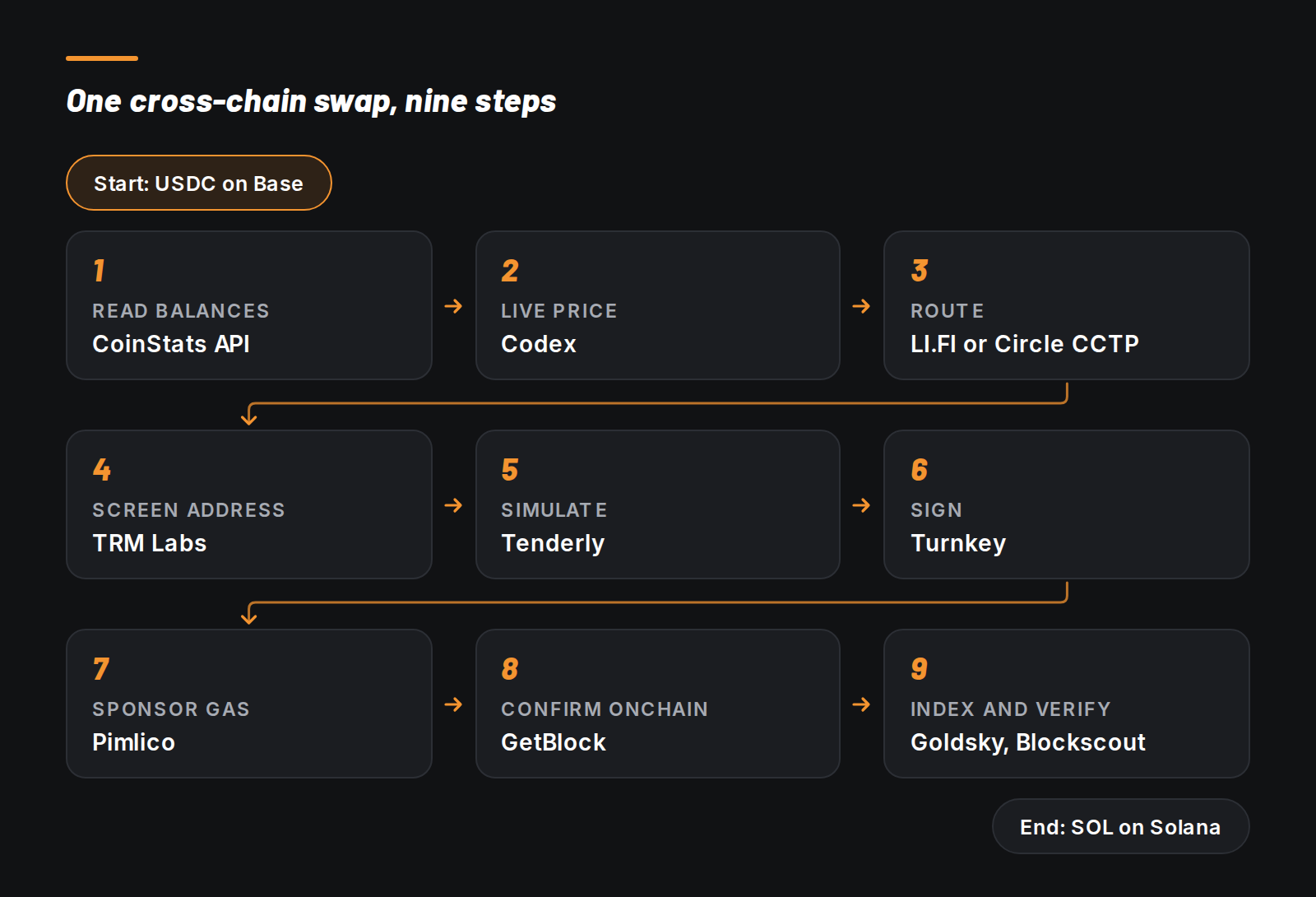
Picture a user swapping USDC on Base for SOL from an embedded wallet. The swap takes nine steps.
- CoinStats API reads the user’s balances, positions and P&L.
- Codex streams the live SOL price to the quote screen.
- LI.FI quotes the cross-chain route, or Circle CCTP moves the USDC natively.
- TRM Labs screens the destination address for sanctions exposure.
- Tenderly simulates the transaction and previews every balance change.
- Turnkey signs it inside a secure enclave.
- Pimlico sponsors the gas, so the user never holds ETH.
- GetBlock reads confirmations on both chains through RPC nodes.
- Goldsky indexes the swap, and Blockscout shows a verifiable transaction page.
Dune comes later, when the team reports volume across every user.
The safety steps earn their place. TRM Labs counted 207 hacks in H1 2026, its highest six-month count. Losses reached $972 million.
The two largest breaches hit signing systems and credentials, not contract code. TRM urges teams to harden key management alongside audits.
Verification matters most when two APIs disagree. BlockExplorer.one’s crypto API guide shows how to check any response against the ledger.
Which Blockchain API Should You Choose?
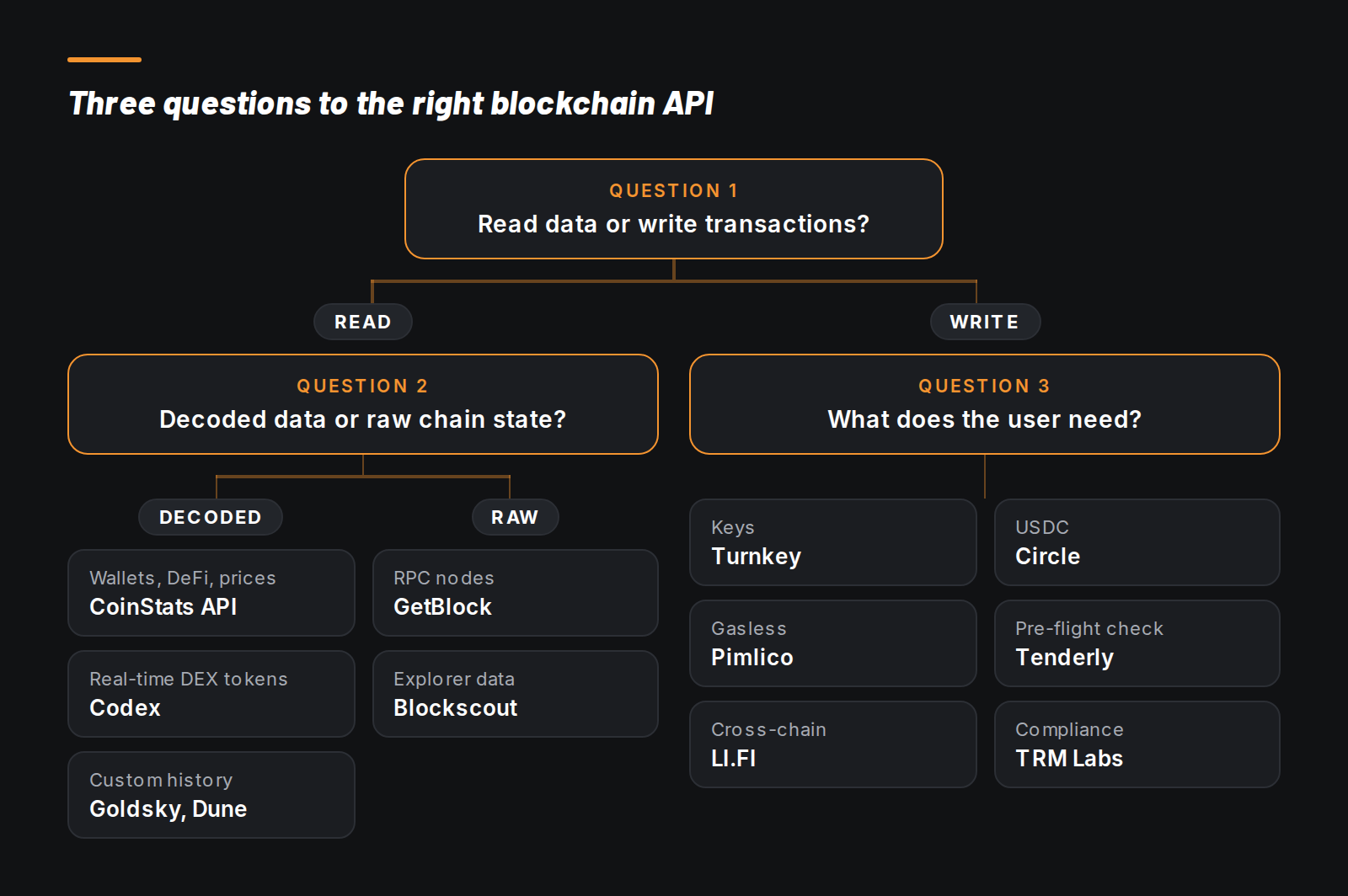
Pick by the job your product does first, then add layers as it grows.
- Portfolio tracker, wallet or tax tool: CoinStats API, plus GetBlock for broadcasts.
- DEX terminal or token screener: Codex, with CoinStats API for wallet context.
- Prediction-market product: Codex.
- Multichain wallet backend: GetBlock for RPC, Blockscout for EVM history.
- Protocol dashboard: Goldsky for live tables, Dune for research.
- Consumer app with email login: Turnkey for keys, Pimlico for gasless transactions.
- Cross-chain swap feature: LI.FI.
- USDC payments or payouts: Circle.
- High-value DeFi transactions: Tenderly simulation before every signature.
- Regulated app moving user funds: TRM Labs screening on every transfer.
- AI agent or crypto assistant: CoinStats API’s MCP Server, plus Turnkey agent wallets.
CoinStats’ own guide to choosing a blockchain API covers these trade-offs in depth.
Final Thoughts
Blockchain APIs split into layers, and no provider owns all six. Start with the data layer, because every screen reads before it writes. CoinStats API covers that layer broadly under one key, which suits most builds.
Add chain access when you broadcast, and wallet APIs when users sign. Safety APIs come before real money moves.
Every provider here has a free path or a trial. Test two per layer with real traffic.
FAQ
What is a blockchain API?
A blockchain API is an interface that lets software read or write blockchain data. It can return raw node data, decoded balances, indexed history or signed transactions.
What is the best blockchain API for developers?
CoinStats API is the best fit for most crypto products that read data. It returns market, wallet, DeFi, portfolio and token-risk data through one key. Apps that write transactions add a node provider such as GetBlock.
Is there a free blockchain API?
Yes, most providers here have a free tier, in different units. CoinStats API gives 20,000 credits a month, GetBlock 50,000 compute units a day. Dune and Tenderly include no free API access.
What is the difference between an RPC node and a data API?
An RPC node returns raw chain state and broadcasts transactions. A data API returns decoded, priced results such as balances and DeFi positions. Most production apps use both.
Which blockchain APIs work with AI agents?
CoinStats API, Codex, Blockscout, Dune, LI.FI and Tenderly ship MCP servers for AI agents. CoinStats API, Codex and Blockscout also accept x402 pay-per-call payments. GetBlock, Turnkey, Circle and TRM Labs offer docs-focused MCP servers.
Do I need more than one blockchain API?
Most production apps do. A typical stack pairs one data API with one node provider. Wallet and safety APIs come next, once users sign and move funds.