
For digital creators, being able to monetize a product can be just as important as developing it and reaching users. However, developments involving major platforms such as Steam, itch.io, and Kickstarter in 2025 and 2026 once again highlighted how payment infrastructure can become a critical dependency for digital platforms.
The discussion is not limited to adult content. From a broader perspective, the issue is that even when a digital platform establishes its own content policies, it may still be subject to different rules imposed by the third-party infrastructure it relies on to process payments.
Redulse takes a different approach by placing cryptocurrency and direct wallet-to-wallet settlement at the center of its payment model. Originally launched as a marketplace for adult-oriented independent games, the project is now making the same underlying payment architecture available to developers and businesses in other industries through Redulse Checkout.
The Steam and itch.io Controversy Highlighted the Influence of Payment Infrastructure
One of the most visible examples of payment processors influencing digital platforms emerged in July 2025.
After facing scrutiny from its payment processors regarding the nature of certain content hosted on the platform, itch.io deindexed adult NSFW content from its browse and search pages. The platform stated that its ability to process payments was critical to creators and that maintaining relationships with its payment partners had to be prioritized. itch.io later suspended Stripe payments for 18+ content while seeking alternative payment processors more willing to support the category.
Steam faced a related controversy. Valve said it had been informed that certain games might violate the rules and standards of Steam’s payment processors, as well as associated card networks and banks. After Steam introduced a new rule reflecting those standards, some adult games were removed from the platform.
The key point here is not to suggest that Visa, Mastercard, Stripe, or another financial company simply “banned adult games.” Instead, these events demonstrated that payment infrastructure can have a meaningful impact on what a digital marketplace is practically able to monetize.
Even if a platform allows certain content under its own rules, the payment provider handling the transaction may apply different risk, compliance, or content policies. Those policies can therefore become an indirect part of the platform’s commercial environment.
The Same Issue Reappeared at Kickstarter in 2026
The discussion did not end with Steam and itch.io in 2025.
In May 2026, Kickstarter explained that changes it had attempted to introduce to its mature-content rules were largely driven by requirements from its payment processor, Stripe. According to Kickstarter, some campaigns approved by the platform had later been reviewed and suspended by Stripe after fundraising had already begun.
Following criticism from the community, Kickstarter rolled back the new mature-content guidelines. However, the company acknowledged that campaigns approved under Kickstarter’s own policies could still potentially be stopped by its payment processor. Kickstarter’s support documentation also states that Stripe may review projects before launch, during a campaign, or afterward in accordance with its own legal and compliance requirements.
Steam, itch.io, and Kickstarter therefore illustrate the same broader point: a platform’s content policy and a payment provider’s policy do not always align.
Redulse’s model is designed to reduce one part of that dependency.
Why Redulse Chose a Wallet-to-Wallet Payment Model
Redulse was created with the goal of giving independent digital creators, particularly those operating in categories that may face additional payment-processing restrictions, another way to distribute and monetize their work.
The platform initially focused on adult-oriented independent games and NSFW game projects.
However, the defining element of Redulse is not simply that purchases can be made with cryptocurrency. Its payment architecture differs from the traditional model in which creator revenue accumulates in a platform balance before the creator submits a withdrawal request.
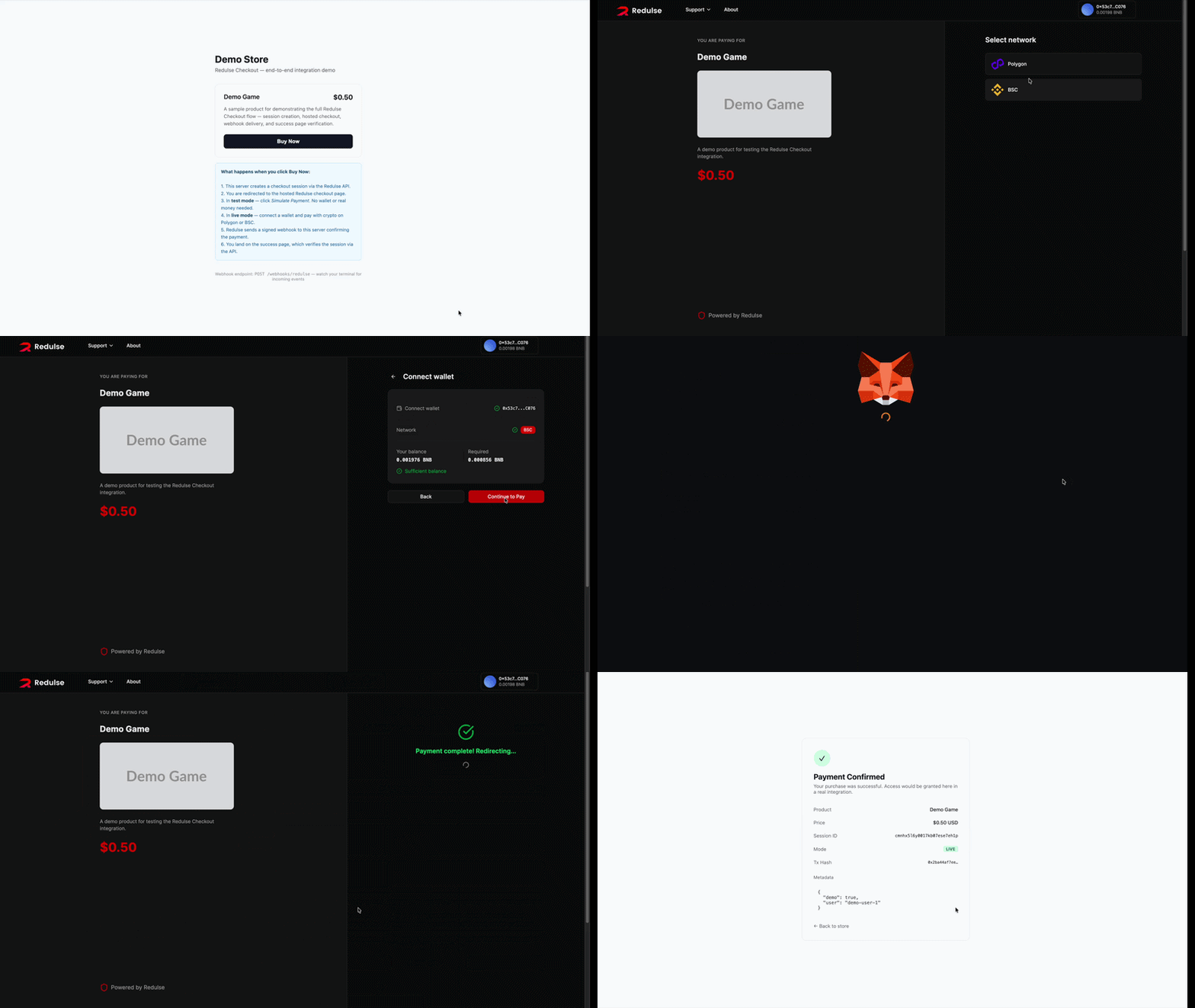
Instead, developers connect and cryptographically verify their own cryptocurrency wallets. When a sale takes place, a smart contract splits the payment and sends the developer’s share directly to the verified wallet.
According to Redulse’s current creator documentation, marketplace sales carry a 5% platform fee, while 95% of the sale amount is sent directly to the developer’s wallet.
In simplified form, the Marketplace payment flow can be represented as:
Buyer Wallet → Smart Contract → Developer Wallet + Redulse Platform Fee
The key distinction, therefore, is not simply that Redulse is “a marketplace that accepts crypto.” It is that the payment is distributed directly to wallets through a non-custodial settlement model.
Redulse also continues to operate its own content policies and moderation standards. Cryptocurrency is not positioned as a tool for eliminating legal, operational, or content-moderation responsibilities. Instead, it is used as alternative payment infrastructure that can reduce reliance on conventional payment processing for supported transactions.
From Redulse Marketplace to Redulse Checkout
One of the more significant developments in Redulse’s payment strategy has been taking the underlying model used in its marketplace and making it available outside that environment.
Redulse has turned the infrastructure into a standalone hosted cryptocurrency payment product called Redulse Checkout.
This distinction matters because businesses do not need to sell products through the Redulse Marketplace or operate in the adult-content industry in order to use Redulse Checkout.
In other words, the Marketplace served as the first real-world implementation of the wallet-to-wallet payment architecture, while Redulse Checkout extends the same principle into a broader payment infrastructure product.
Checkout is designed for a wide range of products that can integrate through a REST API, from websites and mobile applications to games and SaaS platforms.
How Does Redulse Checkout Work?
Redulse Checkout is designed to provide a hosted payment experience without requiring developers to build every component of a blockchain payment flow themselves.
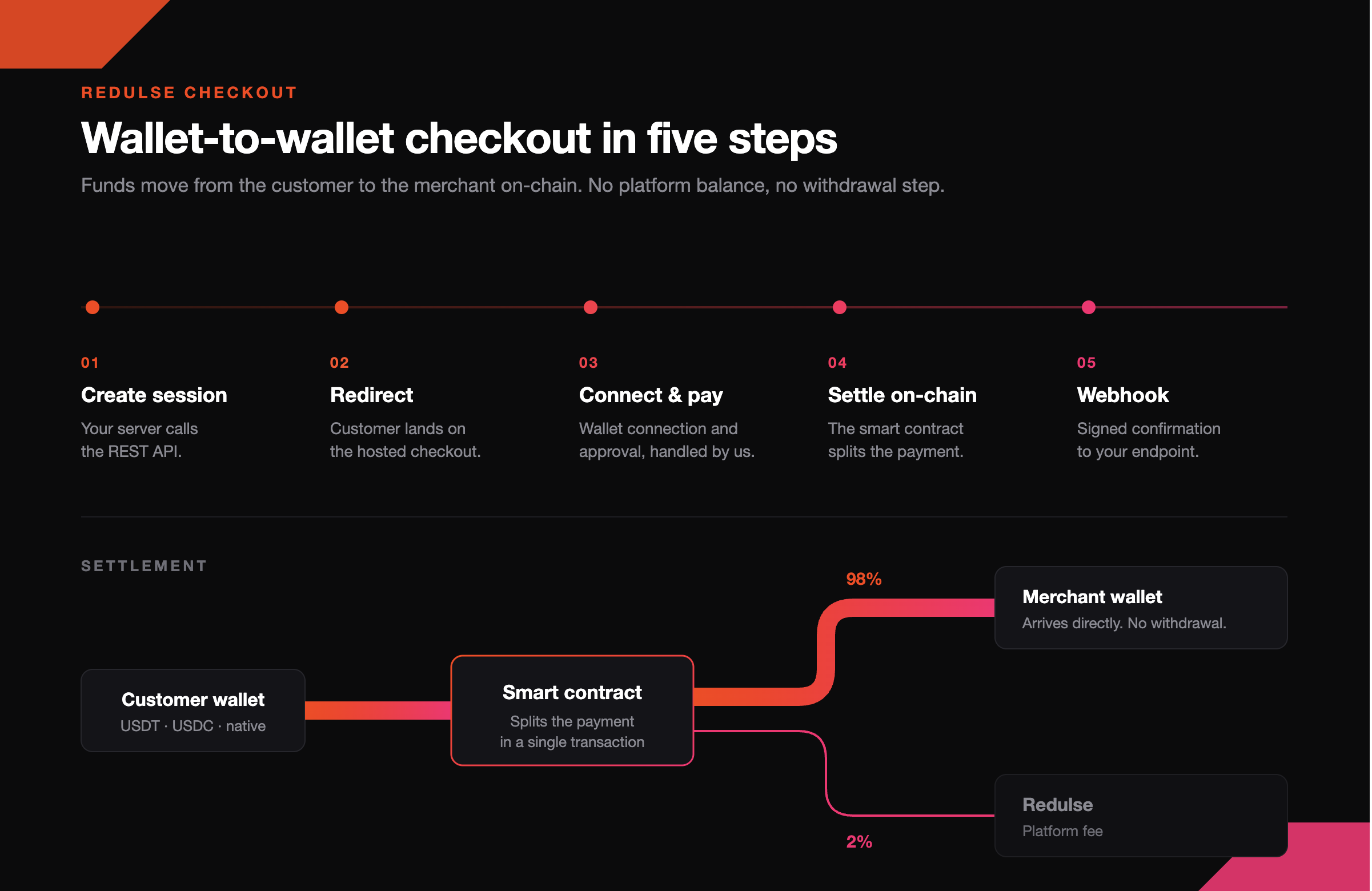
The basic payment process consists of five steps:
- The merchant’s server creates a Checkout session through the REST API.
- The customer is redirected to the hosted payment page provided by Redulse.
- The customer connects a cryptocurrency wallet and approves the payment.
- A smart contract processes and distributes the transaction on-chain.
- Once the payment is confirmed, a signed webhook is sent to the merchant’s system.
According to Redulse’s current documentation, steps such as wallet connection, blockchain network switching, token approval, and payment verification are handled through the hosted Checkout interface. The merchant’s backend integration can therefore rely primarily on REST API requests and webhook events.
This approach is intended to simplify integration for teams that do not want to build a complete blockchain-specific payment interface from scratch.
The Merchant’s 98% Share Goes Directly to Its Wallet
One of the defining features of Redulse Checkout is the way funds are settled.
When a payment is made through Checkout, the smart contract splits the transaction amount directly:
Customer Wallet → Smart Contract → 98% Merchant Wallet + 2% Redulse
As a result, the merchant’s 98% share is not first held in a Redulse account and then transferred later. It is sent directly to the cryptocurrency wallet configured by the merchant.
According to Redulse’s current pricing model, Checkout charges a 2% transaction fee. There is no monthly subscription, setup fee, contract requirement, or minimum transaction volume. The company also states that the merchant’s 98% share is delivered directly to the configured wallet during settlement, without a separate withdrawal stage.
This structure forms the basis of Redulse Checkout’s non-custodial model.
REST API, Webhooks, and Test Mode
Redulse Checkout is more than a hosted payment page. The system also provides a REST API and signed webhook support so developers can connect payment events to their own applications.
Once a payment is confirmed on-chain, the system sends an HMAC-SHA256-signed webhook to the endpoint configured by the developer. This allows, for example, a SaaS service to activate a feature, a digital-product platform to unlock a download, or a game to enable purchased content after payment has been verified.
A test mode is also available, allowing developers to simulate payment and webhook flows without using real funds or testnet tokens.
In terms of blockchain support, Redulse Checkout currently operates on Polygon and BNB Chain. In addition to the native assets of those networks, USDT and USDC are also supported.
A System Designed for More Than Games
One of the most important differences between Redulse Checkout and the Marketplace is the breadth of potential use cases.
The current system is designed to support integrations with:
- websites and web applications,
- SaaS products and digital services,
- mobile applications,
- games,
- digital downloads and license sales,
- Telegram and Discord bots,
- Unity, Unreal, Godot, and Ren’Py-based projects.
In general, systems capable of sending HTTP requests and redirecting customers to a URL can integrate with Checkout.
For example, a Telegram bot could send a user a Checkout link and automatically activate a purchased service once payment is confirmed through a webhook. Similarly, a game or SaaS platform could unlock a license, feature, or digital product after the transaction has been verified.
This broader integration model positions Redulse Checkout as more than simply a payment feature of the Redulse Marketplace.
The Goal Is Not to Eliminate Every Intermediary
An important distinction should be made when evaluating Redulse’s approach. Using cryptocurrency does not mean that a digital business eliminates every intermediary, regulatory requirement, technical dependency, or content responsibility.
Redulse’s proposition is narrower and more practical: for supported cryptocurrency transactions, it aims to reduce reliance on conventional payment processors and on platform-held merchant balances followed by withdrawal procedures.
From this perspective, the core Redulse Checkout proposition can be summarized in four elements:
Hosted Checkout + Simple REST Integration + Smart-Contract Settlement + Direct Merchant-Wallet Payment
The payment controversies involving Steam and itch.io in 2025, followed by Kickstarter’s disclosures in 2026, demonstrated how critical payment infrastructure can be to the operation of digital platforms. Redulse is taking the wallet-to-wallet model first implemented in its Marketplace and extending it to a broader group of developers and businesses through Redulse Checkout.
Readers interested in Redulse’s adult-oriented independent game marketplace can visit: Redulse Marketplace
Developers and businesses interested in integrating wallet-to-wallet cryptocurrency payments into their own products can explore: Redulse Checkout