In recent years, Turkey has undergone a remarkable shift from traditional financial habits toward digital assets. Research conducted by both local and global institutions over the past three years shows that cryptocurrency adoption in Turkey has reached some of the highest levels worldwide, young people’s saving habits are changing, and the search for protection against inflation plays an important role in investment decisions.
New international studies published in 2025 and 2026 further support this picture. Data from organizations ranging from Chainalysis and the IMF to TRM Labs and Henley & Partners show that Turkey has become one of the world’s leading crypto markets not only in terms of user numbers, but also in transaction volume, stablecoin demand, and changing investor behavior. So where exactly does Turkey rank in the global cryptocurrency landscape? In this article, we bring together the latest research and data from different institutions to examine Turkey’s position in the global crypto ecosystem.
Among the Global Leaders in Crypto: One in Five People Is Part of the Ecosystem
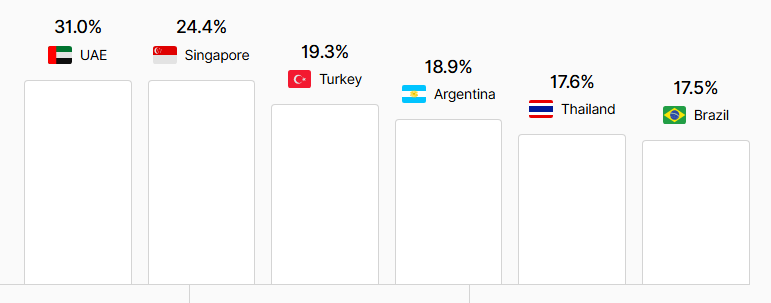
Triple-A, which examines digital asset ownership worldwide, highlights the scale Turkey has reached in its Cryptocurrency Ownership Data research. According to 2024 data, approximately 19.3% of Turkey’s population owns cryptocurrency. This rate places Turkey third in the world, behind the UAE and Singapore. Triple-A’s global estimate indicates that crypto assets in Turkey are no longer limited to a small group of investors.
Awareness Reaches 99%, With “Speed” as a Key Motivation
The local reflection of this high level of adoption is revealed in Paribu’s Cryptocurrency Awareness and Perception Research 2024. According to the report, cryptocurrency awareness in Turkey has reached 99%.
- The share of people trading cryptocurrencies increased from 25.1% to 27%.
- Cryptocurrencies became the third most preferred investment instrument after gold, with a rate of 29%.
- For 75% of users, transaction speed and ease of carrying and storing assets are among the most important advantages.
Digital Assets Are Gaining Ground Over Traditional Investments Among Young People
Binance TR, which examined the demographic dynamics of cryptocurrencies in its research on young people’s approach to crypto assets, sheds light on how Generation Z views the crypto ecosystem. The findings suggest that young people do not see crypto assets merely as a short-term investment tool for generating returns, but as part of a new financial system associated with technology and financial freedom.
Another study supporting this trend, the ING Turkey Savings Trends Survey, also highlights the transformation in investment preferences, particularly among younger people. While traditional investment instruments remain important, crypto assets are steadily strengthening their position among young investors’ saving options. The desire to preserve the value of savings against inflation also stands out as one of the key drivers of this shift.
Chainalysis: Turkey Is by Far the Largest Crypto Market in MENA
Turkey’s weight in the cryptocurrency market becomes even clearer when looking at actual on-chain fund flows. Chainalysis’ 2024 MENA crypto adoption research identified Turkey as the largest crypto market in the MENA region and the seventh largest in the world. Between July 2023 and June 2024, the value of on-chain crypto assets received by Turkey was estimated at approximately $136.8 billion.
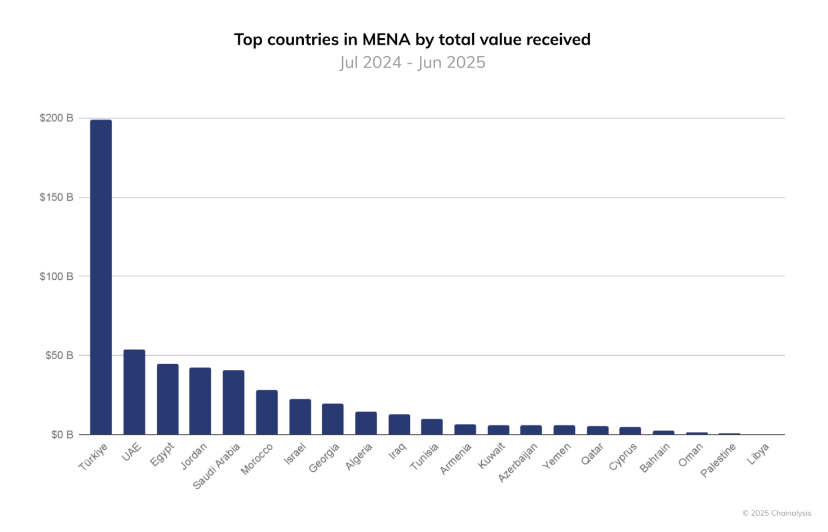
Chainalysis’ 2025 MENA Crypto Adoption research, published in October 2025, showed that growth in the Turkish market continued. According to the report, Turkey remains by far the largest market in the MENA region, with approximately $200 billion in annual crypto transaction volume. The United Arab Emirates, which ranks second with roughly $53 billion in volume, illustrates the scale of the gap between the two markets.
According to Chainalysis’ calculations, total crypto inflows attributed to Turkey reached approximately $878 billion between the beginning of 2021 and mid-2025. However, the research draws attention not only to market growth but also to changes in investor behavior. While growth in small-scale retail transactions slowed, interest in altcoins increased significantly. The 31-day moving average of altcoin trading volume in Turkey was around $50 million in late 2024, but climbed to more than $240 million by mid-2025, surpassing stablecoin trading volume. Chainalysis links this trend to some investors moving toward riskier assets in search of higher returns, in addition to trying to preserve their capital under economic pressure.
IMF: Between One-Quarter and One-Half of Turkish Households Hold Crypto Assets
The scale of cryptocurrency use in Turkey has now also entered the macroeconomic assessments of international financial institutions. The International Monetary Fund (IMF) specifically addressed crypto asset use in the country in its Turkey 2025 Article IV Consultation report, published in 2026.
Based on various studies and data, the IMF states that between one-quarter and one-half of households in Turkey own some form of crypto asset, with participation continuing to rise. According to the report, Turkey ranks 11th globally in crypto asset adoption. Stablecoins receive particular attention. The IMF emphasizes that macroeconomic volatility and high inflation can increase demand for crypto assets as a store of value and as a digital alternative to foreign currencies. The report also notes that altcoin trading volumes have risen significantly over the past year.
Henley: Turkey Ranks 14th Among the Countries Examined
Turkey’s position is not measured solely by trading volume or user numbers. In Henley & Partners’ Crypto Adoption Index 2026, published in September 2026, Turkey ranked 14th among 36 countries and received a score of 36.2 out of 60. Turkey scored 5.8 for public adoption, 4.5 for infrastructure, 5.4 for innovation and technology, 7.2 for the regulatory environment, 6.5 for economic factors, and 6.8 for tax friendliness.
Turkey’s Crypto Market Is Moving From Retail-Led Growth Toward Institutionalization
The Turkey Crypto Guide 2026, published in April 2026 by London-based identity verification and compliance company Sumsub, points to another transformation in the Turkish market. Sumsub describes Turkey as one of the world’s most active and rapidly changing crypto markets, while noting that the country is shifting from a high-growth phase driven by retail investors toward a regulated ecosystem with increasing participation from institutional players.
The report identifies the Capital Markets Board’s regulations for crypto asset service providers, MASAK obligations, KYC procedures, transaction monitoring, and Travel Rule implementation as key elements of the new era. According to Sumsub, Turkey’s high transaction volumes are now developing alongside stricter compliance and oversight mechanisms.
KuCoin Research Puts the Investor Rate at 52%
One of the important studies illustrating the transformation of Turkey’s retail investor profile is KuCoin’s 2023 Understanding Crypto Users in Turkey research. According to the study, the share of Turkish adults aged 18 to 60 investing in cryptocurrencies increased from 40% in November 2021 to 52% in May 2023. KuCoin linked this increase partly to the depreciation of the Turkish lira and the perception of cryptocurrencies as an alternative store of value against inflation.
What Does the September 2026 Chainalysis Report Say?
Chainalysis’ 2026 Global Crypto Adoption Index, published in September 2026, shows that Turkey continues to maintain a strong position in the global crypto ecosystem. Covering the period from July 2025 to June 2026, the study ranked Turkey 20th in crypto adoption among 117 countries with sufficient data.
In the subcategories, Turkey ranked 16th in total crypto flows, 19th in on-chain crypto balances, 17th in the domestic peer-to-peer (P2P) economy, and 20th in cross-border crypto flows.
Chainalysis revised its index methodology this year to include domestic P2P transfers, cross-border transactions, and users’ on-chain balances, in addition to funds flowing to centralized and decentralized platforms. As a result, the findings provide a broader measure of adoption that reflects not only trading volume but also the extent to which crypto assets are used and held within individual countries.
Turkey Is Now One of the Major Players in the Global Crypto Market
Although studies using different methodologies produce varying estimates of the number of crypto investors in Turkey, the overall picture points broadly in the same direction. Triple-A estimates that approximately one in five people in Turkey owns crypto assets, while KuCoin’s study of investors within a specific age group reports a participation rate of 52%. The IMF, drawing on multiple studies, states that somewhere between one-quarter and one-half of Turkey’s population of around 90 million owns crypto assets.
On-chain transaction data also supports the scale of the market. Turkey’s annual crypto volume approached $200 billion as of 2025, while cumulative inflows attributed to the country reached approximately $878 billion between 2021 and mid-2025. While stablecoin use linked to inflation and demand for foreign currency continues, recent data also indicates growing appetite for higher-risk investments in altcoins.
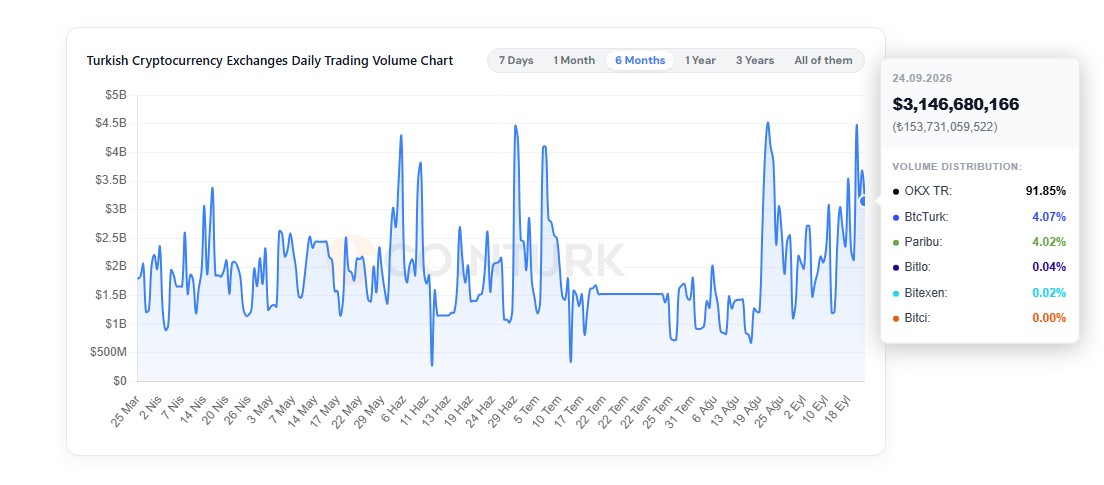
The local market reflects the same trend. According to data from Turkish cryptocurrency exchanges tracked by COINTURK, daily trading volume periodically exceeds $2 billion, demonstrating the scale of market activity in Turkey.
Taken together, the research suggests that Turkey’s rise in the cryptocurrency ecosystem cannot be explained solely by speculative investment interest. High inflation and the depreciation of the local currency support demand for stablecoins and alternative savings instruments, while the younger population’s interest in digital financial technologies, advanced local exchange infrastructure, and an increasingly institutionalized regulatory framework represent other key components of the market.
Turkey has therefore become one of the global markets where the impact of crypto assets—from everyday investment behavior to macroeconomic discussions—is most clearly visible.