Aave, one of the pioneering platforms in the DeFi sector, has come under the spotlight due to a significant governance crisis. The controversy erupted after BGD Labs, a major infrastructure provider for the Aave ecosystem, announced plans to withdraw from the project by early April. This development has reignited debates over the balance of power within the Aave DAO, a community that has prided itself on principles of decentralization.
BGD Points to Centralization Concerns
BGD Labs attributed its decision to leave to what it describes as an increasing concentration of power within Aave’s ecosystem. In its public statement, the team argued that Aave Labs—another core developer—was attempting to tighten its grip over the project, steering all contributing parties according to its own vision, while failing to adequately value existing expertise within the community. The company cited these centralizing tendencies as incompatible with the spirit of decentralization that Aave claims to uphold.
Tension Between V3 and V4 Sheds Light on Governance Challenges
The divide has come to the fore, particularly around the transition between Aave V3 and V4. BGD Labs played a central role in the development, maintenance, and support of V3—the protocol’s previous critical iteration—since 2022. Now, as criticism of V3 emerges, BGD Labs hints that this may be linked to the promotion of V4, which is primarily spearheaded by Aave Labs. The fact that V4’s development is concentrated within one organization has become a focal point for those worried about centralization in the project’s governance.
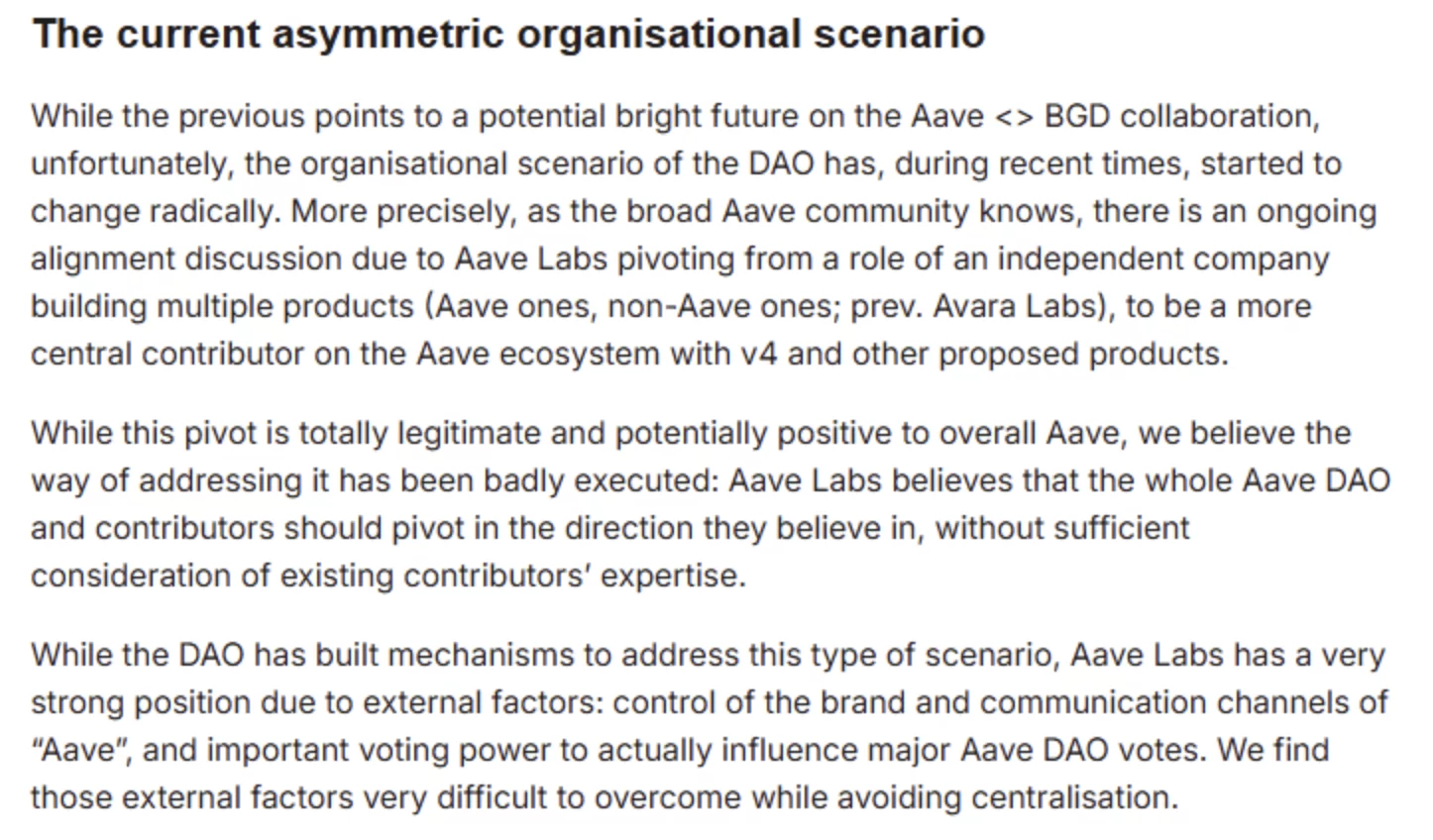
These developments have once again raised tough questions within the DeFi community over whether Aave is slipping away from its decentralized ideal. Many community members now fear that Aave Labs’ significant influence over branding rights and voting power may threaten the core DAO model. Some long-standing contributors warn that this imbalance could undermine governance processes over the long term, weakening the foundations of the protocol.
On the other side, Aave Labs is seeking to maintain calm amid the upheaval. Founder Stani Kulechov reassured the community that BGD Labs’ departure would not destabilize the project, adding that his team could take over V3 maintenance if necessary. He also signaled openness to continuing security-focused collaborations with BGD Labs, should the DAO community deem them beneficial.
Past Disputes and Market Reactions
Governance turmoil is not new for Aave. Late last year, the Aave Chan Initiative—led by Marc Zeller—accused Aave Labs of diverting DAO revenue streams for its own benefit. The resulting controversy sharply eroded market confidence and triggered a significant drop in AAVE token prices.
In a similar vein, Evgeny Gaevoy, founder of crypto market maker Wintermute, weighed in on the latest developments. He suggested that while Kulechov may be consolidating authority, internal divisions could exert downward pressure on token performance, reflecting broader market anxieties.
Indeed, following the latest announcements, the price of AAVE saw an 8 percent dip, though some recovery followed. Nonetheless, continued uncertainty around governance is causing traders and market participants to tread cautiously. The Aave saga mirrors governance headaches that have plagued other major DeFi protocols like MakerDAO and Uniswap, reinforcing that structural disputes are a persistent challenge across the sector.
Amid the turbulence, renewed calls have arisen to redesign DAO models within DeFi projects. Recently, some protocols have begun experimenting with more transparent and auditable hybrid governance frameworks. According to experts, the crisis at Aave may prompt a faster shift toward these alternative structures, as the sector grapples with the pitfalls of concentrated power.