
In the ever-evolving cryptocurrency derivatives market, a significant power shift has occurred, with Binance overtaking the US-based CME in terms of the size of open positions in Bitcoin futures. This change comes during a period when spot Bitcoin ETFs in the US witness continuous outflows, indicating a waning interest from institutional investors. Meanwhile, Bitcoin’s price fluctuates with increased volatility, trending closer to the lower bands of long-term price models.
Binance Leads in Bitcoin Futures Market
In a noteworthy development within the global cryptocurrency derivatives market, Binance has claimed the top spot from CME according to CoinGlass data. The open positions of Bitcoin futures on Binance have surged to 129,080 BTC, amounting to approximately $11.28 billion, eclipsing CME Group’s open positions, which have decreased to 112,340 BTC or $9.81 billion. This marks the first time since the beginning of 2024 that CME’s figures have fallen below $10 billion, reflecting a shift in the market’s center of gravity from institutional-focused US platforms to global exchanges with more retail participation.
The decline at CME began prior to the significant correction experienced in the cryptocurrency market in early October. The allure of the “basis trade” strategy, which takes advantage of the premium between Bitcoin’s price and futures contracts, has rapidly dwindled. The return on investment for institutional investors buying BTC in the spot market and selling it in futures has decreased, leading to a faster unwinding of open positions. Velo data highlights that the annualized basis rate has plummeted from 15% to around 3%.
Conversely, while open positions on Binance also fell after October, they showed signs of recovery in December. Market participants note the growing influence of retail investors, who view price pullbacks as buying opportunities. This trend has made the divergence between institutional and retail investor behaviors more apparent.
Continued Outflows from Spot Bitcoin ETFs
In the US, the selling pressure on spot Bitcoin ETFs persists. According to Farside Investors data, ETFs recorded a net outflow of $19.3 million on the week’s first trading day, marking the seventh consecutive day of negative flows. BlackRock’s iShares Bitcoin ETF saw an investor outflow of $7.9 million, while Fidelity’s FBTC ETF diverged with an inflow of $5.7 million. Institutional withdrawals were also notable in ARK 21Shares ARKB and Invesco Galaxy BTCO.
Experts attribute these ETF sales to more cautious price expectations and year-end tax loss realization strategies. The reduction in institutional positions aligns with the diminishing influence of CME in futures trading.
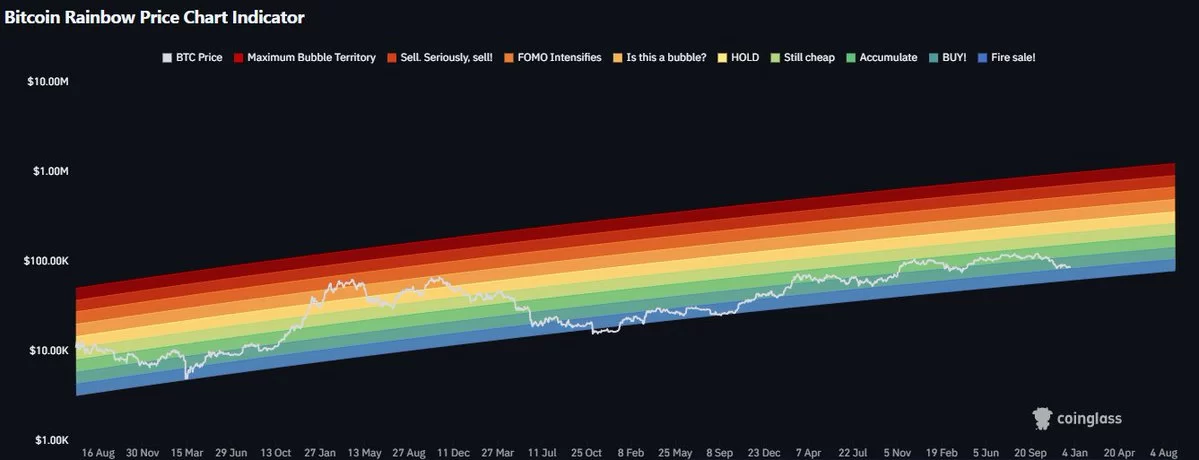
Meanwhile, Bitcoin’s price has declined by over 2% in the last 24 hours, stabilizing around $87,200. Intraday trading tested the $86,717–$90,299 range, with trading volume increasing by 40%, indicating that the market is still dynamic. Analyst Dan Crypto Trades points out that Bitcoin is approaching the lower band of regression and rainbow chart models, historically corresponding to the $60,000–$80,000 range. CoinGlass data suggests indecision in the derivatives market, with a decline of over 5% in total open positions in the last 24 hours, accelerated at CME but showing short-term recovery at Binance.