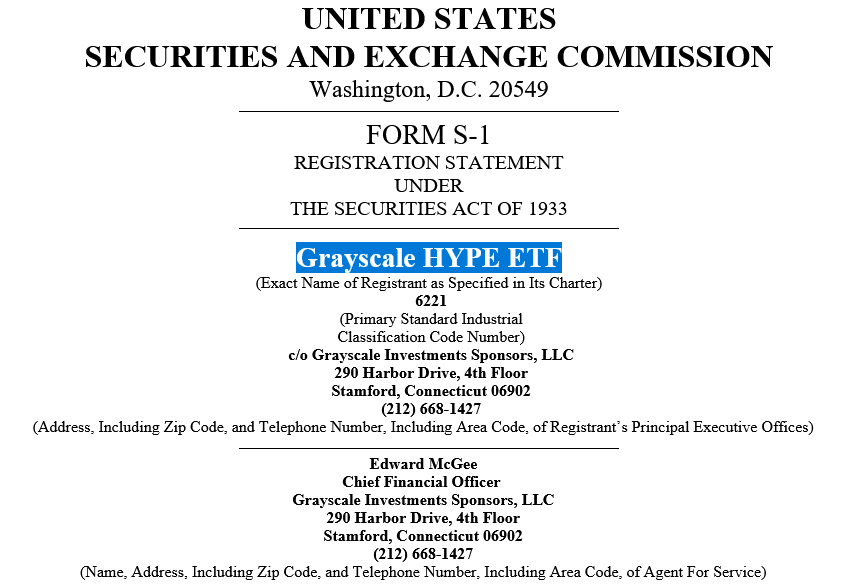
Grayscale, one of the world’s largest crypto asset management firms, has filed an application for a new spot exchange-traded fund (ETF) designed to track the price movements of the Hyperliquid (HYPE) token. If the fund receives regulatory approval, it is set to be listed on the Nasdaq under the ticker code GHYP. This initiative follows recent similar filings by competitors Bitwise and 21Shares, signaling growing institutional interest in blockchain-based financial products.
Fund Structure and Technical Details
In its S-1 filing with the U.S. Securities and Exchange Commission (SEC), Grayscale detailed that the ETF would be directly backed by HYPE tokens, with Coinbase named as the custodian for digital asset storage. However, the application offered no specifics on management fees, suggesting that further information on the fund’s cost structure may be provided at a later stage. The lack of immediate transparency regarding fees leaves open questions for prospective investors about the total expense of holding such a product.
Grayscale has long established itself as a leading institutional player within digital asset investments. The company, widely recognized for its Bitcoin and Ethereum products, now appears set to broaden its portfolio strategy by exploring ETFs tied to new blockchain projects. This shift demonstrates Grayscale’s commitment to diversifying its offerings to appeal to a wider spectrum of market participants.
Staking Option Comes to the Fore
A particularly notable aspect of Grayscale’s application is its reference to potentially incorporating staking rewards into the ETF’s structure at a future stage. Provided that certain conditions are met, investors may benefit from both price appreciation and additional returns via staking mechanisms. Such a hybrid product could offer a meaningful edge for those seeking passive income streams alongside traditional price exposure.
Bitwise and 21Shares also evaluated staking capabilities in their own Hyperliquid ETF submissions, revealing a broader industry trend towards interest in staking-enabled ETFs.
Growth of the Hyperliquid Ecosystem
Hyperliquid has carved out a niche as a prominent protocol in the perpetual futures market, gaining attention for enabling 24/7 trading of tokenized real-world assets, such as oil and gold. This innovation has begun attracting interest not only from retail traders but also from established players in traditional finance eager to diversify into digital assets.
Although weekly trading volumes sometimes fluctuate, Hyperliquid has consistently recorded activity between $40 billion and $100 billion. These numbers underscore the protocol’s commanding presence within the decentralized derivatives sector, despite occasional dips in market activity.
In 2025, new competitors like Aster, Lighter, and edgeX entered the market, intensifying rivalry. Nevertheless, these platforms’ weekly trading volumes have, for the most part, remained lower than those of Hyperliquid.
Overall, the total perpetual futures volume on the platform this year has ranged between $125 billion and $300 billion, marking a significant increase over the same period last year. The sustained activity demonstrates both robust liquidity and a growing appetite for decentralized finance solutions in the derivatives market.