XRP Coin, an influential player in the U.S. crypto market, is recently stirring discussions concerning its future. Within Ripple  $2, differing viewpoints are emerging, suggesting diverse paths for XRP Coin. Some believe that XRP’s growth trajectory could mirror that of rapidly expanding projects like Solana
  $146.
$146.
Solana (SOL) Rises Above Ripple
Luke Judges, global partner leader and director at Ripple, has put forth his insights on emulating Solana’s strategy, an aspect that has grabbed the community’s attention. Solana, a fierce contender among Layer1 networks, reportedly surpasses Ripple in several metrics. Judges thinks that Solana’s operational expertise could serve as a valuable model, as technical superiority alone doesn’t ensure competitive success.
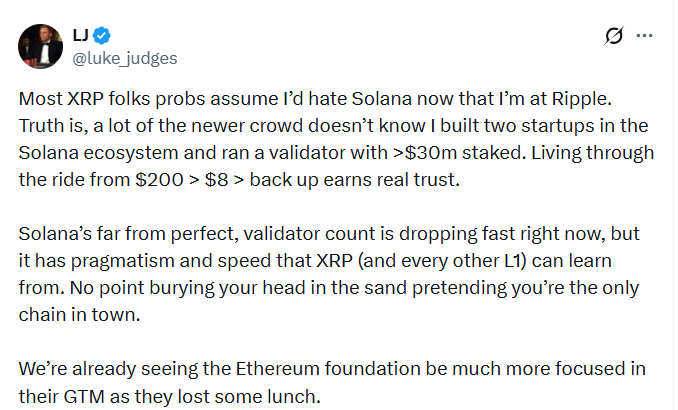
Judges, an experienced figure, holds substantial advanced technical expertise in Solana’s network. He emphasizes pragmatism and speed amid Layer1 competition as essential for Ripple, sharing his perspective:
“Many XRP users assume I hate Solana because I work at Ripple. In reality, newcomers are unaware that I’ve established two startups in Solana’s ecosystem and run a validator with over $30 million staked. Living through fluctuations from $200 to $8 and back instills real confidence.
Although Solana is far from perfect, with declining validator numbers, its pragmatism and swiftness are lessons for XRP and all Layer1s. Playing ostrich by pretending to be the sole blockchain in town is senseless. We can already see Ethereum  $3,334 Foundation zeroing in on its GO-TO-MARKET strategy after missing some opportunities.”
 $
$
Solana’s strategic agility and swift adaptability to trends are deemed its greatest strengths. Ripple, however, appears static, with investors merely awaiting XRP Coin’s rise. Consequently, Solana remains vibrant, whereas Ripple seems ineffectual, akin to the sluggishly advancing Cardano  $0.420957, which also lacks community excitement.
How Ripple Challenges Solana
Conversely, there’s a faction within Ripple that asserts Ripple’s superiority over Solana. It’s intriguing that two opposing views can coexist within Ripple. David Schwartz, Ripple’s CTO and the technical architect of the XRP Ledger, advocates that XRP’s design philosophy emphasizes reliability, efficiency, and enterprise-level performance, negating the need to mimic Solana’s strategy.
Schwartz appears to lean towards having a sufficient roster of corporate clients over millions of active users. He cautions against Solana-like networks sacrificing stability for speed and growth, especially for networks aspiring to underpin financial applications. Schwartz asserts that XRPL’s consensus mechanism, with consistent transaction certainty and near-zero fees, presents a more enticing offer than Solana.
Which do you think is superior, Solana or Ripple?