
As the critical April 6 deadline approaches in the world of cryptocurrencies, headlines are increasingly dominated by political shifts and diplomatic moves on the US-Iran front. While President Trump pushes for a new agreement, his objectives remain largely unfulfilled. In Iran, the US administration asserts a new government has taken shape, yet these claims were swiftly denied by the Iranian parliament’s speaker. At the same time, the US Defense Secretary doubled down on assertions that regime change has already taken place.
A new phase in Iran after regime change claims
In a series of statements, the US Defense Secretary said that significant change has occurred within Iran’s regime, and called for countries to prepare for potential action concerning the Strait of Hormuz. Outlining the impact of ongoing US operations, the Secretary highlighted the evolving situation and implications for regional security. According to these remarks, Iran’s strategic options are narrowing, while the US gains leverage amid military and economic pressure. The coming days, the Secretary stated, are expected to be decisive in shaping the region’s trajectory.
“Over the weekend, I visited the troops involved in the Iran operation. The United States’ range of options is expanding, while Iran’s is shrinking. Our operations are undermining the morale of the Iranian military. The coming days will be decisive; Iran has no viable countermeasures left.
Our ongoing attacks have sparked widespread desertions within Iranian ranks. The new Iranian regime needs to show greater prudence than its predecessor. The reality is that regime change has taken place. President Trump stands ready to negotiate a deal. If Iran remains unwilling, the US will move forward without them.
As for Hormuz, today saw an unprecedented level of traffic through the strait.
This morning, President Trump delivered clear remarks on Hormuz. Countries must be ready to take initiative regarding the strait. Going forward, Hormuz will no longer be solely an American concern. When necessary, the US will respond to Russian and Chinese activities as warranted. However, I will not publicly disclose the details of what Russia and China are doing in Hormuz.
Rest assured, we are fully aware of their actions in Hormuz.”
Market unease over risk of conflict expansion
The possibility that military tensions could spill over to draw in Russia and China has unsettled international markets. Many observers worry that widening hostilities may disrupt global trade routes and impact energy flows. According to reports from CBS, President Trump hinted that a resolution with Iran may be close, revealing that “little more is needed for victory,” which some interpret as a signal that negotiations are intensifying.
Trump also took to social media today, using assertive language to address other nations. His message served as both a warning and a call for greater self-reliance among America’s traditional allies when it comes to security in the Strait of Hormuz. The president suggested it is time for these countries to shoulder more responsibility for their own interests and oil supplies.
“To every country unable to obtain jet fuel because of the Strait of Hormuz—including, for example, the United Kingdom, which refused to participate in efforts against Iran—I have two suggestions: One, buy from the United States, as we have ample supply; two, summon some courage, head to the strait, and secure your own passage.
It’s time to learn how to protect your interests independently, as the US will not assist you further—just as you have not helped us. Iran is essentially dismantled. The hard part is over. Go get your own oil! President DJT”
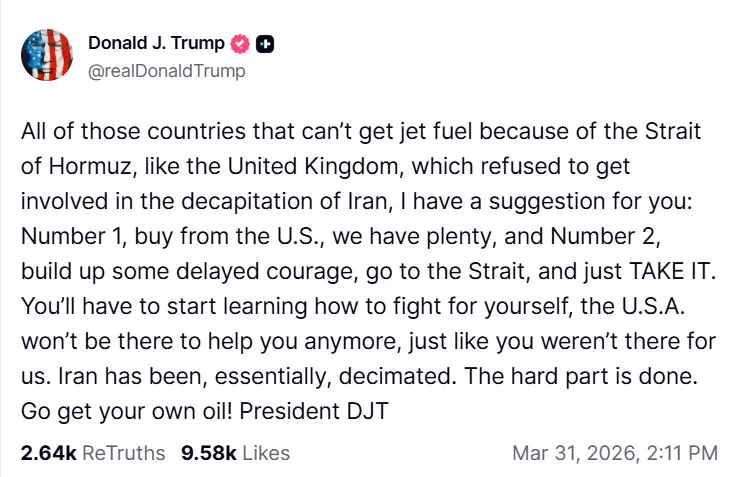
These sharp remarks underline a broader American pivot toward encouraging allied countries to take direct responsibility for their own security concerns, especially where vital energy corridors like the Strait of Hormuz are concerned. The US emphasis on shifting the burden aligns with a longstanding debate over defense spending and partnership obligations within NATO and other alliances.
Meanwhile, Iranian officials have denied any formal establishment of a new government, insisting that claims of regime change are simply part of a US narrative designed to increase diplomatic and psychological pressure. Despite these denials, US policy appears to be entering a new phase of assertiveness, both militarily and rhetorically.
As world leaders weigh their options, global markets and geopolitical observers alike brace for rapid developments. How these high-level proclamations will translate into action remains to be seen, but the stakes for regional and international stability are indisputably high.