
Understanding what happened in the markets today can unlock insights that apply every single day of your trading journey. Today, Bitcoin registered a notable decline, an outcome that seasoned investors saw coming rather than a surprise. The question is: what’s behind today’s significant move, and which data points tell the real story?
Turning tides in the crypto universe
Big events are always around the corner in crypto, making total calm a rare occurrence. Since last year’s round of tariffs, it was clear that global markets were on the brink of transformation—and they have, with more changes likely. What was once regarded as abnormal has quickly become routine, a trend that looks set to define the post-pandemic era.
A quick snapshot of today’s landscape reveals several key dimensions shaping the current market outlook. Geopolitical risks are front and center. With recent political tensions including the removal of Maduro from his country, Trump has signaled he could take similar action elsewhere, including Cuba. After the US staked a claim on Greenland and challenged the European Union, predicting Washington’s next move is increasingly difficult. Iran is now in the spotlight, and in the absence of short-term agreements, the balance of demands and responses seems tilted toward the risk of a devastating conflict.
Volatility and regulation define the future
The United States has entered a phase that lacks predictability. One manifestation of “the new normal” is heightened volatility, especially for assets like Bitcoin that tend to be highly sensitive to risk. This means investors shouldn’t expect a stable performance; volatility is here to stay.
Escalating inflation driven by a surge in oil prices is setting the world economy on an irreversible course. As the US economic data reverts to 2022 levels, many analysts now forecast further interest rate hikes. Meanwhile, the attacks on oil infrastructure point to lengthy production disruptions. While the United Arab Emirates leaving OPEC and producers ramping up to maximum output levels might alleviate the situation in the short term, it won’t solve the problem entirely. Growing core inflation suggests that sticky inflation is back, likely ending the era of monetary easing and risk-driven market rallies.
When Bitcoin was created, its idealistic vision was clear. But as it has grown, it has become a risk-priced asset in the hands of institutions. Ethereum nodes now operate under regulatory scrutiny in safe zones; Bitcoin wallets, thanks to advanced OSINT tools and robust data-sharing policies at exchanges, are much less anonymous than before. The crypto sector is now evolving into a digital version of traditional banking, closely monitored and regulated, with AI accelerating this trend.
2017 was the year many projects sold grand narratives. In 2021, investors started to believe those stories were coming true. By 2024-2025, however, the sector had matured: ambitious claims faded, while giants like BlackRock integrated crypto infrastructure into mainstream finance. The next stage will see blockchain-based digital finance platforms gaining traction, supported by large, public crypto networks. Traditional finance isn’t threatened by this development, as crypto now resembles its established counterparts more than ever. As a result, hyped projects and flashy demos no longer capture much interest, and this cycle’s altcoin season failed to materialize. Only a select few projects are likely to relive the old days of rapid growth.
Sensing these shifts, experienced investors have begun exiting altcoins early. Many “ghost” projects are simply biding their time, while a handful of high-profile altcoins offer fleeting surges—more mirage than oasis—thanks to sparse liquidity and momentary excitement.
15 May selloff: The numbers behind BTC’s slide
Setting aside long-term prognoses, Bitcoin’s latest downturn stemmed largely from American investors offloading their holdings. The Coinbase Premium and a brief FOMO sparked by CLARITY may have underpinned some temporary optimism, but the rally quickly faded. US-listed Bitcoin ETFs experienced over $800 million in outflows in just two days, demonstrating that both individuals and institutions are pulling capital from the market amid deteriorating sentiment.
Popular Turkish on-chain analyst @anlcnc1 offered the following perspective on today’s decline:
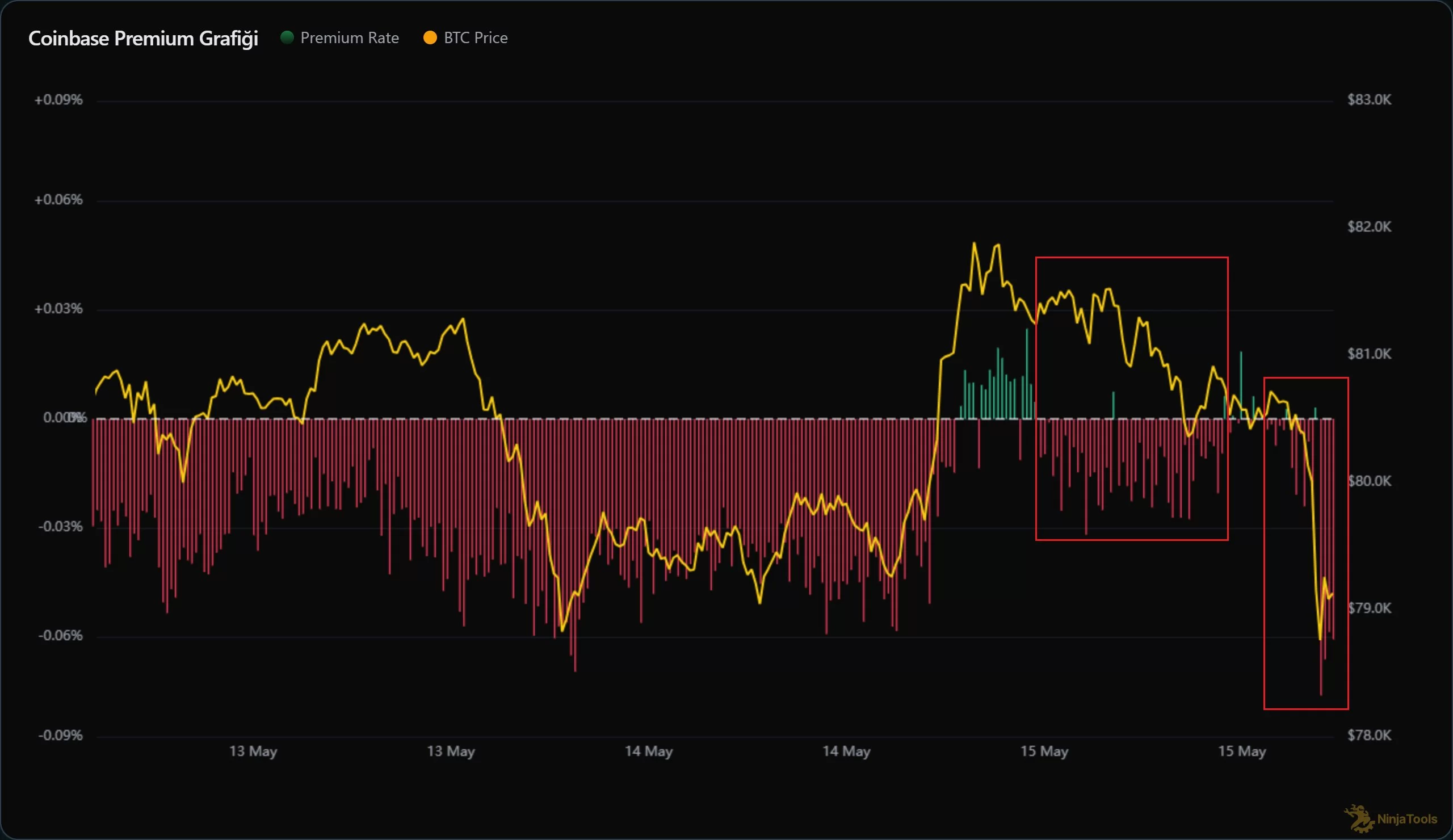
Analyzing price index correlations, we see that even if rallies are driven by derivatives or news, if the premium remains negative, price gains lack substance. A recovery in the Coinbase premium is essential for sustainable price action—so far, we haven’t seen that.
Bitcoin must avoid losing the $78,000 level on a daily closing basis, since both the True Market Mean and short-term investor break-even zones cluster around there. During the prior slip below $79,000, prices bounced from the right support, and now these two areas—$78,200 and $78,400—should function as support if tested. In short, $78,000 is the critical level. Daily closes below could trigger short-term holders to incur losses, unleashing panic selling and rapid pullbacks. As long as Bitcoin holds above $78,000, short-term traders remain in profit.