
With March drawing to a close, the anticipated quick resolution to the conflict—once predicted by Trump to last mere weeks—has yet to materialize, and prospects for an outcome in the near future remain slim. As a result, Bitcoin has slipped back to the $66,000 range, capping off a difficult Sunday for altcoins. Despite some evidence of renewed buyer activity, Glassnode data signals that this uptick is not robust enough to mark a decisive turnaround in the market.
On-chain signals offer mixed messages
New buyers have tentatively entered the scene, but the price of Bitcoin has lingered for some time in the $60,000 to $70,000 band—a range that currently serves as the cost basis for most holders. While Glassnode analysts recognize a notable concentration of supply within this window, they argue that demand does not yet appear sufficiently strong to drive a sustained rally. Historically, periods of strong recovery are characterized by noticeably higher demand than what is presently observed.
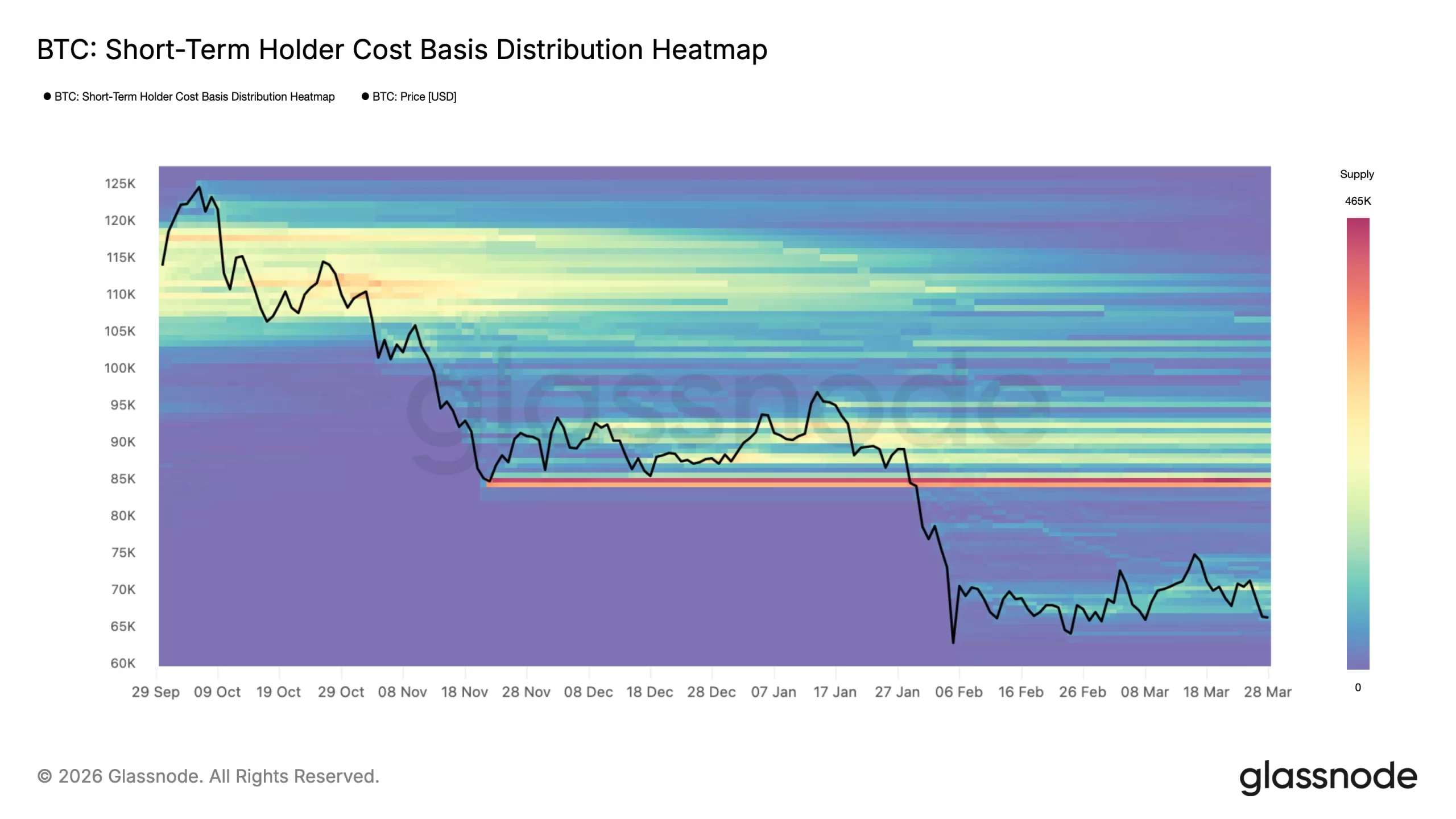
“While the accumulation of supply in this range is striking, its intensity is weaker compared to historical precedents ahead of strong recoveries. The accumulation structure is positive in form, but not yet in magnitude.” – Glassnode
US investors pull back as uncertainty rises
Investor appetite from the United States appears to have cooled considerably, according to recent observations. After spending a period in negative territory, the Coinbase Premium index momentarily recovered only to stabilize at a negative level following the latest downturn. Add to this the evolving geopolitical situation over Iran—with the US deploying more troops and naval assets to the region—and the sense of uncertainty has only grown more pronounced.
Disagreement over future projections
Not all analysts share Glassnode’s cautious outlook. For instance, the market observer @OnchainDecoded has argued that the realized price near $53,000 provides an important floor, and that long-term investors currently remain comfortably in profit. However, when factoring in only the actively circulating supply from the past seven years, this figure actually rises to $72,500—challenging the validity of @OnchainDecoded’s assessment and suggesting those views disregard inactive supply.
“Short-term investors (STH) are operating at a loss based on their cost basis, while long-term holders (LTH) still hold sizable profits—in past cycles, this divergence has provided the conditions for patient accumulation just before major recoveries. Similar patterns were observed at the cycle lows in both 2019 and 2022.”
Adding further nuance, Rohan J argued that mounting geopolitical risks and broader macroeconomic headwinds have weakened markets overall. However, he expects that any de-escalation in conflict could trigger a relief rally for digital assets.
Another analyst, SugSsak, noted that compared to the intense buyer activity seen in November 2023 and January 2024, recent demand remains tepid. According to SugSsak, new capital is unlikely to enter the market unless the $60,000 support level is maintained.
MeasuredEdge, meanwhile, flagged a potential risk in the form of a so-called “fakeout” scenario. He cautioned that many short-term holders purchased Bitcoin around the $85,000 mark, creating a formidable resistance. Should the price rally, these holders could act as a persistent source of selling pressure by seeking to break even.
“One key detail to watch is how much of the short-term holders’ cost basis clusters near $85,000—this forms a heavy wall of resistance, as any recovery rally may prompt underwater buyers to exit.”