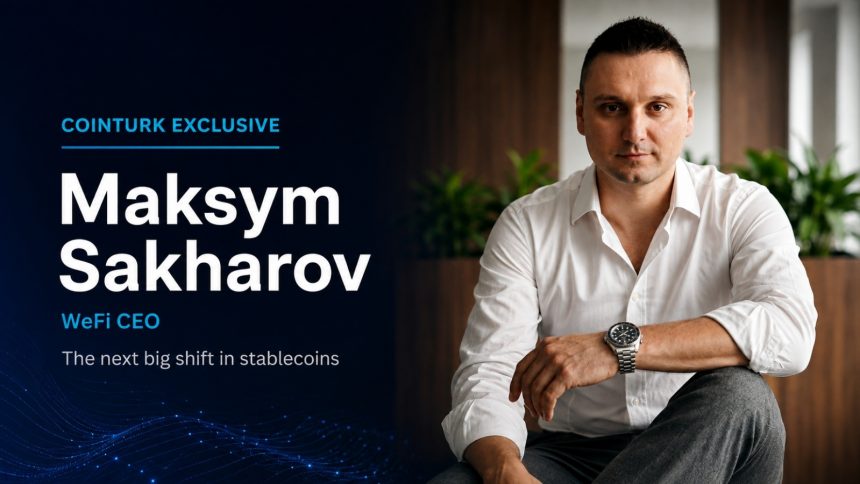
In an exclusive interview with COINTURK, WeFi CEO Maksym Sakharov discussed the future of stablecoins, competition between Big Tech companies and banks, Türkiye’s importance in the crypto market, and the development of blockchain-based financial services over the next five years. According to Sakharov, the main transformation driven by stablecoins may take place in corporate treasury and operational processes before they become widely used for everyday consumer payments.
Stablecoins Will Form the Payment Layer, While Financial Logic Will Drive the Real Innovation
COINTURK: Stablecoins are becoming part of mainstream finance. Once stablecoin payments become widespread, what do you think the next major innovation will be?
Maksym Sakharov: The next major innovation will be rules-based treasury management, where businesses can automate how funds move, settle, and are recorded. Stablecoin payments make it easier to transfer value. The next phase will give companies greater control over the processes surrounding those transfers.
Today, many treasury operations still depend on manual approvals, delayed settlement information, separately managed reconciliation processes, and fragmented visibility across different markets. Once stablecoin payments become widespread, businesses will not simply want money to move faster.
Companies will want to determine when funds move, where they settle, who can approve transactions, what conditions must be met, and how those transactions are reflected in their internal records. This is where the major opportunity lies. Payments will become part of a smarter operating system for money. Finance teams will be able to manage liquidity, supplier payments, platform payouts, and internal transfers with more precise timing and clearer control mechanisms.
Stablecoins form the payment layer. The next innovation will be the financial logic built around that layer.

The Future Between Big Tech and Banks Will Not Be Binary
COINTURK: Big Tech companies are increasingly expanding into financial services. Do you see Big Tech as the biggest competitor to traditional banks, or will blockchain infrastructure create opportunities for both sides to coexist?
Maksym Sakharov: Big Tech companies and banks will compete in certain areas. However, the more important question is how financial services will be distributed.
Many technology companies already operate within regulated financial structures or through licensed partners. Therefore, the issue is not simply a divide between unregulated technology companies and regulated banks.
Big Tech’s greatest strength is its distribution capacity. Technology companies have significant advantages through user attention, integrated digital experiences, payment access, data, and their ability to make financial tools part of everyday digital behavior.
Banks, meanwhile, continue to hold strong positions through their relationships with customer accounts, trust in their balance sheets, access to the fiat currency system, compliance operations, and regulated financial products. Blockchain-enabled financial infrastructure could transform the layer between these two sides. It could make settlement, value transfer, and programmable financial activity easier to connect across different platforms.
The future will probably not be a choice between two alternatives. It will be more layered. Some technology companies will offer more financial services, while some banks will become increasingly digital. The successful companies will be those capable of combining trusted access, a strong user experience, and modern settlement capabilities.
Settlement Processes Are Still Waiting for Their Major Transformation
COINTURK: Cross-border payments have improved significantly thanks to stablecoins. Which other financial processes do you believe are still waiting for a major transformation?
Maksym Sakharov: Settlement processes are still waiting for their major transformation. This may appear to be merely a back-office issue until it becomes expensive, slow, and operationally challenging for a business handling large numbers of payments, currencies, suppliers, platforms, or legal entities.
The fundamental problem is that the payment itself and the information about the payment often move separately. A company may have received the funds but may still need to match invoices, settlement records, bank statements, payment confirmations, foreign exchange transaction details, and internal reports.
This creates a substantial amount of manual work, even when the transfer of money itself is fast. Stablecoins can help resolve this problem if payment flows carry cleaner settlement data and connect more directly with accounting and treasury systems. The benefit is not limited to transferring money more quickly. The uncertainty and administrative workload that arise after a payment can also be reduced.
This is one of the less visible areas in which digital assets can provide value to companies that do not consider themselves crypto users. These companies may simply want cleaner records, fewer unresolved payments, and stronger financial visibility.
Perceptions Will Change When Crypto Delivers Normal Financial Outcomes
COINTURK: Many people still view crypto as an investment instrument rather than financial infrastructure. What needs to happen for this perception to change permanently?
Maksym Sakharov: This perception will change when the industry stops asking users to believe in a particular category and starts delivering normal financial outcomes.
For many people, crypto still means buying, holding, trading, or monitoring prices. That association will weaken only when the technology becomes useful in financial activities that people already know and understand. The change will take place through products that make it easier for users to receive income, make payments, access digital value, complete payment processes with businesses, or transfer money across different markets.
The technical layer should not become the main story in these products. For years, the crypto industry has marketed the investment side of digital assets. The next phase needs to focus on use cases that appear ordinary and are part of everyday life. The language being used also needs to change. If every product is explained through blockchain networks, tokens, wallets, and technical claims, mainstream users will continue to view crypto as a separate market.
When a product is described in terms of the financial function it performs rather than the technology it uses, perceptions will begin to change.
Digital Asset Adoption in Türkiye Is Primarily Pragmatic
COINTURK: Türkiye has become one of the world’s most active markets for crypto and stablecoin usage, driven by high digital adoption and economic conditions. What makes Türkiye such an important market, and what lessons can the rest of the world learn from the country’s adoption of digital assets?
Maksym Sakharov: Türkiye is an important market because it demonstrates how quickly adoption can progress when digital behavior and financial pressure come together.
Türkiye is a market with strong crypto activity, a high level of user familiarity with digital platforms, and practical reasons that encourage individuals and businesses to seek alternative ways of accessing, storing, and transferring value. The lesson is that adoption does not always wait for a perfect institutional narrative to emerge. In some markets, users move before institutions because their needs are urgent.
Users may be looking for access to dollar-denominated assets, more flexible money transfer options, or financial tools that respond more quickly than existing methods. Of course, this does not mean that every market will follow the same path as Türkiye. Türkiye has its own economic, regulatory, and user-behavior conditions. However, Türkiye demonstrates an important reality: the adoption of digital assets is often pragmatic before it becomes ideological. People use tools that solve a problem.
The main lesson for the rest of the world is that adoption can grow rapidly when financial need, digital readiness, and usable access come together.
Operational Interoperability Will Be Critical for Stablecoins
COINTURK: As more institutions enter the stablecoin market, how important will interoperability become? Do you expect different stablecoin networks to work together seamlessly in the future, or will the market remain fragmented?
Maksym Sakharov: Interoperability will be critical. However, this does not mean that the market will converge around a single network.
Fragmentation at the technical layer will probably continue because different stablecoin issuers, blockchain networks, custody providers, payment companies, and countries will continue to develop different systems. The real objective should be operational interoperability. A business should be able to send, receive, settle, and reconcile value with its own records without having to understand every network route being used.
A financial institution should also be able to connect to stablecoin activity through open standards, access to liquidity, routing mechanisms, and reliable settlement processes. This is similar to how traditional finance operates in practice. Users do not see every correspondent bank, payment processor, or messaging layer behind a transaction. They expect the payment to arrive, be completed, and be recorded correctly.
Stablecoins need to reach the same level of maturity. I believe technical diversity will continue, while product and settlement layers will become more interconnected. The market may retain its multi-network structure, but it cannot remain operationally fragmented if stablecoins are to scale.
New Users May Use Blockchain Without Owning Bitcoin or Ethereum
COINTURK: The next wave of users may not directly own Bitcoin or Ethereum, but they could use blockchain-enabled financial services every day. How should the industry prepare for this shift?
Maksym Sakharov: The industry should prepare for this shift by developing product architectures for people who do not want to manage crypto directly.
Integrated wallets, account abstraction solutions, account recovery processes, customer support, compliance checks, and access points familiar to users should be placed at the center of product design. The next wave of users may interact with these services through cards, accounts, payroll tools, money transfer products, business platforms, or treasury systems.
These users may never choose a blockchain network, hold a significant crypto asset, or think about settlement mechanisms. This changes what good product design means. The user experience should begin with the financial transaction, while technical choices should be handled in the background.
This shift also raises the standard for reliability. When mainstream users experience a problem, they expect to receive support, access clear transaction histories, be protected against fraud, and recover their accounts easily if they lose access.
For blockchain-enabled services to reach a new user base, they first need to function like reliable financial products.
Stablecoins May Become Widespread in Corporate Finance Departments Before Consumer Payments
COINTURK: Looking ahead over the next five years, which development in digital finance do you believe will surprise both the crypto industry and the traditional financial world the most?
Maksym Sakharov: The most surprising development may be that stablecoins become treasury and operations management tools before they turn into a universal consumer payment habit.
A large part of the public debate focuses on whether consumers will use stablecoins for everyday purchases. This use case may develop in certain areas, but businesses may adopt stablecoin technology earlier for less visible reasons. Treasury teams, digital platforms, businesses, and international companies face concrete problems involving settlement times, liquidity movements, record reconciliation processes, and foreign exchange risks.
If stablecoins provide solutions to these problems, adoption could grow within corporate operations before becoming widely visible on the consumer side. This could surprise both sides of the market. The crypto industry often focuses on visible user adoption, while traditional financial institutions wait for consumer behavior to change before determining whether a field has become legitimate.
However, the first strong signal may come from the operational side. Stablecoins could become standard in finance departments, settlement processes, and the payment systems of digital platforms before most people even realize they are using blockchain-enabled financial infrastructure.
About WeFi
WeFi is a technology platform developing blockchain-based financial infrastructure for fintech companies and financial institutions. Built on the WeChain network, the company aims to provide on-chain banking, rapid settlement, the management of fiat currencies and crypto assets within a single balance, distributed custody solutions, and regulation-compliant “Deobank” infrastructure.
WeFi’s solutions enable banks, payment providers, money transfer companies, fintech startups, and asset management platforms to develop blockchain-enabled financial services.