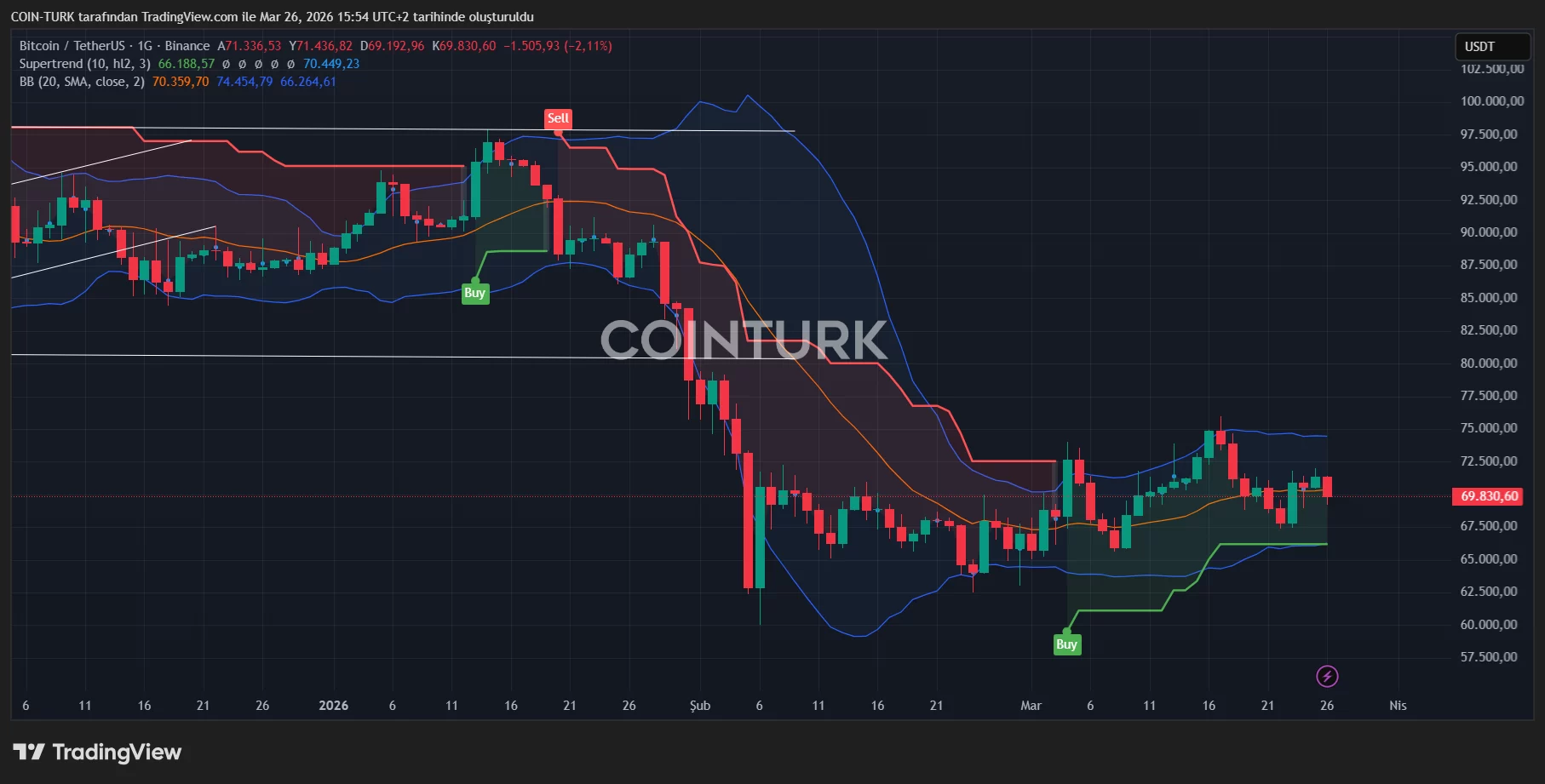
Bitcoin is once again pushing to regain the $70,000 mark, trimming its losses over the past hour. While cryptocurrency tax legislation dominates headlines in Turkey, international focus has shifted to statements emerging from Iran. Reports from the semi-official Tasnim News Agency, citing well-informed sources, suggest that an agreement with the United States could be possible if certain conditions are met, raising hopes of a diplomatic breakthrough even as uncertainty persists.
Mixed Signals from Tehran
Although a meeting between US and Iranian officials had been anticipated today, no formal announcement has been made. Despite Iran’s denials, experience suggests that high-level discussions may have taken place behind closed doors—as has occurred many times before. One source told Tasnim that the negotiation claims amounted to a “deception project,” yet former US President Trump has maintained throughout the week that talks have been ongoing. With the deadline for Trump’s ultimatum expiring this Saturday, observers expect Iran to make a concrete move; otherwise, the risk of escalation looms.
Iran’s Preconditions for Diplomacy
Iran is seeking firm assurances that war will not resume, as noted by Tasnim. Furthermore, it has underscored that ending hostilities must cover all fronts, including resistance groups. According to Iranian officials cited by Tasnim, claims from the US regarding negotiations are seen as “yet another deception project.” Tehran asserts its legal right of sovereignty over the Strait of Hormuz and demands that this be recognized, along with guarantees that obligations by other parties will be upheld. In its response, Iran insists that attacks and assassinations by its adversaries must cease. Currently, Tehran is awaiting a reply to its position regarding the latest US proposal.
Iranian Foreign Minister Abbas Arakchi elaborated on the nation’s stance, explaining how Iran differentiates between allies and adversaries in its strategic waterway:
“We have granted passage through the Strait of Hormuz to countries we see as friends. We allowed China, Russia, India, Iraq, and Pakistan to cross. However, there is no reason to let our enemy use this strait. We have warned all nations that any deployment of hostile armed forces in this region will heighten tensions. Our message to neighboring countries is simple: do not allow your land or waters to be used against us. We do not target our neighbors, only American bases and interests. Even in infrastructure warfare, we have only targeted assets with American stakeholders.”
At 16:58, a senior Iranian official provided an update, revealing Tehran’s deliberations on a US proposal conveyed via Pakistan.
In Iran’s estimation, the proposal is “one-sided and unjust,” serving only the interests of the US and Israel. Iran’s initial response—also routed through Pakistan—stressed that the proposal lacks the basic preconditions for a successful outcome.
There is, as of now, no consensus for launching negotiations, and at this point, planning a meeting would not be realistic. Turkey and Pakistan continue to work towards establishing common ground between Iran and the US. Diplomacy has not ceased, and if Washington opts for pragmatism, a viable path forward could still emerge.
With regional tensions simmering, Iran’s signals are closely watched by investors and policymakers alike. The country is adamant that any agreement must come with security guarantees, while regional actors like Turkey and Pakistan strive to lay the groundwork for potential dialogue. As both sides weigh their next steps, the international community holds its breath, aware that the days ahead may prove decisive for the stability not only of the Middle East, but of global markets as well.
Meanwhile, back in Turkey, debate over new cryptocurrency tax measures continues to engage the public, even as market fluctuations in digital assets such as Bitcoin mirror the region’s uncertainty. Against this backdrop, the interplay of geopolitical developments and economic policy will likely shape outcomes for both investors and ordinary citizens.