
Bitcoin has reclaimed the $69,000 level, and altcoins are also showing signs of recovery. Meanwhile, the New York Federal Reserve (NY Fed) has released a much-anticipated economic report today, featuring findings from the Consumer Expectations Survey for February 2026. The report carries significant weight as it sheds light on consumer sentiment regarding inflation, the labor market, and overall financial wellbeing.
NY Fed’s Economic Outlook
According to the NY Fed’s February 2026 Consumer Expectations Survey, there is a mixed, but largely positive, outlook among households on the US economy. The report characterizes the current mood as one where “labor market expectations have softened somewhat, but concerns over loan defaults have diminished.” Several highlights from the report’s summary point to shifting consumer attitudes and forecasts.
Inflation Expectations and Labor Market Trends
The survey reveals that the median one-year inflation expectation edged down by 0.1 percentage points in February, to stand at 3.0%. Expectations for inflation over the next three and five years remained stable at 3.0%. Looking at income, the median expectation for wage growth one year ahead dropped by 0.2 percentage points to 2.5%—slightly below the twelve-month average of 2.6%. Notably, the likelihood that a respondent would voluntarily leave their job in the next 12 months declined sharply by 2.8 percentage points, reaching 15.9%, the lowest reading in the series’ history.
Participants’ perception of the chance that someone who loses their job will secure new employment within three months declined by 1.6 points to 44.0%. However, the mean expectation for a higher US unemployment rate one year from now also fell, dropping by 2 points to 39.9%. This suggests that, while near-term job market confidence has softened, broader worries about rising unemployment have eased.
The NY Fed report notes that “while some confidence in the ease of finding new jobs has waned, Americans are nevertheless less fearful about overall unemployment moving higher in the coming year.”
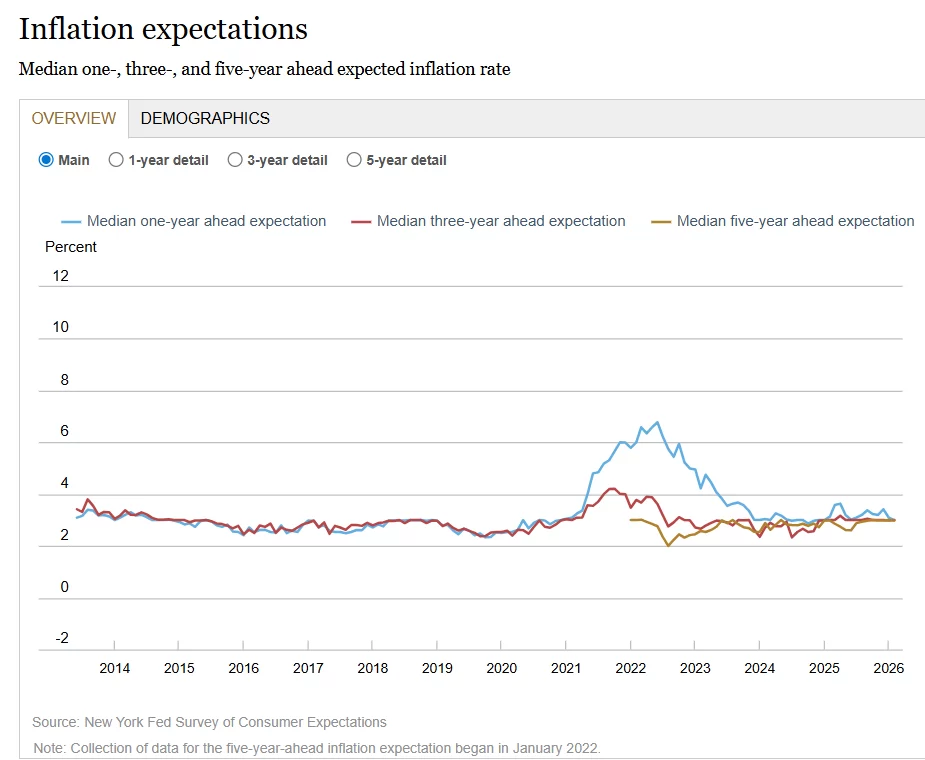
The report also provides an update on financial vulnerabilities. The average perceived likelihood of not being able to make minimum debt payments over the next three months dropped by 2.1 points to 11.6%, marking its lowest point since February 2024. Meanwhile, cost-of-living expectations indicate moderation: consumers see food prices rising 5.3% (down 0.4 points), medical care increasing 9.7% (down 0.1 points), and rent growing by 5.9% (down 0.9 points). The rental growth estimate is the lowest recorded since December 2024.
This general cooling in inflation expectations and the declining sense of uncertainty could strengthen the Federal Reserve’s case for cutting interest rates in the coming months. Signs of a slower labor market also reinforce this narrative, aligning with data released last week. However, the NY Fed cautions that new geopolitical tensions, particularly the recent escalation involving Iran—which unfolded after data collection for this survey—could impact future inflation, especially in the energy sector.
“While inflation and labor market trends might support potential rate cuts, we must recognize that global events, such as the flare-up with Iran, could still disrupt these dynamics, especially in terms of energy costs,” the Fed emphasized in its assessment.
Overall, the February 2026 Consumer Expectations Survey points to a landscape where Americans expect price increases and economic pressures to moderate, while household and labor market confidence remains resilient, albeit with lingering caution over possible external shocks.
Market observers and policymakers alike will monitor these developments closely, as they balance domestic economic signals with ongoing global uncertainties.
The NY Fed’s findings offer a snapshot of public sentiment that could shape monetary policy decisions moving forward, particularly if easing inflation and faltering labor strength persist in the coming quarters.