Decentralized finance (DeFi) has solved a fundamental problem that traditional finance never truly addressed: direct asset ownership and unrestricted market access. Today, anyone can hold their funds in a personal wallet, transfer capital instantly, and interact with financial infrastructure without any intermediaries.
Real-World Assets Shift from Hype to Tangible Market
Despite this progress, crypto users still face an old dilemma. Even portfolios diversified with different tokens, protocols, and strategies are heavily exposed to a single underlying factor: crypto liquidity cycles. When volatility spikes, most of the market reprices in unison, diminishing diversification benefits.
This is precisely why real-world assets (RWAs) have become a hot topic in the sector. RWAs are not just a trendy narrative; they represent a new way to access fundamentally distinct asset classes—like cash equivalents, credit, commodities, and equities—beyond the crypto universe.
Tokenized Treasuries and New On-Chain Infrastructures
Bringing these assets onto blockchains, however, has proven challenging. Many solutions have recreated the very frameworks DeFi sought to avoid—custodial institutions, geographic restrictions, middlemen, and permissioned access regimes.
A new era is emerging. RWAs are now not only being tokenized but also integrated into DeFi in a manner compatible with self-custody and composable on-chain infrastructure. This marks a decisive step beyond mere representation.
Just a few years ago, tokenized real-world assets were considered mostly experimental. Today, the space has matured enough to stand as a distinct market category. According to leading data sources like RWA.xyz, about $21 billion worth of RWAs are currently active on public blockchains, owned by more than 620,000 wallets. In just two years, this market has expanded more than tenfold. If we include stablecoins, the scope broadens dramatically, with stablecoins alone valued at nearly $298 billion held by over 220 million users.
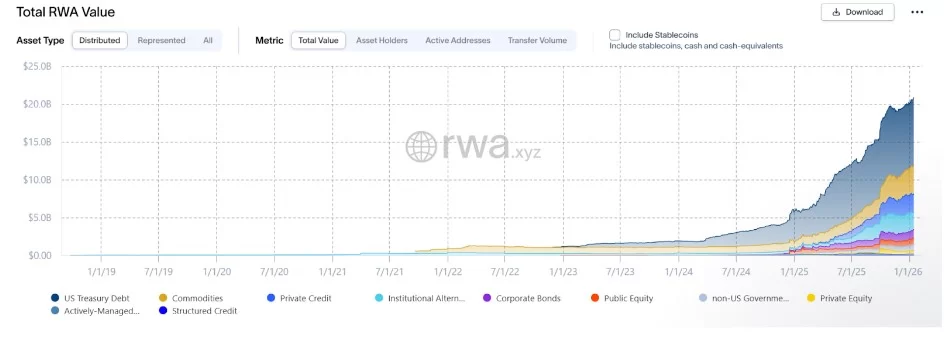
Within the RWA ecosystem, tokenized US Treasury bonds have become a standout sector, reaching a market cap of around $9 billion, up from $3.8 billion just a year ago. Those assets are now distributed across 62 different products with roughly 59,000 holders, underscoring investors’ growing comfort with holding tokenized versions of traditional financial products on a larger scale.
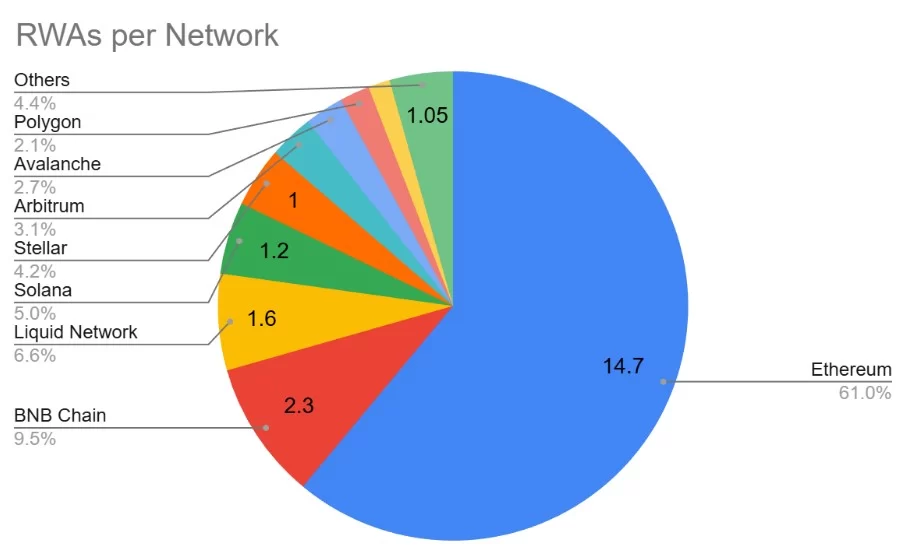
Ethereum continues to dominate this market: approximately $12.8 billion in tokenized RWAs exist on the Ethereum blockchain, accounting for about 61% of the total, per RWA.xyz data. As the category grows, however, success might be defined less by issuance volume and more by distribution—where and how these assets are actually used. Ecosystems enabling daily on-chain use of RWAs could eventually enjoy the strongest adoption.
Looking further, institutional forecasts point to substantial potential for tokenized assets. McKinsey predicts the market cap for these assets (excluding crypto and stablecoins) could reach $2 trillion by 2030. Boston Consulting Group estimates the value of tokenized illiquid assets could hit $16 trillion over the same period. While predictions vary and guarantees are elusive, the general direction is clear: RWAs are maturing from a speculative idea into a significant financial category.
The Centralization Paradox in Many RWAs
Yet, despite rapid growth, a significant portion of DeFi users has yet to fully embrace RWAs. The main issue lies in their structure: most tokenized assets are not truly managed on-chain. Underlying assets remain off-chain, custody is performed by traditional financial institutions, and regulatory constraints often limit participation.
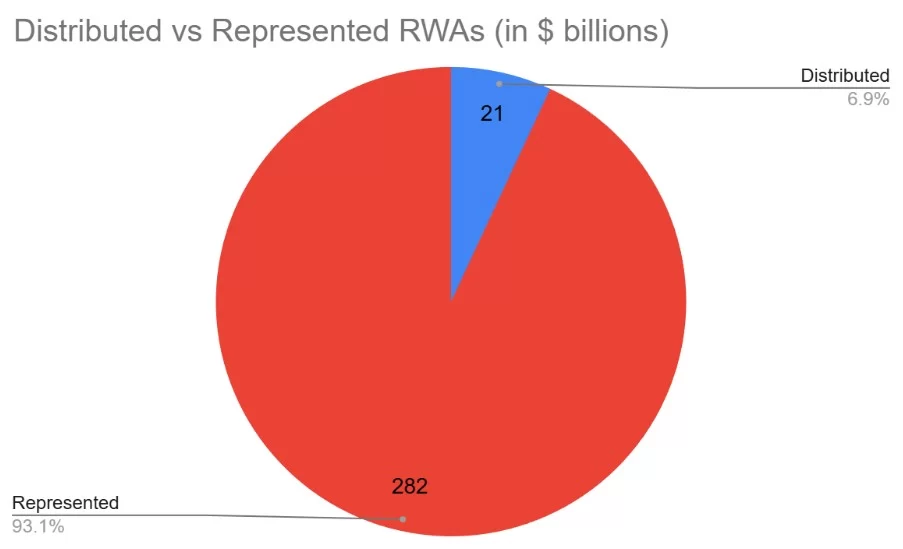
RWA.xyz highlights this by distinguishing between “distributed” and “represented” assets. Distributed RWAs can move freely between wallets and platforms, whereas represented RWAs are trapped within the issuing platform’s ecosystem, functioning more like internal ledgers than transferable assets.
This distinction is crucial. Currently, the value of represented RWAs has surpassed $280 billion—vastly exceeding that of distributed RWAs. It reveals a larger friction within tokenization: while tokenization activity is booming, a substantial chunk of it is geared toward institutional systems, not the open DeFi markets.
Regulation dictates much of this structure. Tokenization providers often restrict access geographically or mandate the use of licensed intermediaries. For instance, the Swiss-based tokenized securities issuer Backed distributes products exclusively via licensed entities and restricts access in certain jurisdictions, including the US. These safeguards are necessary for regulated financial products but mean many RWAs still resemble traditional finance in management and accessibility.
Ultimately, while tokenization is happening, it does not always fully align with DeFi’s hallmark of open architecture.
DeFi-Focused RWA Access on TON’s Blockchain
One initiative aiming to bridge the gap between tokenization and practical usability is xStocks, available on the STON.fi protocol.
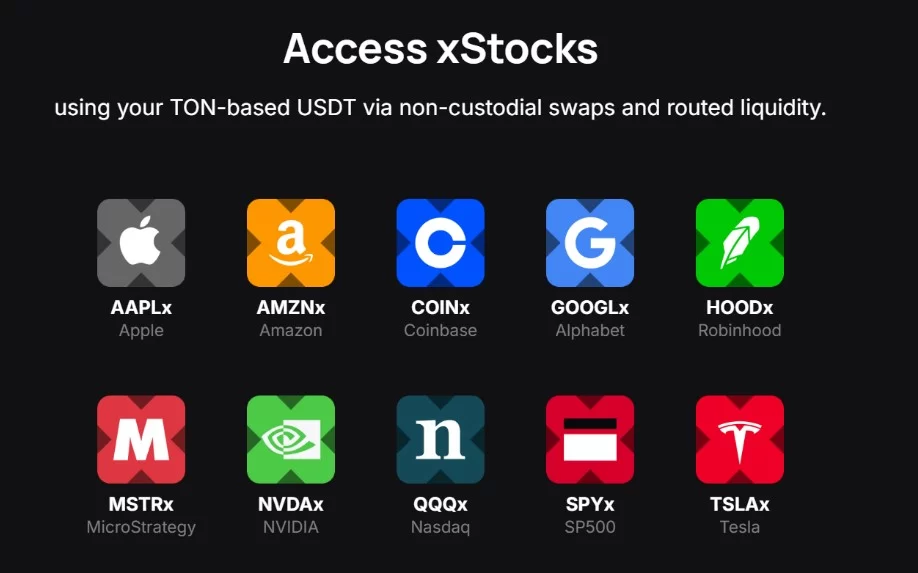
xStocks are tokenized representations of select US equities and ETFs issued on the TON blockchain by Backed Assets (JE) Limited. They are designed to track underlying asset prices and allow eligible users to trade them within the TON ecosystem.
Legally, these are on-chain tracker certificates that mirror the performance of specified stocks or ETFs, structured as debt instruments issued by Backed. They do not confer shareholder rights in the underlying companies. Popular names such as AAPLx, NVDAx, TSLAx, SPYx, and QQQx headline the initial lineup.
Crucially, xStocks emphasizes a DeFi-native relationship: self-custody is at the core. Users control their wallets, while STON.fi acts purely as infrastructure rather than as a broker or intermediary.
Transparency is another highlight. xStocks are fully backed, 1:1 with underlying stocks, and utilize reserve proof mechanisms by the issuer and custodian. In terms of operations, DeFi design prevails—users can swap xStocks with other TON-based assets on STON.fi, while independent resolvers on the Omniston protocol optimize routing to minimize slippage and deliver better prices.
This system also provides 24/7 access—a hallmark of blockchain markets. While traditional stock markets run on fixed schedules, tokenized access lets users manage portfolios on-chain any time of day. Nonetheless, regulatory and market structure limits remain; the main advancement is closer alignment between traditional market exposure and DeFi principles.
Moving from Tokenization to Usability
The RWA sector has crossed a critical threshold, evolving from a speculative concept into a measurable, actively adopted market. At the same time, much tokenization still happens within permissioned, traditional financial infrastructure rather than in open DeFi environments.
The next evolution will likely focus not just on minting more tokenized assets, but on making them truly usable in environments where crypto users are already active. Integrations like xStocks on STON.fi provide a case in point, combining regulated market access with the self-custody and composability that define DeFi ecosystems.
In crypto, portfolio diversification has long meant adding more tokens. RWAs, however, hint at a broader horizon—expanding the variety of assets that can participate in on-chain finance.
This article was researched and written by STON.fi Dev CEO Slavik Baranov, a technology executive with nearly three decades of experience in software development, fintech, and blockchain innovation. Under his leadership, STON.fi Dev developed one of the leading AMM protocols on the TON blockchain. xStocks are tokenized securities (tracker certificates), available only where permitted by law. STON.fi does not issue, list, or facilitate direct trading of these products; interaction with them is solely via third parties and in permitted jurisdictions. This article is for informational purposes only and does not constitute an offer or solicitation for any security.