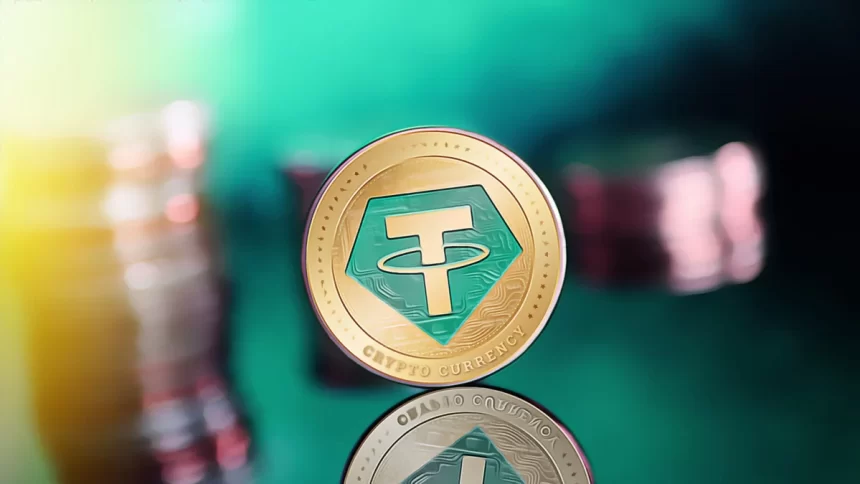
Tether, the world’s largest stablecoin issuer, has significantly boosted liquidity in the crypto market by minting over $5 billion worth of USDT on the TRON blockchain within the past two weeks. In its most recent transaction alone, the company added around $1 billion USDT to the TRON network. Altogether, the total USDT supply on TRON has seen a sharp rise during this period.
Sharp rise in liquidity demand
The massive USDT issuance by Tether in such a short timeframe highlights the market’s sudden demand for dollar-based liquidity. Back in April, the company produced 2 billion USDT on the Ethereum network within just three days, underscoring a persistent growth in market demand since the start of the year.
Driving this increase are recent milestones such as Bitcoin’s surge above $80,000 for the first time in a long while and the rapid liquidation of short positions. At the same time, institutional buyers withdrew more Bitcoin from the market each day than five times the daily mined supply. According to CryptoAppsy data, demand for Tether spiked as Bitcoin’s price crossed the $80,000 threshold.
According to the company, “USDT issuance volumes are generally determined by large orders from major buyers; a spike in demand signals greater need for dollar-based tokens in the market.”
The newly issued $5 billion USDT represents about 2.6% of Tether’s total circulating supply. In terms of market capitalization, Tether’s total USDT now stands at $189.5 billion. The company’s dominance in the stablecoin market has climbed to 58.9%. As of April 2026, the overall stablecoin market hit a record $321 billion in total volume.
USDT growth and regulatory moves
During the same period, Tether took decisive action on the TRON blockchain in collaboration with the U.S. Treasury Department’s Office of Foreign Assets Control and American law enforcement agencies, freezing a combined $344 million in USDT held in two wallets. One wallet contained approximately $213 million, while the other held $131 million. Tether stated that it froze these funds based on information from U.S. authorities linking the wallets to illicit activities.
Tether CEO Paolo Ardoino emphasized, “USD₮ is not a safe haven for unlawful activity. When credible links to sanction regimes or criminal networks are confirmed, we respond quickly and decisively.”
To date, Tether has frozen over $4.4 billion in assets related to illegal activities, with more than $2.1 billion of that total resulting from cooperation with U.S. law enforcement authorities.
Microtransactions and payment cards surge
The data also shows that USDT use is surging among individual users beyond large transactions. Paolo Ardoino revealed that 3.6 billion separate USDT transfers under $100 were made in 2025, indicating USDT’s growing role not only in inter-exchange settlements but also in micro-payments.
Usage of crypto-based payment cards has climbed as well. Monthly spending volume via these cards reached $600 million—a sixfold increase compared to the previous year. On-chain card transactions have totaled $7.2 billion, covering 24 million transactions and 1.36 million unique wallet addresses.
A remarkable 62.5% of these card transactions have been conducted using Tether’s USDT, with 90% of transactions processed through Visa. The Solana ecosystem also saw $348 million in transaction volume, while Jupiter Global posted a 660% monthly growth rate.