Rich Dad Poor Dad, published in 1997, has become one of the world’s best-selling personal finance books, earning its author Robert Kiyosaki a place among the most recognizable names in finance literature. Kiyosaki, whose book featured on lists such as The New York Times, Business Week, Wall Street Journal and USA Today, shared some significant observations recently, reigniting discussions about the future of global finance.
Turning point in 1974 received renewed attention
Known for his bullish stance on assets like Bitcoin and precious metals, Kiyosaki has long encouraged his audience to accumulate gold, silver, and BTC, often warning that major shifts are on the horizon. The recent surge in silver prices appears to have given his views greater weight in public discourse. Now, Kiyosaki describes another critical “turning point” for global economics, echoing upheavals of the past.
According to the author, the year 1974 fundamentally reshaped both global monetary and pension systems. He links today’s resurgence of inflation, tensions in oil-producing regions, and related economic pressures to the historic end of the gold standard and subsequent evolution of the US dollar.
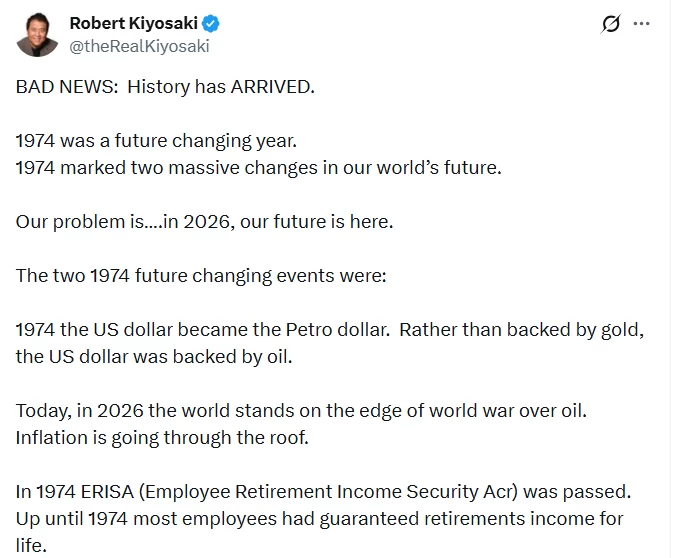
“1974 was a year that changed the future. It marked two major shifts in our world’s fate.
Our problem is this… in 2026, our future will arrive. Two pivotal moments came in 1974:
That year, the US dollar became the Petrodollar—backed not by gold, but by oil.
Today, by 2026, the world is on the brink of war over oil. Inflation is at its peak.
In 1974, ERISA (Employee Retirement Income Security Act) was passed. Before ERISA, most workers enjoyed lifetime guaranteed pensions. Afterward, millions shifted to 401k, RRSP, and IRA plans that provide no guarantees. Soon, millions of baby boomers will realize they have no income after they retire.
Adding to this chaos, Social Security and Medicare are insolvent.
When oil prices push up food and fuel costs, millions of baby boomers will end up homeless or living in RVs. All this is happening as the world, nations, and individuals are drowning in debt.
America has become one of the greatest debtor nations in history.”
For years, Kiyosaki’s predictions have often been seen as overblown or alarmist. Still, silver’s dramatic rally has lent more credibility—or at least visibility—to his ideas. He argues that rising energy costs and supply disruptions could accelerate price increases, eventually driving the US toward insolvency. Such a scenario, he claims, would spell the end for the dollar as the world knows it.
Extraordinary conditions and policy response
However, critics note that bold forecasts like Kiyosaki’s often overlook one crucial factor: extraordinary situations can prompt extraordinary policy responses. For example, despite recent upheavals, the Federal Reserve could cut interest rates or inject liquidity to stabilize markets. The US retains the unique power to print money, as witnessed during the pandemic era. Back then, dire predictions also dominated headlines, when lockdowns stalled production and broke supply chains worldwide. Ultimately, central banks took decisive actions—even at the cost of future consequences—and the crisis was weathered. From this lens, one could argue Kiyosaki underestimates the capacity for such interventions should new turmoil emerge.
Bitcoin, gold, and silver as safeguards
Staying true to his longstanding message, Kiyosaki again urges investors to safeguard themselves against systemic shocks by acquiring what he calls “real money”—gold, silver, and Bitcoin. He presents these assets as hedges for an uncertain future shaped by decisions made in the mid-1970s.
“I continue to advise you to save real money… gold, silver, and Bitcoin… and to keep investing in your financial education.
The FUTURE created in 1974 has arrived. Don’t let the losers determine your financial future. Only you can shape your destiny. Build a prosperous future for yourself,” Kiyosaki said.
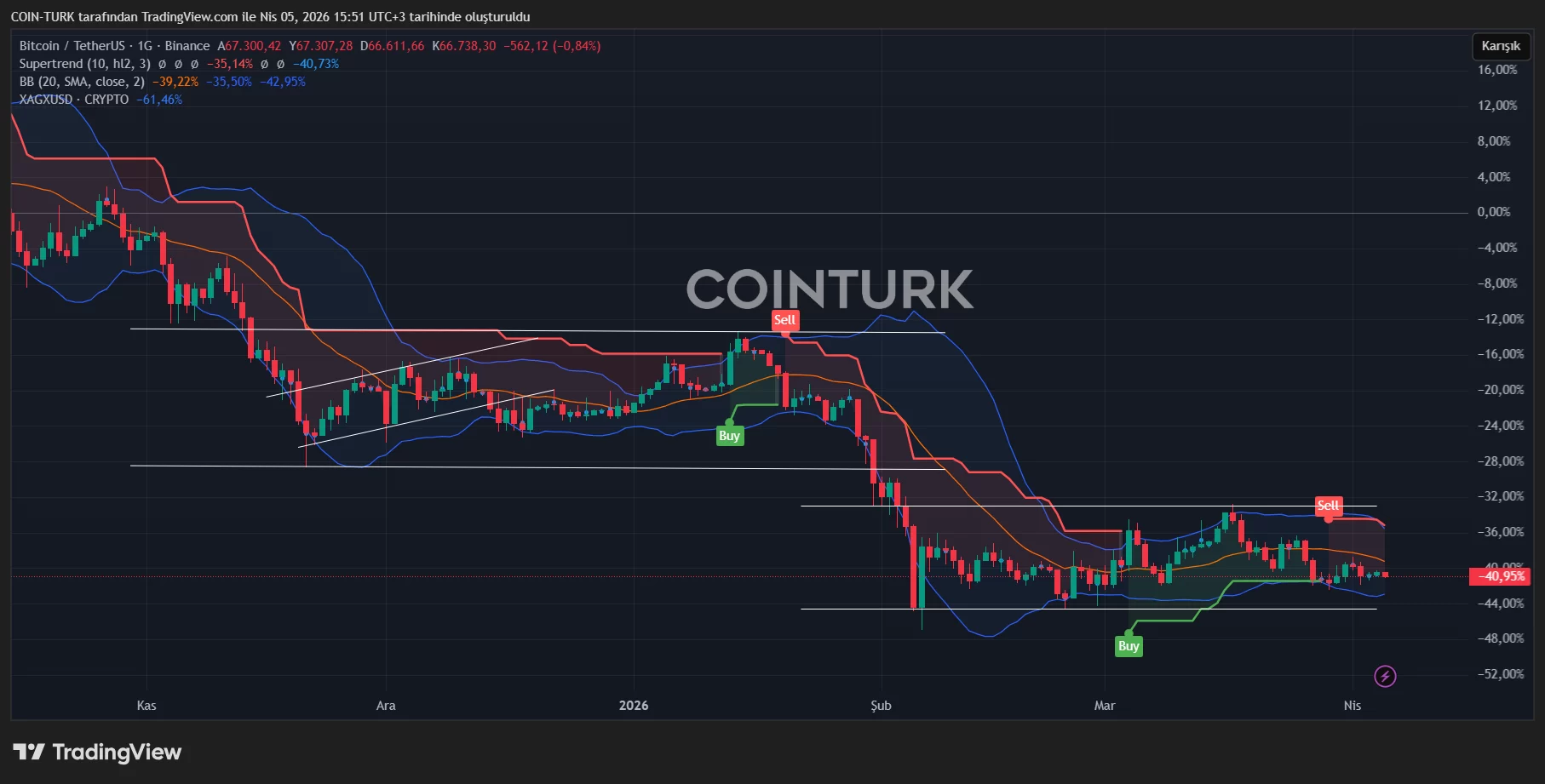
It’s worth recalling that Kiyosaki previously disclosed selling Bitcoin in November 2025; he sold holdings bought for $6,000 each at a price of $90,000 apiece. After this $2.25 million sale, he reportedly invested the proceeds in surgery centers and billboard advertising ventures. Soon after, Bitcoin experienced significant price declines. Today, as Kiyosaki again advocates buying Bitcoin, observers note his timely exit last fall—and point out that, with stagflation concerns rising, even his billboard business bet may face hurdles.