The XRP market in recent weeks exhibits a Blockchain scenario reminiscent of a prolonged period of weakness. Blockchain data highlights that short-term investors have moved to a relatively advantageous position, while more seasoned buyers remain under the pressure of losses. This analysis suggests that the current price compression coupled with psychological thresholds may strengthen the selling tendency, creating a fragile balance for recently positioned investors.
Blockchain Data Resembles Early 2022
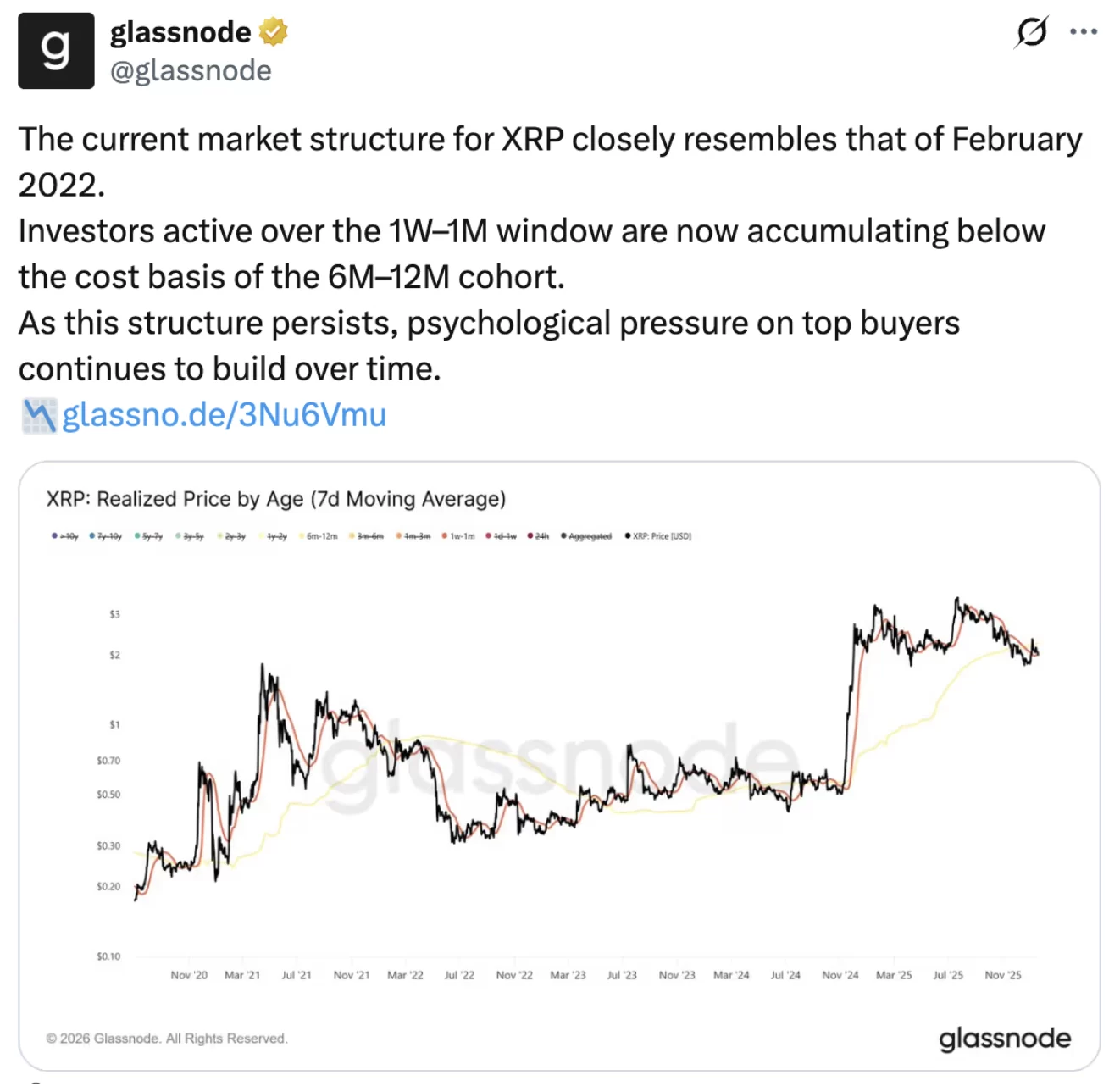
Blockchain analysis firm Glassnode reports that XRP’s current cost-based distribution is showing structures similar to those in early 2022. According to the data, investors who purchased between one week to a month ago accumulated assets at lower costs compared to those who opened positions six to twelve months prior. This development brings short-term participants to a profitable point while leaving medium-term investors in the loss zone.
The cost difference emerges as a decisive factor in market psychology. During periods when upward price movement is challenging, the inclination to sell among investors registering losses increases. Blockchain data reveals a notable divergence between short-term groups in profit and more experienced participants under cost pressure.
A similar pattern emerged when XRP traded around $0.78 in February 2022. In the following months, the price dropped to $0.30 by mid-summer, initiating an extended decline. Although the current outlook does not necessarily imply a similar trajectory, past events offer a strong reference for shaping investor behaviors.
The $2 Level Shapes Selling Behavior
For XRP, the $2 region serves as a significant behavioral threshold since mid-2025. Glassnode data shows approximately $500 million to $1.2 billion in realized losses on a weekly basis each time this level is tested. This indicates that investors perceive this range as an exit point rather than a new buying area.
As long as the price remains below $2, pressure increases on participants who opened positions at higher costs. While short-term investors are purchasing at lower levels, long-standing groups are positioned to sell with the expectation of reaching a breakeven point. This contrast emerges as a key factor complicating the direction of the price.
The current structure creates a balance that prevents a clear market direction from forming. Short-term demand supports the price while supply from previous periods limits the movement space. As the cost disparity within the Blockchain persists, pressure is expected to remain on investors who bought near recent peaks.