One of the longest-standing digital assets in the crypto sphere, XRP, is undergoing a striking shift in its investor base, as revealed by updated wallet data from February 2026. Recent figures indicate a dramatic 30% increase in total wallets, demonstrating XRP’s widespread adoption across the globe. Today, holding as few as 2,232 XRP is enough for an investor to be counted among the wealthiest 10% of all XRP wallets worldwide—a testament to a radical democratization of ownership. These shifting metrics highlight a critical market phase where robust institutional interest and an influx of retail participants converge.
Retail Investors Propel Wallet Growth and Decentralization
Between December 2024 and February 2026, the total number of XRP wallets surged from 5.97 million to 7.79 million, signaling unprecedented activity and expansion in the ecosystem. Most notable is the sharp rise in wallets holding fewer than 500 XRP, pointing to growing confidence among small-scale investors and the lowered barriers for entering the market. Meanwhile, a steady increase in accounts holding between 500 and 10,000 XRP underscores a collective embrace of long-term accumulation strategies among individual savers.
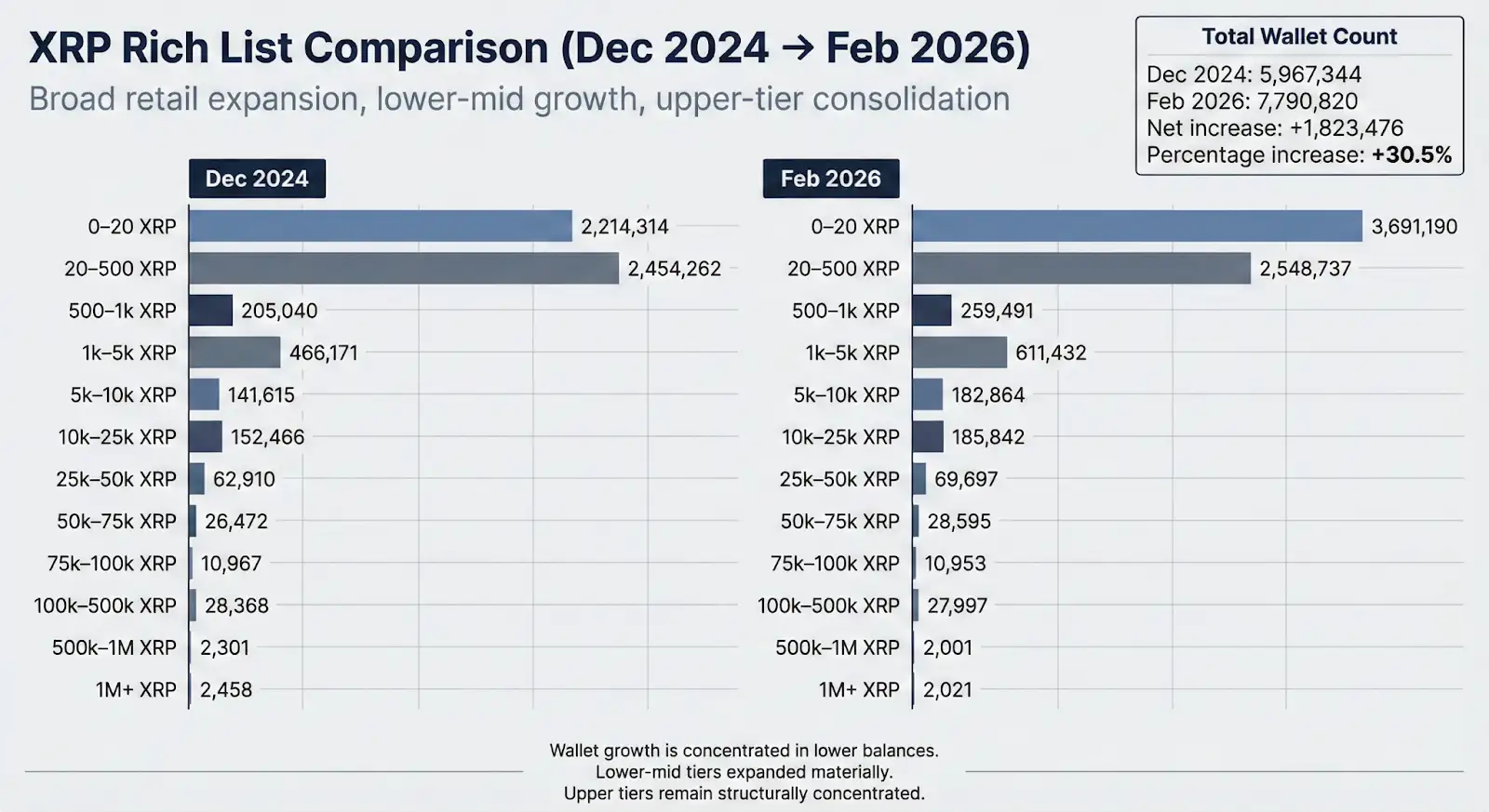
A closer look at the wealth breakdown reveals a more dispersed landscape: to enter the top 5%, an investor now requires 7,700 XRP, while the exclusive top 1% threshold stands at around 46,400 XRP. Lowered entry points compared to prior years suggest that XRP is no longer concentrated in the hands of a select few but rather distributed across a broad and diverse community. This diffusion is seen as a healthy form of organic growth, enhancing the asset’s resilience to market manipulation.
The massive uptick in wallet numbers represents more than just quantitative growth. It also signals XRP’s accelerating acceptance at a global scale. Notably, the slight decrease in holdings by “whale” accounts—those with over 1 million XRP—reflects a transition, as millions of new small investors absorb market liquidity. This shift paints a picture of a more democratized XRP Ledger, becoming firmly rooted in financial records as evidence of structural transformation.
Infrastructure Development and Institutional Strategies
Ripple CEO Brad Garlinghouse has repeatedly stressed that XRP’s outlook is built not on short-term price speculation, but on years of meticulous infrastructure work. The company is focused on building regulatory-compliant foundations in critical sectors such as cross-border payments, improved liquidity management, and real-world asset tokenization. Against a backdrop of volatility, institutional players are quietly establishing positions, seeking to strengthen XRP’s role as a linchpin in the evolving architecture of international finance.
As market observers debate whether XRP can decouple from Bitcoin’s price trends, many suggest that the current accumulation phase could be decisive. Signs of institutional adoption and anticipated ETF inflows are helping shift XRP’s identity—from merely another cryptocurrency to a viable, global payment solution. This strategic positioning establishes deep roots for the asset, allowing it to weather speculative waves and stand out with a robust foundation.
Shifts in wallet hierarchy further reveal that, unlike investors who react to periods of fear and uncertainty, those with a long-term vision are holding their positions. Ongoing improvements in liquidity pools and advances in the XRP Ledger’s technology have broadened the platform’s use cases, making the ecosystem increasingly attractive. Ultimately, this infrastructure-driven expansion offers valuable clues about the role XRP will play in upcoming market cycles.