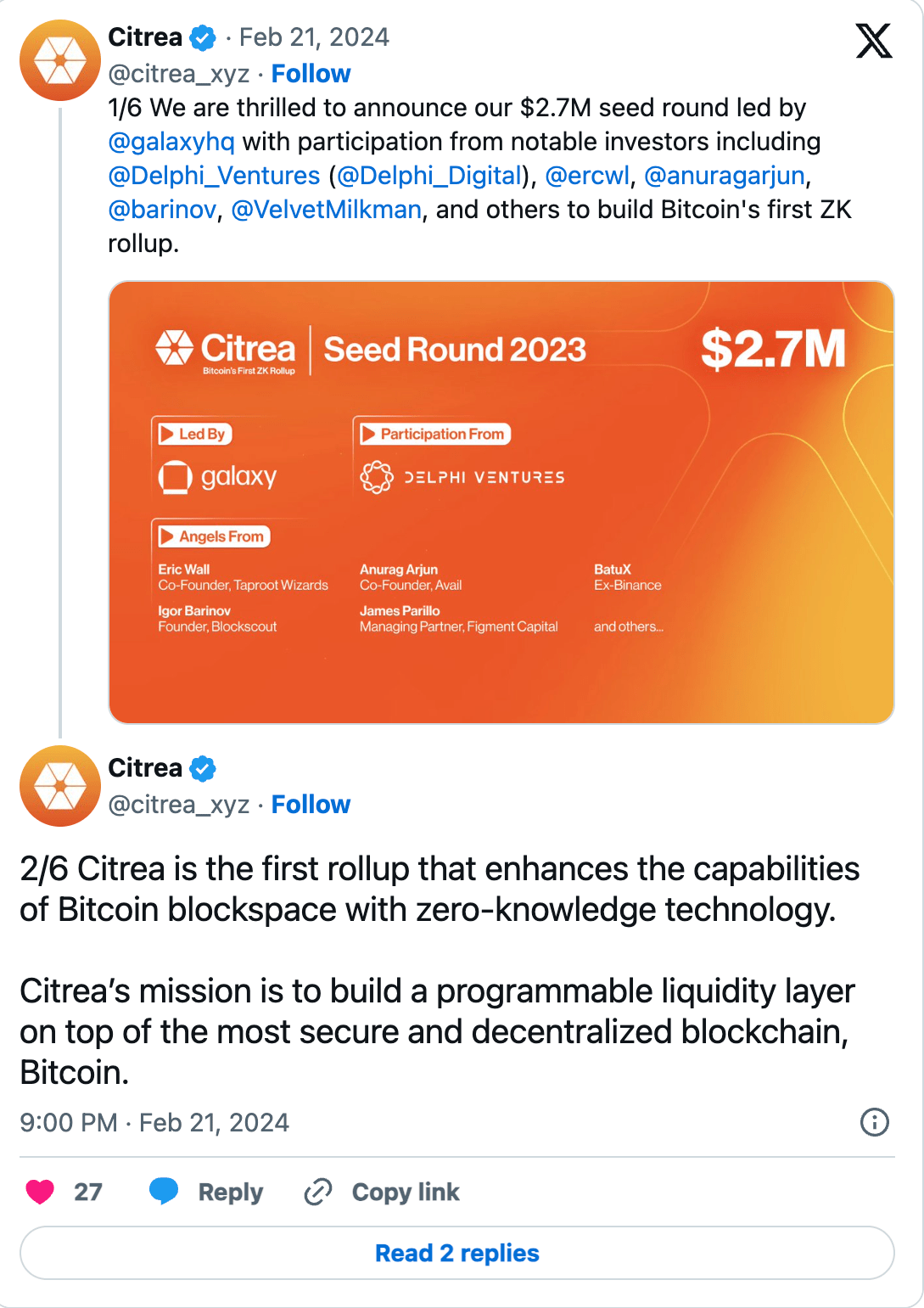
A project aimed at bringing a zero-knowledge roll-up solution to the Bitcoin ecosystem, Citrea, has successfully closed a $2.7 million investment round led by Galaxy Digital’s venture arm Galaxy Ventures. The project announced in a blog post dated February 2 that the funds would enable the launch of Citrea by blockchain infrastructure company Chainway Labs.
Notable Advances from the Citrea Team
The company stated that Citrea is the first rollup solution that enhances the capabilities of the Bitcoin blockchain area with zero-knowledge technology and makes it possible to build everything on Bitcoin. The round was completed in 2023 and saw participation from Delphi Ventures, Taproot Wizards co-founder Eric Wall, Blockscout founder Igor Barinov, and others.
ZK-rollups can be described as concepts more commonly associated with Ethereum through Layer-2 blockchain networks like Polygon and zkSync. ZK-rollups aim to be efficient and cheaper by bundling transactions on the second layer of ecosystems and securing them with a cryptographic protocol called ZK-proofs.

Bitcoin also has second layers focused on payment solutions, such as the Lightning Network, and scaling projects like ZKSats and Rollux that will compete with Citrea. In its post on the subject, Citrea claimed that ZK-rollup addresses the challenges of Bitcoin in processing more transactions and supports various applications without changing the consensus rules:
“In doing so, Citrea uses Bitcoin not only as a cryptocurrency but also as a foundational layer for securing and executing transactions.”
Anticipated Moves in the Bitcoin Ecosystem
Bitcoin developers are experiencing a growing split over how the blockchain ecosystem should be used. Some believe it should maintain its use as a peer-to-peer cryptocurrency as described in the whitepaper, but recent projects like Ordinals that allow NFT-like assets and the BRC-20 standard that permits speculative tokens challenge this view.

Citrea stated in a blog post published on February 6 that it aims to turn the Bitcoin ecosystem into a foundational layer for blockchain games, NFTs, and the decentralized finance (DeFi) ecosystem without compromising security and without changing consensus rules. The solution also relies on the Ethereum Virtual Machine, which allows all EVM developers to build on Bitcoin.