
The Federal Reserve is preparing for one of the most significant leadership changes in its history, with only a few weeks remaining before the transition. Last year, Donald Trump interviewed several potential candidates before declaring he would appoint someone “who will not resist rate cuts” as the next Fed Chair. Subsequently, Kevin Warsh emerged as Trump’s nominee.
Warsh secures committee approval
Kevin Warsh, testifying before the Senate Banking Committee last week, argued that inflation could be reined in through interest rate cuts and a reduction of the Fed’s balance sheet. According to Warsh, employment risks tied to Trump’s immigration policies could be offset, suggesting a different stance from the current Fed, which has not considered rate cuts necessary in light of the ongoing war. Warsh, however, has signaled his intent to implement such cuts.
Today, Warsh received the crucial nod from the Senate committee, a necessary step before the full Senate vote. Democrats had demanded that the investigation into Jerome Powell end before confirming Warsh, a condition met last Friday when the Department of Justice complied. Just minutes ago, the Banking Committee approved Warsh, clearing the way for the next vote.
With committee approval now in hand, Warsh’s nomination moves to the full Senate after the chamber reconvenes following its recess in the week of May 4. Barring any unforeseen surprises, Warsh is expected to secure enough votes and formally succeed Powell on May 15. The uncertainty surrounding his appointment has effectively ended with the outcome of this preliminary vote.
Powell’s era concludes
As the Fed meeting approaches in a matter of hours, Warsh’s approval means Jerome Powell’s remarks today will likely serve as his farewell address as Chair. Powell has led the institution for an extended period, and though he could choose to remain as a board member, tonight’s statements are particularly crucial as he prepares to step down. In the previous meeting, the Iran crisis was not at the forefront, but as the war nears its second month, monthly energy inflation has climbed by 1%.
Markets will be closely watching Powell’s commentary on the course of inflation and the independence of the Fed. When Trump previously attempted to remove him, Powell famously told reporters he was being “threatened with jail for not cutting rates.” Tonight presents a final opportunity for Powell to assert his position and perhaps direct a message to Trump. Observers are also keen to hear any guidance Powell offers Warsh, particularly on safeguarding the central bank’s independence.
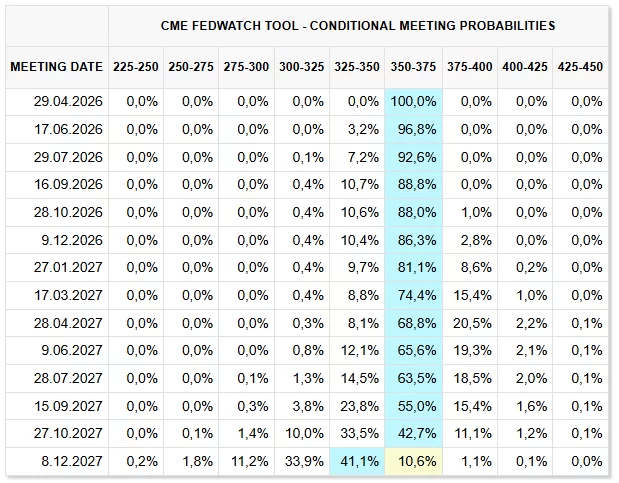
According to CME FedWatch data, markets do not expect rate cuts before next year. Although prolonged conflict has cemented inflationary pressures, any swift rate reductions under Warsh, as Trump desires, could reignite debates about the Fed’s autonomy in monetary policy. The consequences of these evolving dynamics remain to be seen in the coming weeks.
For now, the stage is set for an extraordinary change in leadership at the Fed, a transition that could have far-reaching consequences for monetary policy, financial markets, and global economic stability. Eyes will especially be on the relationship between the Trump administration and the central bank, given the president’s track record of prioritizing growth-friendly policies, sometimes at odds with economic orthodoxy.
Kevin Warsh, known for his stance on faster policy adjustments and support for market-driven reforms, enters a role filled with challenges. Balancing inflation controls, labor market shifts, and demands from the administration will put both his independence and leadership style to the test.
The new chair’s first actions will be scrutinized by policymakers, investors, and international partners alike. Any move perceived as politically motivated could spark renewed attention on the independence of America’s central bank and rattle market confidence.
Meanwhile, outgoing chair Jerome Powell’s legacy will hinge on his resilience during turbulent times and his parting words this evening. The tone and substance of today’s remarks could shape the transition and offer important signals to both Warsh and the broader public about the path ahead.