
The Purchasing Managers’ Index (PMI) provides critical insights into the current state of the US economy by tracking the mood in key sectors. Today’s updated PMI data arrives at a pivotal time, following recent conflicts involving Iran, and offers fresh clues about the US manufacturing industry’s health. With the Federal Reserve preparing its next interest rate decision in May, eyes are firmly on whether troubling signals are hidden in the data.
US PMI report snapshot
The US Manufacturing PMI showed marked improvement in April compared to March. The seasonally adjusted manufacturing PMI rose to 54.5 in April, from 52.3 in March. This was the strongest expansion reported since May 2022, signaling notable growth. The improvement was largely driven by inventory building, as firms sought to shield themselves from rising raw material costs and ongoing supply chain disruptions.
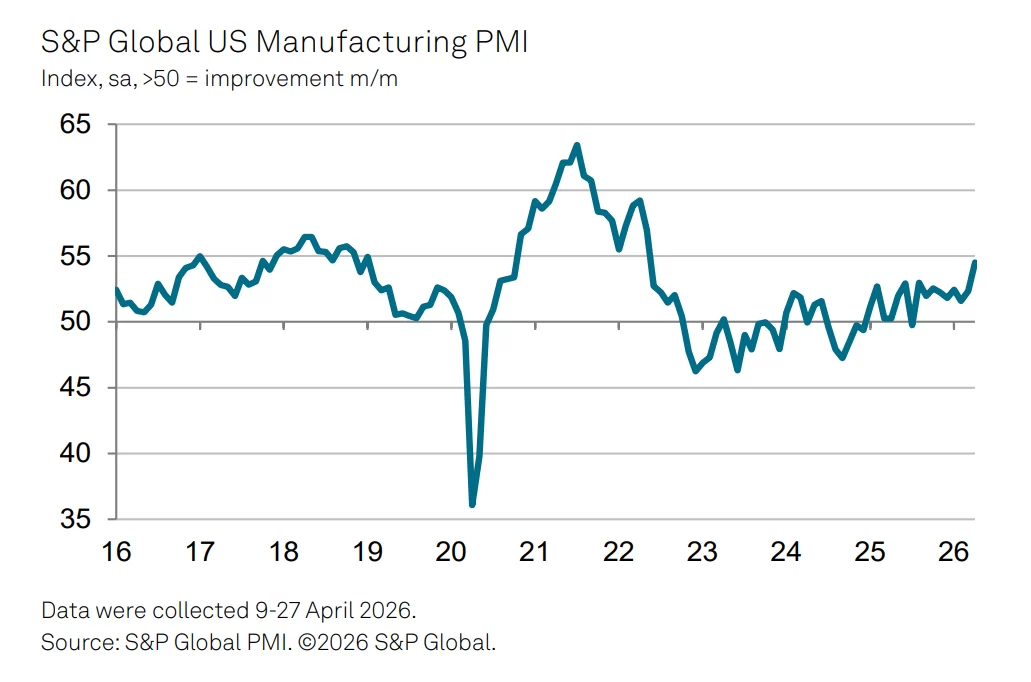
Export weakness and cost pressures
New orders and production volumes saw the fastest increases in four years, though most of this growth was concentrated in the domestic market. Meanwhile, US exports have now declined for eleven consecutive months, highlighting the lingering impact of the Iran conflict on overseas demand. Both input and output prices jumped at their fastest pace in the last ten months as manufacturers hiked selling prices to offset rising costs, pushing operational expenses and wages to near yearly highs. These developments present renewed challenges for inflation and complicate the Fed’s rate setting decisions.
Chris Williamson, Chief Business Economist at S&P Global Market Intelligence, commented as follows:
“The increase in manufacturing activity seen in April is not as encouraging as it might initially appear. The main force behind this rebound is the need for firms to get ahead of anticipated price hikes and supply disruptions; this likely provides only a short-term boost, as the negative effects on the economy could intensify in coming months.
Purchasing growth reached its fastest rate since the pandemic. This stems from more frequent supply delays and price increases due to the Middle East conflict, as well as existing inflation and supply pressures aggravated by tariffs.
With input costs rising, businesses are now under mounting pressure to reduce overheads, resulting in lower employment; at the same time, producers have increased their selling prices to defend profit margins.
On a more positive note, production expectations for the coming year have improved. This reflects optimism that the US economy may be less affected by the conflict than feared and that worries over tariffs are receding following the Supreme Court’s recent ruling.”
The report underscores a dual dynamic: manufacturers are showing resilience and caution, concurrently stockpiling inventory while battling cost and supply challenges, particularly as global tensions persist. The conflict in Iran has amplified supply chain risks and put extra pressure on export performance, shaping business decisions across the sector.
The increase in production and orders, largely fueled by domestic demand, has not translated to export growth. Instead, it has underscored the vulnerability of US exporters to international developments.
The latest PMI figures signal a complex landscape ahead for Federal Reserve policymakers. Rising prices, increased operational expenses, and persistent inflation could force a more cautious approach in the upcoming interest rate meeting.
Expectations remain mixed: while the short-term PMI rebound offers hope of continued expansion, rapid increases in selling prices and supply delays could still threaten broader economic stability.
Despite risks, improved business sentiment for next year points to confidence that US manufacturing will weather global uncertainties better than many of its peers—helped in part by recent regulatory decisions easing tariff-related anxieties.
For now, industry leaders are watching both the Fed and global geopolitical developments closely, knowing that supply chain disruptions and inflationary pressures could swing sentiment and policy decisions quickly.