
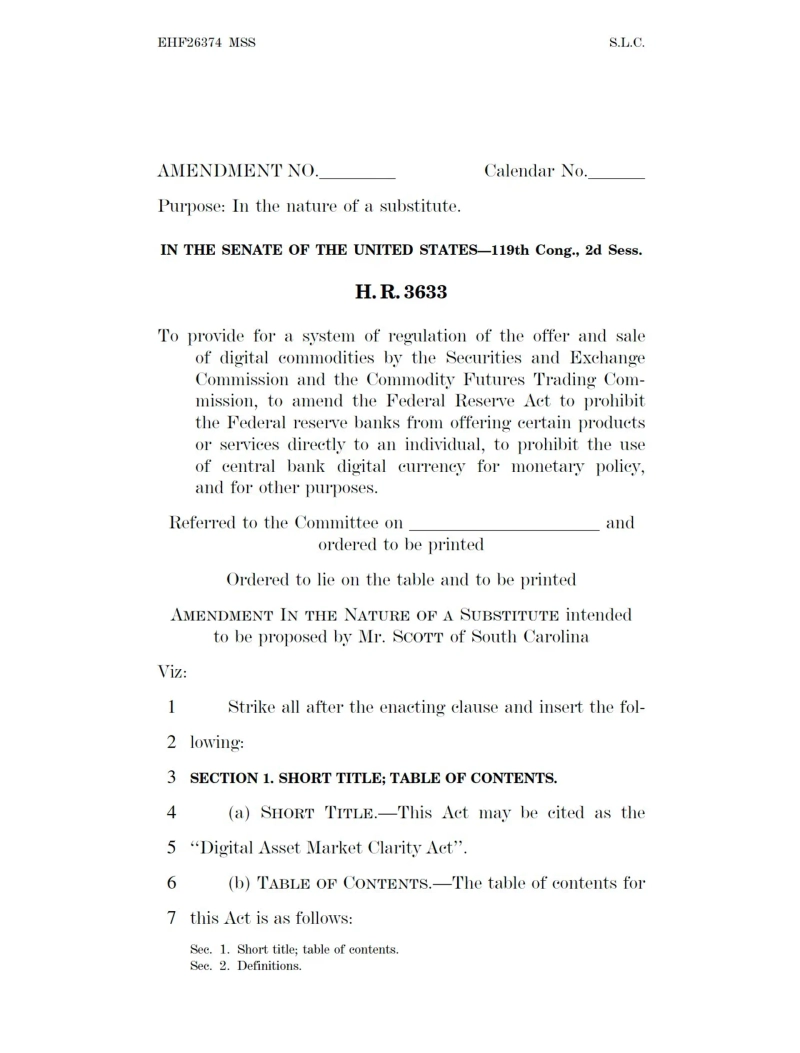
The U.S. Senate Banking Committee has published a new draft of the CLARITY Act, a sweeping legislative proposal aimed at establishing a market structure for digital assets. According to CryptoAmerica host Eleanor Terrett, the committee released the 309-page document to the public on May 12, after months of preparation that began in January.
Draft surfaces ahead of key senate session
The committee is inviting lawmakers to submit amendment proposals through the end of the next business day, just before a regulatory session scheduled for May 14. This amendment window suggests that negotiations over the bill’s final contents could accelerate as the legislation moves closer to a decisive stage.
The CLARITY Act aims to define which U.S. authorities will oversee digital assets and the specific rules that will govern them. The proposal seeks to deliver a long-awaited regulatory framework for the crypto industry, encompassing crypto assets, DeFi applications, and stablecoin models.
Senate Banking Committee Chair Tim Scott emphasized that the legislation is designed to protect consumers, strengthen the fight against financial crimes, and ensure that the United States remains at the forefront of financial innovation.
Stablecoin yield clauses spark industry debate
The latest draft closely mirrors earlier versions previously shared with the sector. However, a contentious clause regarding stablecoin yield or interest-type reward structures remains intact. This point has fueled ongoing tensions between the banking sector and crypto companies.
While some financial institutions have called for restrictions on stablecoin reward programs, the crypto industry has intensified lobbying efforts in the bill’s final stages. At the heart of the standoff lies the question of how stablecoin issuers offering returns to users might compete with traditional deposit systems.
The draft also plans to boost consumer protections and broaden the powers of law enforcement to combat illicit finance. Additional measures are under consideration that could expand investigative authority in anti-money laundering cases.
Legal certainty for DeFi developers
Provisions modeled after the Blockchain Regulatory Certainty Act are included as well. These would prevent developers who do not hold direct control over user assets from being treated as money transmitters or financial service providers.
This measure is seen by developers in the DeFi sector as a critical safeguard. For years, industry representatives have argued that individuals engaged only in software development or contributing to protocol infrastructure should not be held liable as financial intermediaries.
The fate of the CLARITY Act remains uncertain. The latest text omits any special provisions to address government officials’ potential conflicts of interest arising from crypto ties. While Democrats have warned that the absence of such rules may make support difficult, the White House opposes targeting specific individuals through regulation.
If the bill passes out of committee, it must then be aligned with a parallel version from the Senate Agriculture Committee. Final passage on the Senate floor will require at least 60 votes, making the backing of some Democratic senators crucial to the CLARITY Act’s prospects.