






Bitcoin’s price made an encouraging leap toward the coveted $70,000 mark, only to once again retreat below this critical threshold. For months, cryptocurrency traders have watched as repeated tests of key resistance levels have failed, with former support zones now acting as stubborn barriers. As the community waits to see if bitcoin can break through, much attention has shifted to exchange-traded fund (ETF) flows and expert commentary on the evolving landscape.
ETF Inflows Signal Renewed Institutional Demand
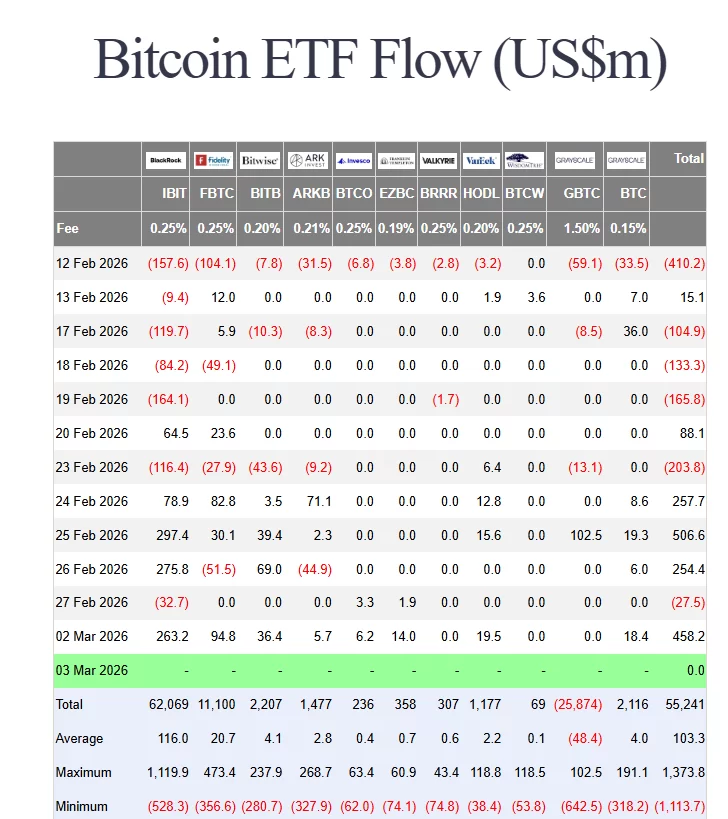
After a prolonged lull in ETF activity, last week marked a turnaround with net inflows returning to the market. On the first trading day of March, Bitcoin ETFs attracted a robust $458 million in fresh investments. With the risks associated with Iran reportedly priced in by the market, this surge signals that bitcoin may be recovering from oversold conditions. The cryptocurrency’s responsiveness to both positive and negative news has accustomed investors to volatility but also reinforced underlying bullish momentum.
Ethereum, XRP, and SOL Record Mixed ETF Activity
While Ethereum’s ETF products saw more modest inflows of $38.7 million, the coin itself surged past $2,000. Observers suggest that if bitcoin consolidates between $67,000 and $68,000, Ether may gain much-needed breathing room. XRP ETFs are still awaiting March data, but February saw steady net inflows, interrupted by just two days where $8 million was withdrawn—an unusually rare event in this segment. Cumulative net inflows for XRP ETF products have now surpassed $1.24 billion, underscoring sustained investor engagement.
Solana (SOL) ETF products have experienced only a single day of outflows since early February—$14,000 on February 9—while consistently bringing in net inflows ranging from $2 million to $30 million on other days. The opportunity created by price corrections has pushed SOL’s cumulative net inflows close to the $1 billion milestone. In contrast, ETF products tracking Dogecoin have been all but dormant, seeing virtually no new investment for several weeks.
These contrasting ETF flows capture a wider tendency in digital assets: investors respond quickly to dips by increasing allocations to favored products, yet some tokens like DOGE struggle to generate consistent inflow interest. This dynamic highlights shifting sentiment across the crypto spectrum.
QCP Capital Comments on Volatility and Market Resilience
Geopolitical developments have also exerted pull on the market. On Saturday, the first U.S. strike against Iran sent bitcoin and ether tumbling to $63,000 and $1,910 respectively, though both quickly rebounded. Analysts at QCP Capital, looking at the recent bump in options market activity, point to a potential recovery targeting $75,000 for bitcoin. Compared to last June’s turbulence, they noted, the price movement did not cause widespread panic, reflecting increasing resilience in crypto markets.
“Although the current moves are larger in scale than those seen last June, they haven’t triggered panic. Among notable option flows are purchases of 1,000 contracts for BTC-27MAR26-74k-C and 4,000 contracts for BTC-27MAR26-75k-C, suggesting that some investors are anticipating a recovery in March after five consecutive months of decline,” QCP Capital analysts explained.
This optimism is fuelled by buyers snapping up high-strike call options, hinting at renewed confidence for bitcoin’s near-term prospects. The market’s ability to absorb shocks, even amid geopolitical uncertainty, further underpins these upbeat forecasts.
With ETF inflows mounting and volatility no longer inducing panic selling, the cryptocurrency market appears to be at a crossroads. Should bitcoin maintain its position above key levels, renewed rallies could materialize in the coming weeks, providing further impetus across other major tokens.
As March unfolds, all eyes remain on whether institutional participation through ETF inflows can help bitcoin sustain its upward push—or if yet another resistance retest will send prices retreating once again.