
In the evolving world of cryptocurrencies, reliable on-chain data platforms like CryptoQuant play a pivotal role in assessing market trends. The latest analysis from CryptoQuant’s experts points to a critical condition required for Bitcoin to resume its upward momentum. At the time of reporting, Bitcoin hovers near $66,700, with altcoins suffering losses exceeding 5% on the day. What, then, is needed for Bitcoin to break its current stagnation?
Retail appetite for crypto declines
Altcoins have long struggled to attract investor attention, and now, even Bitcoin faces a noticeable drop in demand. While institutional purchases persist, CryptoQuant analysts highlight a decrease in Bitcoin’s spot demand. By the end of March, the net visible 30-day demand was down by approximately 63,000 BTC—a sign that selling pressure currently outweighs buying activity. Notably, U.S.-based investors, previously more active, appear to have lost enthusiasm.
Institutional buying fails to reverse trend
Although Michael Saylor’s accumulation phase stood out, even these above-average institutional purchases were insufficient to ease market pressure. CryptoQuant’s data shows that Bitcoin ETF inflows surged last month, reaching roughly 50,000 BTC—a peak not seen since October 2025. Despite this, total spot demand kept shrinking, indicating that increased institutional interest was more than canceled out by persistent retail selling.
“Despite this institutional momentum, overall visible demand continues to contract, demonstrating that sales from individuals and other market participants have more than offset the uptick in institutional buying.
The contraction in demand since the end of November 2025 confirms that the overall market remains in a distribution phase,” CryptoQuant analysts noted.
Could Bitcoin reach $81,200?
The outflow of South Korean investors last year foreshadowed broader caution, but American demand sustained the market for a time. Now, as 2025 progresses, U.S. investors are also becoming more risk-averse in crypto. The Coinbase Premium Index, a barometer of U.S. investor appetite, has remained in negative territory for much of the year—underscoring this declining interest.
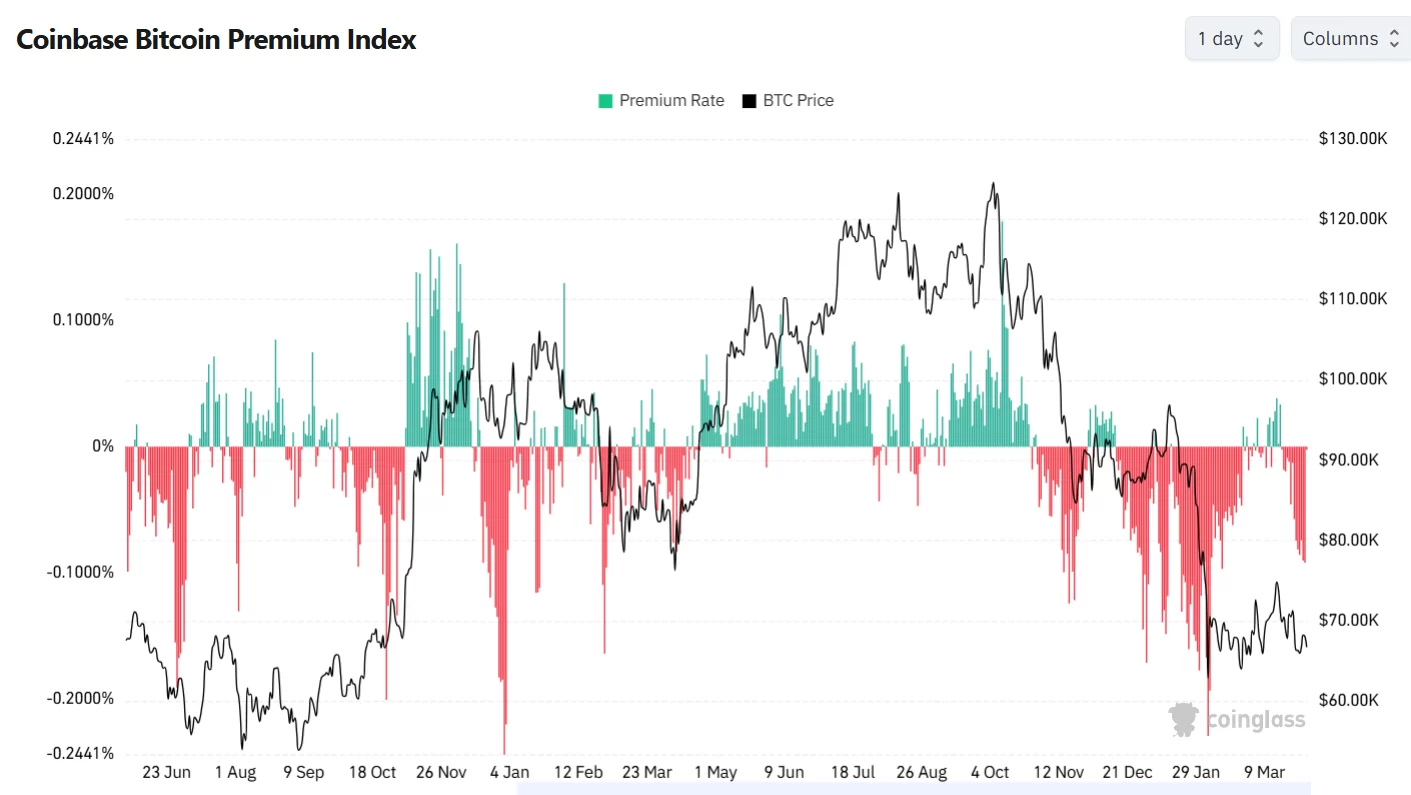
Investor sentiment varies across regions. While South Korean traders have shifted focus to local exchanges, spurred by better returns from AI-linked companies, the narrative centers today on U.S. participants. Macroeconomic uncertainties and shifting political dynamics have driven many to the sidelines, further weakening the market’s foundations.
Additionally, “whale” holders have switched roles, becoming net sellers. CryptoQuant reports that after purchasing more than 200,000 BTC through 2024, large holders began trimming positions from mid-2025 onwards, a trend that accelerated into late 2025 and early 2026.
“The 365-day simple moving average continues its downward trajectory, confirming that this phase of distribution is structural, not temporary,” the analysis reads.
Although it may be difficult to acknowledge, the market has, for some time, exhibited bear-market characteristics. On a positive note, CryptoQuant analysts anticipate that improved macro conditions—particularly any easing in U.S.-Iran tensions—could trigger a short-term Bitcoin rally. The current bear market resistance zone spans from $71,500 to $81,200, and Bitcoin must re-enter this range before attempting a move higher.
“A reduction in geopolitical tensions could serve as a short-term catalyst, potentially sparking a relief rally to the lower boundary of $71,500. If buying momentum strengthens, the next significant resistance is the Trader Realized Price at around $81,200, which capped January 2026’s bear market rally,” the CryptoQuant report adds.