A lively exchange between NBA legend Scottie Pippen and veteran chart analyst Peter Brandt set the crypto world abuzz over the weekend. The conversation began when Pippen compared Bitcoin’s market structure in 2020 with projections for 2026. Brandt, renowned for his more than fifty years of futures trading expertise, jumped in with a bold forecast: by 2029, Bitcoin could reach $250,000. He advised Pippen to keep an eye on what he calls the “banana chart,” a visual metaphor rooted in Bitcoin’s historical geometric growth patterns.
Brandt’s Geometric “Banana” Theory Shapes the Outlook
Brandt’s so-called “banana” is a multi-year, curved growth channel he’s tracked since 2012 to model Bitcoin’s price trajectory. Within this structure, price action repeatedly bounces between a lower green boundary, representing deep corrections, and an upper red band where speculative peaks unfold. After testing the $92,000 mark in January 2026, Bitcoin now sits just above $60,000—almost precisely at the midpoint of this channel. This middle ground suggests the market is currently far from both speculative extremes and historical lows.
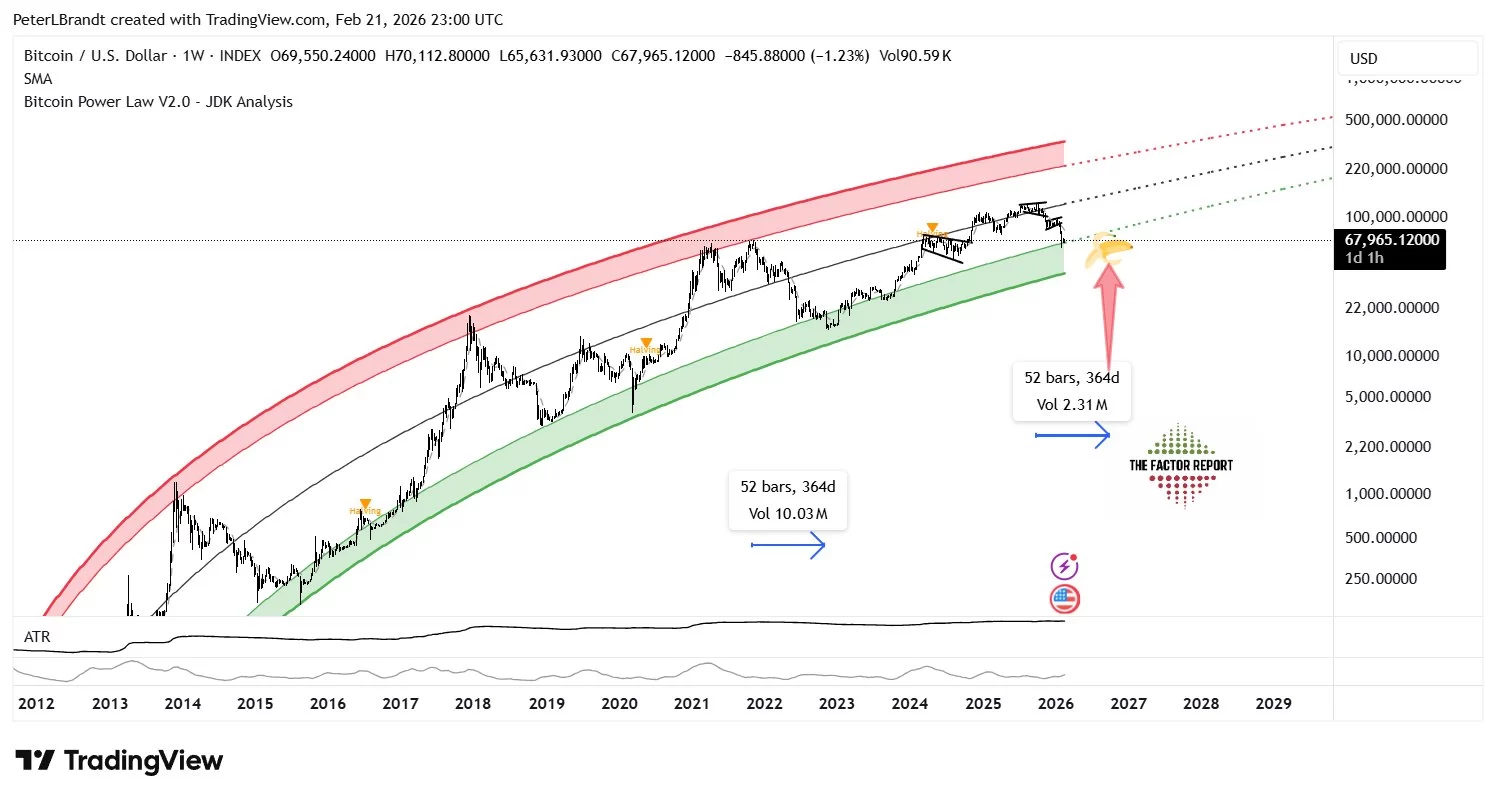
Brandt’s projection hinges on the idea that Bitcoin’s market undergoes cyclical waves, a pattern observed in 2013, 2017, and 2021. He anticipates the next such cycle to culminate in or around 2029, coinciding with Bitcoin’s upcoming halving events. Rather than treating the $250,000 target as speculative hype, Brandt positions it within a long-term market framework anchored in geometric analysis. While acknowledging Pippen’s optimistic analogy, he emphasizes that Bitcoin’s price adheres to clear, mathematical rules over time.
According to the metrics of the logarithmic growth channel, it is only a matter of time before Bitcoin’s price scale expands into six figures—providing it remains within these boundaries. The $250,000 figure aligns as a plausible upper limit based on behaviors witnessed during previous cycles. With half a century in professional trading, Brandt’s methodical perspective frames this not just as a prediction, but almost a mathematical inevitability should the pattern hold.
Pippen’s Inquiry Signals Growing Mainstream Interest
Scottie Pippen’s foray into the intricacies of Bitcoin’s market structure underlines a key shift: cryptocurrency discussions now extend well beyond dedicated finance circles. Pippen’s analogies about 2026 point to a key transition phase for Bitcoin, as it matures into a mainstream asset. Brandt’s intervention brings technical rigor to the debate, converting raw opinion into a structured data analysis that guides both veteran and novice participants.
Right now, Bitcoin’s placement in the channel suggests it is neither at historic lows nor overheated highs. This equilibrium, according to Brandt’s “banana channel” framework, opens up substantial room for an upward move. The hierarchic structure he describes points to disciplined, channel-bound movement rather than chaotic swings, reinforcing the case for measured, sustained growth.
This cross-field dialogue between a sports icon and a finance guru has injected fresh optimism regarding Bitcoin’s prospects over the next three years. While Brandt is quick to acknowledge the market’s volatility, he maintains faith in the mathematical consistency behind Bitcoin’s geometric path. The $250,000 target for 2029 thus emerges as both a historic pattern repetition and a potential blueprint for future financial landscapes.
“Bitcoin’s price has always respected long-term geometric trends, and there’s no reason to think that will stop now,” Brandt told the discussion, reinforcing his belief in mathematics over fleeting market sentiment.
For observers, Brandt’s approach offers more than just speculation—it lends a sense of mathematical discipline to a market often accused of unpredictability. As celebrities and finance experts continue to bridge the gap between popular culture and technical analysis, Bitcoin’s journey promises to keep both camps watching closely. Whether or not the $250,000 mark is achieved, the ongoing debate ensures the digital asset remains at the center of the global financial conversation.