Gold’s recent prominence in financial headlines isn’t simply driven by its reputation as a “safe haven.” Geopolitical tensions, energy market volatility, uncertainty surrounding the dollar, and shifting interest rate expectations have all converged, causing gold’s price movements to become as swift downward as they are upward. According to Reuters reports dated March 24–25, 2026, spot gold recently experienced one of the fastest reversals in its history within a matter of weeks. This behavior reflects a new reality: Market participants are no longer relying solely on traditional “buy and hold” strategies for gold, preferring instead more agile, active trading approaches.
Speedier Transactions Redefine Gold Markets
This shift has less to do with gold itself and more with how investors access it. In Turkey, physical gold remains a popular savings tool. However, challenges—such as wide bid-ask spreads, issues with storage, limited trading hours, and an inability to swiftly respond to price swings—have sent short- and mid-term traders searching for alternatives. Some jewelers simply declined to sell under such volatility. In this climate, tokenized gold products are stepping into the spotlight.
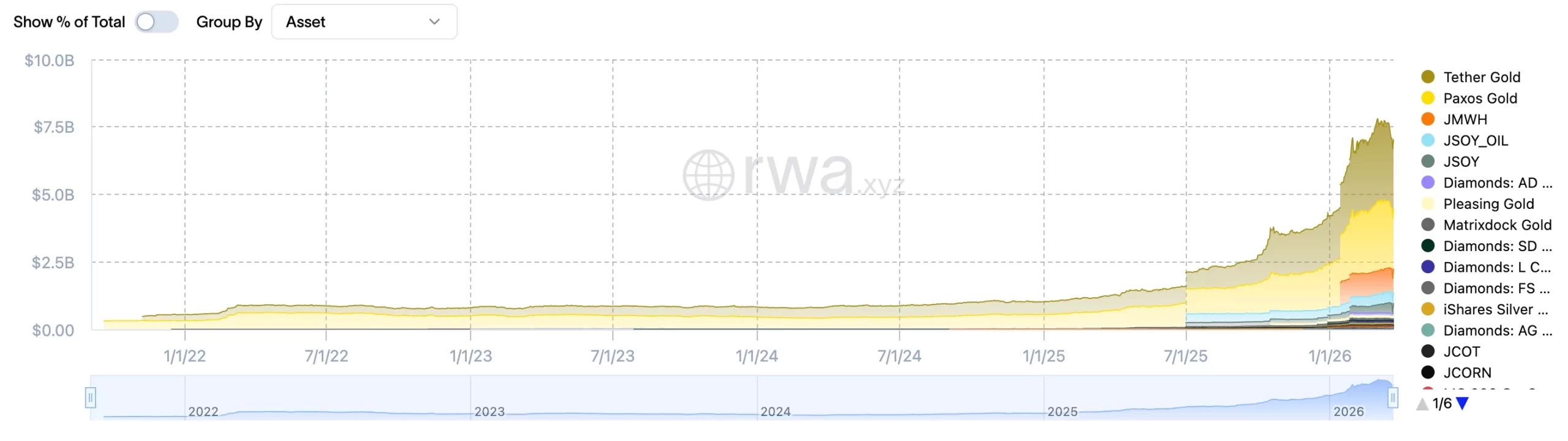
Today, numerous digital gold tokens are available to traders. According to official materials, Tether’s XAUT product stands out, each token backed by at least one troy ounce of physical gold. This gives users the security of gold’s intrinsic value, combined with the convenience and speed of digital markets. Data from the RWA platform suggests that over $7 billion in tokenized digital gold is now circulating, with more than half of that leveraging the Ethereum network. Other popular ecosystems include the XRP Ledger and Polygon, reflecting the sector’s growing diversity.
The rationale behind this surge is clear. The World Gold Council’s full-year 2025 figures reveal global gold demand soared above 5,000 tonnes—a new record. Exchange-traded fund inflows and an uptick in physical gold coins and bars further highlight increasing interest. Yet, this enthusiasm is no longer confined to jewelry shops or bank counters. Thanks to digital platforms, gold has become a more liquid, accessible, and easily divisible investment. Particularly during periods of sharp intraday price movements, the ability to enter and exit the market from a desktop or mobile device has proven to be a considerable advantage.
One compelling trading model gaining ground features trading pairs such as XAUT/USDT. Through such pairs, users can readily access gold prices using balances in stablecoins like USDT, Ethereum, or even Bitcoin—eliminating traditional banking transfer hurdles. On BYDFi’s official platform, for instance, the XAUT/USDT pair is supported, providing a streamlined transition for traders already accustomed to handling USDT. This setup allows for swift portfolio reallocation toward defensive instruments like gold when market risk surges, all with the technical ease of a few clicks.
Flexible Buying: Even Small Increments Now Possible
Perhaps the most appealing aspect of digital gold isn’t just its speed but its flexibility. Physical gold is typically traded in fixed forms—such as grams, quarter coins, or bars. In the digital realm, investors can buy or sell virtually any value, from as little as 100 TRY up to 100 million TRY, unconstrained by minimum weight restrictions. This granularity means investors can move in and out of the market gradually, alleviating pressure to make large lump-sum purchases. In volatile markets, such flexibility is a strategic asset, allowing for diversified cost averaging rather than having to make risky directional bets. Tokenized gold products thus marry the value-preserving nature of traditional gold with the adaptability of digital finance tools.
Ultimately, what’s unfolding in today’s gold markets is more than just dramatic price swings. The very way investors access gold is being reshaped. War, uncertainty, inflation, and shifting interest rates once again keep gold in focus, but investors are increasingly managing their trades from screens—not jewelry counters. While physical gold’s reassurance remains crucial, those seeking agility and rapid reactions are finding digital alternatives more compelling than ever. Trading pairs like XAUT/USDT give gold transactions a new layer of flexibility and day-to-day practicality. It’s no surprise, then, that more users are gravitating to platforms that offer straightforward, hassle-free solutions.
For those curious about participating, BYDFi makes the process accessible: Users can register quickly with just an email—without any KYC requirement—to explore the platform and its features.