
Dogecoin (DOGE), one of the most popular meme coins in the cryptocurrency market, is struggling to signal a robust recovery as February progresses. A combination of technical indicators, on-chain data, and derivatives market metrics presents a cautious outlook for DOGE. Persistent selling pressure continues to weigh on investors’ short-term expectations, overshadowing any potential bullish sentiment.
Technical Indicators Confirm a Bearish Trend
On the four-hour chart, Dogecoin is clearly entrenched in a downtrend. The pattern of consecutive lower highs and lower lows starkly illustrates that sellers maintain control over the price. The fact that the price remains below all key exponential moving averages indicates that the downward momentum has not yet been broken. Notably, the 200-period exponential moving average, positioned in the $0.125–$0.126 range, is serving as a formidable technical resistance for DOGE.
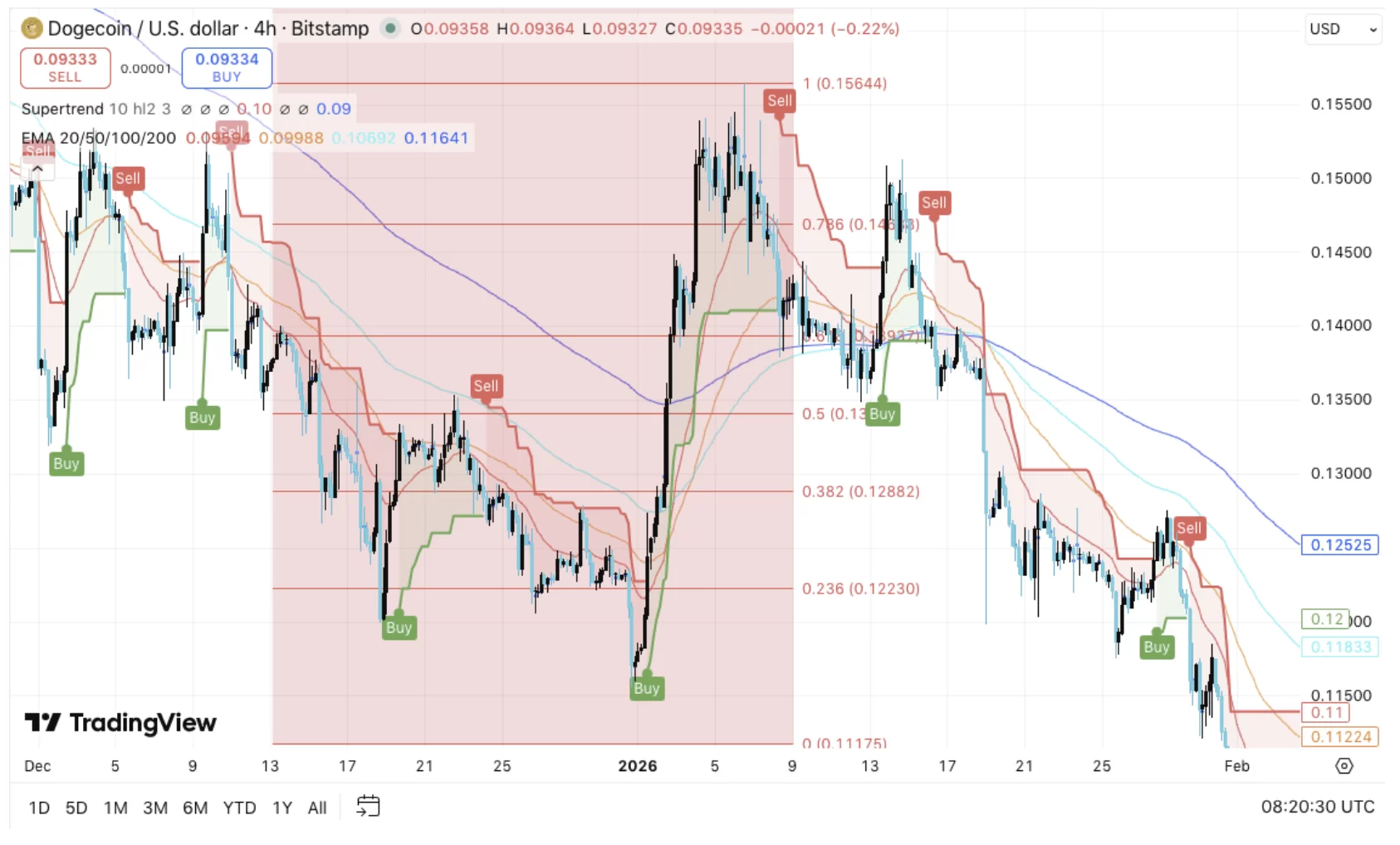
While short-term buying attempts occasionally occur, these bullish efforts remain feeble, meeting swift selling at previous resistance levels. The $0.118–$0.120 range, which was previously broken downward, is a critical region that Dogecoin struggles to surpass. As long as the price remains below this range, short-term direction favors sellers. Maintaining a closure above this level could be the first technical signal of stabilization; however, current price movements have not yet pointed towards such a scenario.
On the downside, the $0.112–$0.110 range remains a critical support zone. If this area is breached, the selling might accelerate towards $0.105. In the event of a deeper decline, the $0.100–$0.098 range stands as the last robust defensive line from both a psychological and technical perspective.
What Do Derivative Markets and Spot Flows Indicate?
The weakness in the technical outlook is echoed by derivative market data. Historically, Dogecoin’s open interest saw rapid spikes during strong uptrends, later contracting sharply through liquidations. Current data illustrates that open positions are around $1 billion with relatively low leverage usage, indicating weak investor appetite for risk.
Spot market data paints a similar picture. Predominant net outflows on most trading days highlight ongoing distribution rather than accumulation on the DOGE front. Especially large outflows coinciding with price declines suggest that investors continue to reduce their positions. Short-term entries lack the strength to reverse the overall trend.
Moreover, the recent drop in volume across the meme coin market is noteworthy. Increased interest in Bitcoin and Ethereum ETFs is prompting capital to shift towards larger and relatively safer assets, leaving high-risk assets like Dogecoin in the background during this period.