
In a significant development in the cryptocurrency market, spot Bitcoin  $78,439 ETFs in the United States have witnessed substantial outflows. A total net outflow of $869.86 million was recorded from 11 ETFs on Thursday, marking the second-largest capital loss in their history. The cumulative outflows of $2.64 billion over three weeks highlight investor caution and diminishing confidence in market directions.
Institutional Investors Flee Bitcoin Investment
According to data from SoSoValue, the 11 spot Bitcoin ETFs experienced an outflow of $869.86 million on November 14th. This figure stands out as the second-largest collective outflow since the launch of these ETFs in January 2024. Institutional investors are reducing their Bitcoin positions due to increased volatility and a global trend of risk aversion.
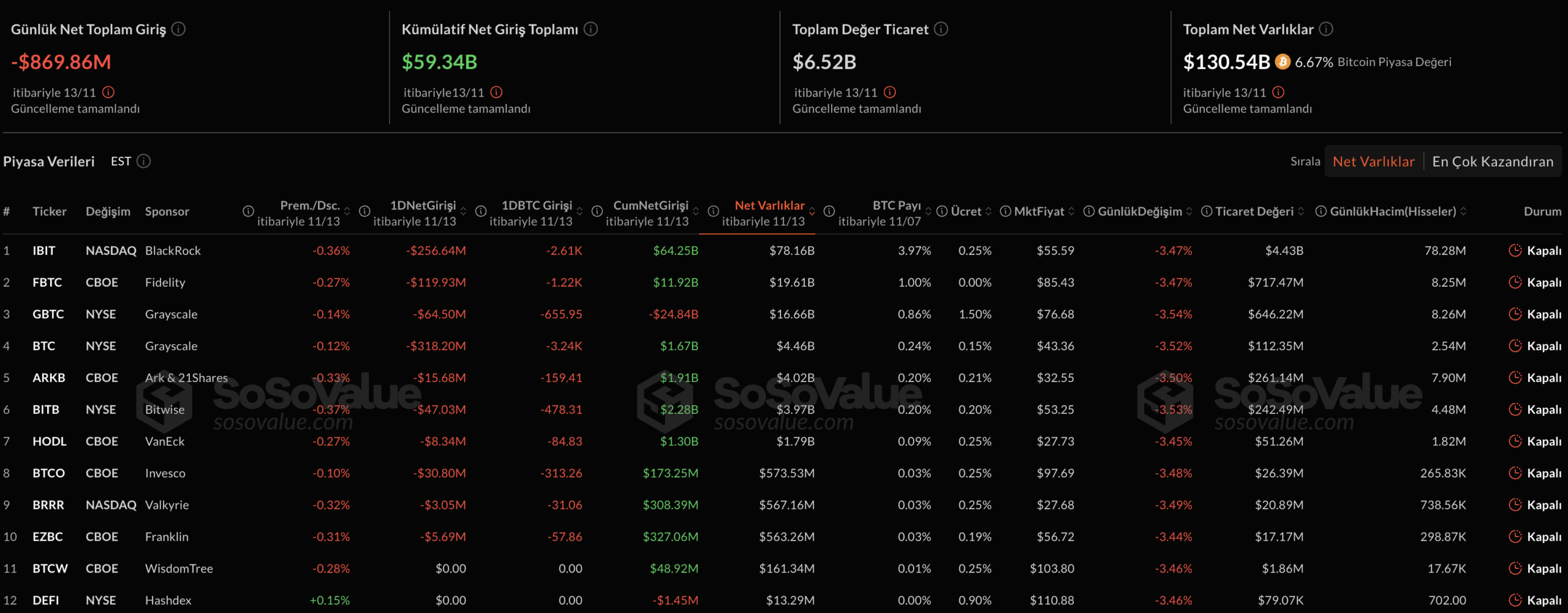
The total net outflow of $2.64 billion over a three-week period indicates a prevailing cautious mood in the cryptocurrency market. The decline of Bitcoin below the $100,000 threshold has especially led long-term investors to withdraw from ETFs. Enhanced uncertainty in the market has reduced trading volumes in both spot ETFs and derivative products, deepening short-term selling pressure. Analysts caution that a sustained movement under $100,000 could result in further institutional withdrawals.
Concurrent Withdrawals in Ethereum ETFs
Withdrawals are not limited to Bitcoin, with Ethereum  $2,485-focused spot ETFs also recording substantial outflows. A $259.72 million outflow marks their highest daily exit since October 13th. This parallel movement indicates that investors are leaning towards a general risk reduction strategy in cryptocurrencies.

At the time of writing, Bitcoin was trading around $97,500. The largest cryptocurrency has lost 5% in the past 24 hours and 11% since the beginning of the month. Analysts suggest that outflows from ETFs might continue with the price decline, but the low levels may eventually present opportunities for new entries in the long term.
Despite the outflows observed on the institutional front, some analysts argue that such corrections in ETFs should be considered within the “natural liquidity cycle.” The general consensus, however, is that investor confidence is unlikely to recover unless the $100,000 threshold is regained.