In the ongoing war of words between the United States and Iran, former President Donald Trump has again seized the spotlight with claims that Iran has requested a ceasefire. The atmosphere between the two nations has been marked by mutual distrust and a penchant for dramatic, often contradictory statements, with each side quick to dismiss or reinterpret the other’s announcements. Trump’s remarks once again raise questions about the reality behind closed diplomatic doors and the credibility of official statements from both countries.
Iran denies ceasefire intentions
Amid mounting speculation, Iran has consistently denied making any overtures toward a ceasefire, recalling similar denials during last year’s 12-day conflict, which ended only after protracted behind-the-scenes negotiations. Iranian officials, including the foreign minister, have refuted claims of direct communication with the United States, stating that any messages received do not equate to formal negotiations. This pattern of initial denial followed by eventual acknowledgment has characterized Iran’s diplomatic approach in recent crises.
Unpredictable statements shape the narrative
The pattern of public statements from both leaders contributes to growing uncertainty. Trump, well known for his unconventional tactics and tendency to issue bold or ambiguous pronouncements, once again took to social media to share his perspective. While his statements often create media storms, Iran’s strategy has been to issue categorical denials or downplay the substance of American claims, leaving observers caught between conflicting narratives.
Recent developments echo previous escalations, during which both Trump’s administration and Iranian officials maintained their pattern of alternating bluffs, flat denials, and indirect messaging. The result is a scene marked by confusion and a lack of clear, verifiable information. As the global community watches, the risk of miscalculation or misunderstanding remains high, complicating efforts to foster meaningful dialogue or deescalate tensions.
According to those familiar with the developments, Iranian sources are likely to issue a rebuttal in the coming hours. This expectation underscores the ongoing pattern in which announcements from one side are swiftly contested by the other, perpetuating an endless cycle of claim and denial with little resolution in sight.
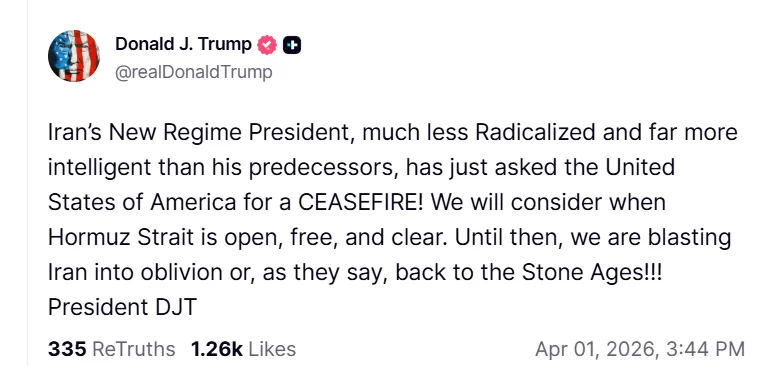
“The new President of Iran’s regime, far less radicalized and far smarter than his predecessors, just requested a CEASEFIRE from the United States! We’ll consider this once the Strait of Hormuz is open, free, and secure. Until then, we’ll either bomb Iran out of existence or, as they say, send them back to the Stone Age! President DJT”
Trump’s latest statement follows a familiar script—presenting the Iranian side as capitulating while simultaneously issuing stark threats. Historically, such communications have intensified tensions and rarely led directly to policy changes. However, they are significant for shaping public perception and diplomatic maneuvering.
As commentaries and denunciations continue to circulate, the world waits to see whether either government will take tangible steps toward dialogue or continue their rhetoric-driven standoff. For now, the situation remains fluid, with both sides signaling resolve but leaving the prospect of de-escalation unresolved.