Amid renewed tensions in the Middle East, the ceasefire negotiated between the United States and Iran had initially been expected to curb Israeli attacks and shore up security in Lebanon. Iran’s early statements suggested this broader scope, raising hopes for regional stability. However, Israel has expressed dissatisfaction with the arrangement and signaled that its operations in Lebanon will continue. The question of whether the ceasefire remains intact continues to fuel heated debate, with ripple effects noticeable even in the cryptocurrency markets.
Questions arise over the ceasefire’s future
A key issue threatening the ceasefire is Israel’s ongoing offensive against Lebanon, which Iran points to as a legitimate reason for ending the truce. Meanwhile, the US has suggested that recent attacks on Gulf countries could justify halting the ceasefire from its side. This evolving situation puts both parties to the test, revealing their real willingness to uphold the agreement. With US midterm elections on the horizon, former President Trump faces political incentives to reach a resolution, while Iran is turning the truce to its advantage in domestic politics.
The fragile balance may shift suddenly
While the ceasefire has not been officially revoked, the latest developments have increased the prospect that the less committed side could abruptly bring it to an end. Iran’s parliament speaker, Qalibaf, reiterated during the preparation of this article that, “The ceasefire proposal covered Lebanon and the entire axis of resistance.” At the same time, Iranian President Pezeshkian emphasized that Israel has violated the ceasefire terms.

 ETH
ETH SOL
SOL BSC
BSC ROBINHOOD
 USDT
USDT AAPL
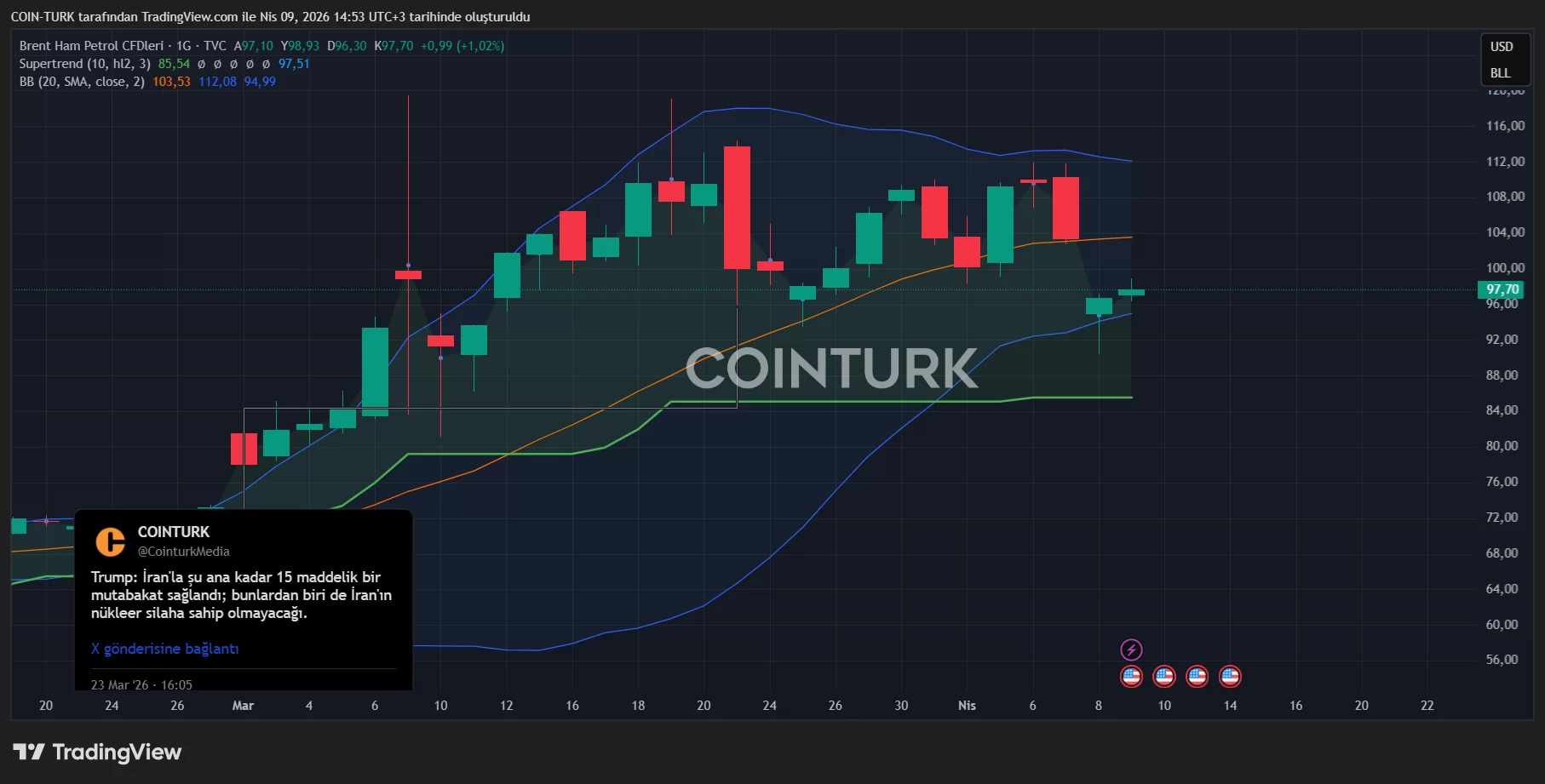
AAPLAs always, attention quickly turns to oil prices, which have seen a modest uptick. After a rapid decline, the price has rebounded to $97 per barrel, with analysts noting that any substantial violation of the truce could push crude toward the $100 mark. The two-week negotiation process for the ceasefire was initiated with a proposal from Pakistan, so upcoming meetings and statements could strengthen optimism for its continuation if progress is reported in the days ahead.
Both the US and Iran have practical reasons for preserving the current pause—Washington seeks a resolution, while Iran benefits from a two-week respite. Statements from both sides may therefore reflect posturing intended to gain leverage in negotiations rather than signaling an imminent breakdown.
Turning to the impact on cryptocurrencies, minutes from yesterday’s key financial meeting predated the ceasefire and thus had little direct effect on the digital assets market. Those discussions pointed to the possibility of both rate hikes and cuts, suggesting a delicate balance in economic pressures. For now, investors are closely watching macroeconomic indicators due today, such as the monthly Personal Consumption Expenditures (PCE), Gross Domestic Product (GDP) figures, and tomorrow’s employment data.
Bitcoin has managed to hold above the $71,500 mark, a level that analysts interpret as a relative safe zone for the world’s largest cryptocurrency. Ether (ETH) and several leading altcoins, however, have lost ground in parallel with rising oil prices. The correlation underscores the sensitivity of digital assets to geopolitical and energy market volatility.
Among the top 100 cryptocurrencies over the past week, SIREN has emerged as the standout performer, registering a 200% gain. Other notable gainers, including EDGE, ZEC, and MON, have all posted increases between 30% and 40%, reflecting selective optimism in an otherwise turbulent market.
Qalibaf noted, “The ceasefire proposal covered Lebanon and the entire axis of resistance.” Meanwhile, President Pezeshkian stated in parallel, “Israel has violated the ceasefire.”
Despite pockets of strength, the broader climate remains one of uncertainty. Investors and international observers alike continue to monitor developments in Lebanon and the wider region with caution, aware that any escalation could rapidly alter both geopolitical and market trends.
In summary, the fate of the US-Iran ceasefire remains uncertain, with each new development watched for signs of escalation or stabilization. As Middle East tensions cast a shadow over world markets, oil and cryptocurrencies provide early signals of sentiment shifts. In the coming days, the focus will remain on diplomatic negotiations and key economic indicators as leaders weigh their next moves.