
The United States Supreme Court has officially annulled a set of customs tariffs, leaving businesses, officials, and global markets uncertain about what comes next. The decision has created widespread confusion over how—if at all—billions of dollars in tariffs previously collected will be repaid. With hundreds of legal challenges expected to be filed in US trade courts by impacted businesses, many are left bracing for an extended period of legal and economic limbo. Importantly, experts say the now-canceled tariffs had a minimal impact on inflation, meaning the Supreme Court’s decision is unlikely to have any significant effect on monetary policy expectations or interest rate forecasts.
Breakdown of the Tariff Ruling
According to Gemini, the Supreme Court delivered its highly anticipated verdict on February 20, 2026, in the case of Learning Resources, Inc. v. Trump. The court concluded that former President Donald Trump did not have legal authority to impose sweeping customs tariffs under the International Emergency Economic Powers Act (IEEPA) of 1977, critically restricting executive power in this area. By affirming decisions reached by the Federal Circuit Court of Appeals, the Supreme Court effectively erased the legal framework underpinning the tariff regime introduced by the Trump administration.
Key Legal Arguments and Rationale
The justices grounded their decision in several key arguments. First, they noted that Article I of the US Constitution explicitly and solely grants Congress the power to levy taxes and customs duties. The president, especially during peacetime, has no inherent right to wield this authority single-handedly. Furthermore, the court clarified that the “regulate importation” clause in the IEEPA refers to setting quotas or quality controls—such as placing limits or quarantines on certain goods—but does not authorize the imposition of taxes or tariffs. The court pointed out that taxation is a far weightier government action than routine regulatory measures. They also observed that, over nearly 50 years, no previous president used the IEEPA to introduce broad tariffs, reinforcing that Trump’s interpretation greatly exceeded traditional legal boundaries.
In its official explanation, the court emphasized that a power with such sweeping economic and political consequences—potentially touching trillions of dollars in trade and even influencing federal budget deficit forecasts—must be expressly and unambiguously granted by Congress. For this reason, the court found the contested tariffs invalid.
“For an authority that carries such enormous economic and political weight, Congress must confer it with unmistakable clarity,” the court’s opinion underscored.
With the legal foundation for the tariffs removed, the fate of billions in government-collected import duties remains up in the air. The government must now grapple with the prospect of mass refund claims from importers. Trump, meanwhile, has described this scenario as nothing short of a disaster for the US, warning that the abrupt removal of these tariffs could have significant financial repercussions. In the financial sector, especially in cryptocurrency markets, observers are also anticipating further declines as legal uncertainty continues to mount. Trump has long sought alternative strategies for recouping revenue from foreign nations, and analysts expect further details on potential new approaches to emerge soon.
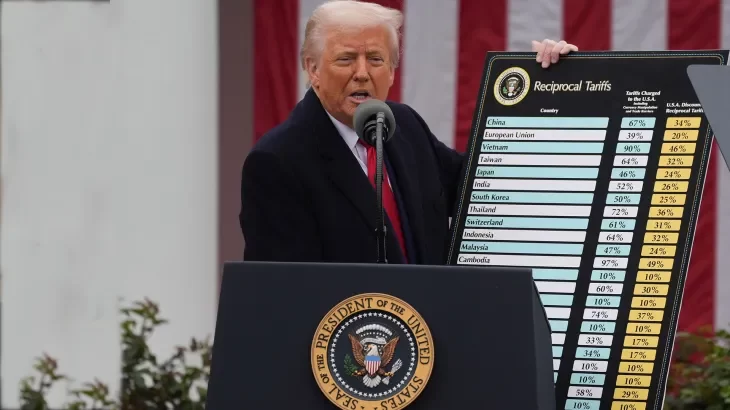
Perhaps the most bitter truth for many is that the tariff chaos which plagued the United States throughout 2025 has proven to be in vain. Financial markets, and especially cryptocurrencies, faced repeated downturns as uncertainty over tariffs rattled investor confidence time and again.
As legal disputes over tariff refunds mount and markets digest the seismic Supreme Court ruling, both the government and affected industries are entering uncharted legal territory. The coming weeks are expected to bring further developments as parties seek clarity on refund mechanisms and alternative trade policies.
Despite significant legal and economic disruption, reasoned voices say the direct impact on broader macroeconomic indicators is likely to be limited. Still, the long-term repercussions—both in domestic politics and international trade relations—remain the subject of speculation.
With the legal landscape changed overnight, market watchers, businesses, and policymakers alike now await further guidance on how the US will navigate this unprecedented moment in its trade policy history.